
• Kapcsolat

  • Hírlevél

  • Rólunk

  • Szállítási lehetőségek

  • Prospero könyvpiaci podcast

  • 'Magyar nyelvű oldal. Change to english.'
    Kívánságlista
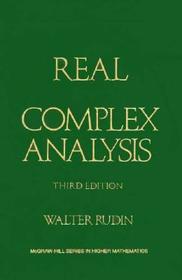
    Real and Complex Analysis

    Real and Complex Analysis by Rudin, Walter;

    Sorozatcím: HIGHER MATH;

      • 10% KEDVEZMÉNY?

      • A kedvezmény csak az 'Értesítés a kedvenc témákról' hírlevelünk címzettjeinek rendeléseire érvényes.
      • Kiadói listaár GBP 158.44
      • Az ár azért becsült, mert a rendelés pillanatában nem lehet pontosan tudni, hogy a beérkezéskor milyen lesz a forint árfolyama az adott termék eredeti devizájához képest. Ha a forint romlana, kissé többet, ha javulna, kissé kevesebbet kell majd fizetnie.

        71 535 Ft (68 129 Ft + 5% áfa)
      • Kedvezmény(ek) 10% (cc. 7 154 Ft off)
      • Kedvezményes ár 64 382 Ft (61 316 Ft + 5% áfa)

    71 535 Ft

    Beszerezhetőség

    A kiadónál véglegesen elfogyott, nem rendelhető. Érdemes újra keresni a címmel, hátha van újabb kiadás.

    Why don't you give exact delivery time?

    A beszerzés időigényét az eddigi tapasztalatokra alapozva adjuk meg. Azért becsült, mert a terméket külföldről hozzuk be, így a kiadó kiszolgálásának pillanatnyi gyorsaságától is függ. A megadottnál gyorsabb és lassabb szállítás is elképzelhető, de mindent megteszünk, hogy Ön a lehető leghamarabb jusson hozzá a termékhez.

    A termék adatai:

    • Kiadás sorszáma 3
    • Kiadó McGraw-Hill Education
    • Megjelenés dátuma 1986. szeptember 16.

    • ISBN 9780070542341
    • Kötéstípus Keménykötés
    • Terjedelem432 oldal
    • Méret 241x172x20 mm
    • Súly 739 g
    • Nyelv angol
    • 0

    Kategóriák

    Hosszú leírás:

    This is an advanced text for the one- or two-semester course in analysis taught primarily to math, science, computer science, and electrical engineering majors at the junior, senior or graduate level. The basic techniques and theorems of analysis are presented in such a way that the intimate connections between its various branches are strongly emphasized. The traditionally separate subjects of 'real analysis' and 'complex analysis' are thus united in one volume. Some of the basic ideas from functional analysis are also included. This is the only book to take this unique approach. The third edition includes a new chapter on differentiation. Proofs of theorems presented in the book are concise and complete and many challenging exercises appear at the end of each chapter. The book is arranged so that each chapter builds upon the other, giving students a gradual understanding of the subject.

    This text is part of the Walter Rudin Student Series in Advanced Mathematics.

    This is an advanced text for the one- or two-semester course in analysis taught primarily to math, science, computer science, and electrical engineering majors at the junior, senior or graduate level. The basic techniques and theorems of analysis are presented in such a way that the intimate connections between its various branches are strongly emphasized. The traditionally separate subjects of 'real analysis' and 'complex analysis' are thus united in one volume. Some of the basic ideas from functional analysis are also included. This is the only book to take this unique approach. The third edition includes a new chapter on differentiation. Proofs of theorems presented in the book are concise and complete and many challenging exercises appear at the end of each chapter. The book is arranged so that each chapter builds upon the other, giving students a gradual understanding of the subject.

    This text is part of the Walter Rudin Student Series in Advanced Mathematics.

    Több

    Tartalomjegyzék:

    Preface

    Prologue: The Exponential Function

    Chapter 1: Abstract Integration

    Set-theoretic notations and terminology

    The concept of measurability

    Simple functions

    Elementary properties of measures

    Arithmetic in [0, ?]

    Integration of positive functions

    Integration of complex functions

    The role played by sets of measure zero

    Exercises

    Chapter 2: Positive Borel Measures

    Vector spaces

    Topological preliminaries

    The Riesz representation theorem

    Regularity properties of Borel measures

    Lebesgue measure

    Continuity properties of measurable functions

    Exercises

    Chapter 3: Lp-Spaces

    Convex functions and inequalities

    The Lp-spaces

    Approximation by continuous functions

    Exercises

    Chapter 4: Elementary Hilbert Space Theory

    Inner products and linear functionals

    Orthonormal sets

    Trigonometric series

    Exercises

    Chapter 5: Examples of Banach Space Techniques

    Banach spaces

    Consequences of Baire's theorem

    Fourier series of continuous functions

    Fourier coefficients of L1-functions

    The Hahn-Banach theorem

    An abstract approach to the Poisson integral

    Exercises

    Chapter 6: Complex Measures

    Total variation

    Absolute continuity

    Consequences of the Radon-Nikodym theorem

    Bounded linear functionals on Lp

    The Riesz representation theorem

    Exercises

    Chapter 7: Differentiation

    Derivatives of measures

    The fundamental theorem of Calculus

    Differentiable transformations

    Exercises

    Chapter 8: Integration on Product Spaces

    Measurability on cartesian products

    Product measures

    The Fubini theorem

    Completion of product measures

    Convolutions

    Distribution functions

    Exercises

    Chapter 9: Fourier Transforms

    Formal properties

    The inversion theorem

    The Plancherel theorem

    The Banach algebra L1

    Exercises

    Chapter 10: Elementary Properties of Holomorphic Functions

    Complex differentiation

    Integration over paths

    The local Cauchy theorem

    The power series representation

    The open mapping theorem

    The global Cauchy theorem

    The calculus of residues

    Exercises

    Chapter 11: Harmonic Functions

    The Cauchy-Riemann equations

    The Poisson integral

    The mean value property

    Boundary behavior of Poisson integrals

    Representation theorems

    Exercises

    Chapter 12: The Maximum Modulus Principle

    Introduction

    The Schwarz lemma

    The Phragmen-Lindelöf method

    An interpolation theorem

    A converse of the maximum modulus theorem

    Exercises

    Chapter 13: Approximation by Rational Functions

    Preparation

    Runge's theorem

    The Mittag-Leffler theorem

    Simply connected regions

    Exercises

    Chapter 14: Conformal Mapping

    Preservation of angles

    Linear fractional transformations

    Normal families

    The Riemann mapping theorem

    The class L

    Continuity at the boundary

    Conformal mapping of an annulus

    Exercises

    Chapter 15: Zeros of Holomorphic Functions

    Infinite Products

    The Weierstrass factorization theorem

    An interpolation problem

    Jensen's formula

    Blaschke products

    The Müntz-Szas theorem

    Exercises

    Chapter 16: Analytic Continuation

    Regular points and singular points

    Continuation along curves

    The monodromy theorem

    Construction of a modular function

    The Picard theorem

    Exercises

    Chapter 17: Hp-Spaces

    Subharmonic functions

    The spaces Hp and N

    The theorem of F. and M. Riesz

    Factorization theorems

    The shift operator

    Conjugate functions

    Exercises

    Chapter 18: Elementary Theory of Banach Algebras

    Introduction

    The invertible elements

    Ideals and homomorphisms

    Applications

    Exercises

    Chapter 19: Holomorphic Fourier Transforms

    Introduction

    Two theorems of Paley and Wiener

    Quasi-analytic classes

    The Denjoy-Carleman theorem

    Exercises

    Chapter 20: Uniform Approximation by Polynomials

    Introduction

    Some lemmas

    Mergelyan's theorem

    Exercises

    Appendix: Hausdorff's Maximality Theorem

    Notes and Comments

    Bibliography

    List of Special Symbols

    Index

    Több

    0