

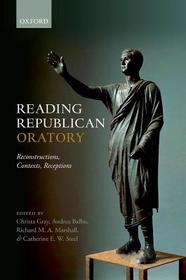
Reading Republican Oratory
Reconstructions, Contexts, Receptions
-
10% KEDVEZMÉNY?
- A kedvezmény csak az 'Értesítés a kedvenc témákról' hírlevelünk címzettjeinek rendeléseire érvényes.
- Kiadói listaár GBP 132.50
-
59 823 Ft (56 975 Ft + 5% áfa)
Az ár azért becsült, mert a rendelés pillanatában nem lehet pontosan tudni, hogy a beérkezéskor milyen lesz a forint árfolyama az adott termék eredeti devizájához képest. Ha a forint romlana, kissé többet, ha javulna, kissé kevesebbet kell majd fizetnie.
- Kedvezmény(ek) 10% (cc. 5 982 Ft off)
- Kedvezményes ár 53 841 Ft (51 278 Ft + 5% áfa)
Iratkozzon fel most és részesüljön kedvezőbb árainkból!
Feliratkozom
59 823 Ft

Beszerezhetőség
Megrendelésre a kiadó utánnyomja a könyvet. Rendelhető, de a szokásosnál kicsit lassabban érkezik meg.
Why don't you give exact delivery time?
A beszerzés időigényét az eddigi tapasztalatokra alapozva adjuk meg. Azért becsült, mert a terméket külföldről hozzuk be, így a kiadó kiszolgálásának pillanatnyi gyorsaságától is függ. A megadottnál gyorsabb és lassabb szállítás is elképzelhető, de mindent megteszünk, hogy Ön a lehető leghamarabb jusson hozzá a termékhez.
A termék adatai:
- Kiadó OUP Oxford
- Megjelenés dátuma 2018. február 22.
- ISBN 9780198788201
- Kötéstípus Keménykötés
- Terjedelem384 oldal
- Méret 239x164x29 mm
- Súly 722 g
- Nyelv angol 0
Kategóriák
Rövid leírás:
Public speech was a key aspect of politics in Republican Rome, yet the partial nature of the available evidence means that our understanding of its workings is dominated by one man: Cicero. This volume explores the oratory of the Roman Republic as practiced by individuals other than Cicero, focusing on the surviving fragments of such oratory.
TöbbHosszú leírás:
Public speech was a key aspect of politics in Republican Rome, both in theory and in practice, and recent decades have seen a surge in scholarly discussion of its significance and performance. Yet the partial nature of the surviving evidence means that our understanding of its workings is dominated by one man, whose texts are the only examples to have survived in complete form since antiquity: Cicero.
This collection of essays aims to broaden our conception of the oratory of the Roman Republic by exploring how it was practiced by individuals other than Cicero, whether major statesmen, jobbing lawyers, or, exceptionally, the wives of politicians. It focuses particularly on the surviving fragments of such oratory, with individual essays tackling the challenges posed both by the partial and often unreliable nature of the evidence about these other Roman orators-often known to us chiefly through the tendentious observations of Cicero himself-and the complex intersections of the written fragments and the oral phenomenon. Collectively, the essays are concerned with the methods by which we are able to reconstruct non-Ciceronian oratory and the exploration of new ways of interpreting this evidence to tell us about the content, context, and delivery of those speeches. They are arranged into two thematic Parts, the first addressing questions of reception, selection, and transmission, and the second those of reconstruction, contextualization, and interpretation: together they represent a comprehensive overview of the non-Ciceronian speeches that will be of use to all ancient historians, philologists, and literary classicists with an interest in the oratory of the Roman Republic.
Tartalomjegyzék:
Frontmatter
List of Abbreviations
List of Contributors
Introduction
A: TRANSMISSION
i. Republican Rome
Roman Orators between Greece and Rome: The Case of Cato the Elder, L. Crassus, and M. Antonius
Republican Satire in the Dock: Forensic Rhetoric in Lucilius
Plautus and the Tone of Roman Diplomacy of Intervention
The Eloquence of Publius Sulpicius Rufus and Gaius Aurelius Cotta in Cicero's Brutus
ii. Imperial Rome
The Fragments of Republican Orators in Quintilian's Institutio oratoria
Vis and Seruitus: The Dark Side of Republican Oratory in Valerius Maximus
Reconstructing Republican Oratory in Cassius Dio's Roman History
Netting the Wolf-Fish: Gaius Titius in Macrobius and Cicero
B: RECONSTRUCTION OF THE FRAGMENTS AND THEIR SOCIAL AND POLITICAL CONTEXTS
i. Reconstructions in the Literal Sense
Gaius Titius, Orator and Poeta. (Cic. Brut. 167 and Macrob. Sat. 3.16.4-16)
Clodius' Contio de haruspicum responsis
Certain gentlemen say . . .': Cicero, Cato, and the Debate on the Validity of Clodius' Laws
ii. Oratorical Performance
The Politics of Pronuntiatio: The Rhetorica ad Herennium and Delivery in the Early First Century BC
Traces of Actio in Fragmentary Roman Orators
I Said, He Said: Fragments of Informal Conversations and the Grey Zones of Public Speech in the Late Roman Republic
iii. Gender in Fragmentary Oratory
Of Fragments and Feelings: Roman Funeral Oratory Revisited
Fragments of Epideictic Oratory: The Exemplary Case of the Laudatio Funebris for Women
Women from the Rostra: Fulvia and the Pro Milone
Oratorum Romanarum Fragmenta Liberae Rei Publicae: The Letter of Cornelia, Mater Gracchorum, and the Speeches of her Father and Son
Endmatter
Bibliography
Index

