

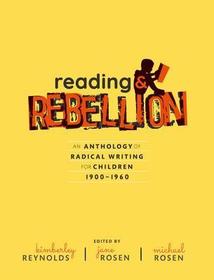
Reading and Rebellion
An Anthology of Radical Writing for Children 1900-1960
-
10% KEDVEZMÉNY?
- A kedvezmény csak az 'Értesítés a kedvenc témákról' hírlevelünk címzettjeinek rendeléseire érvényes.
- Kiadói listaár GBP 29.99
-
14 327 Ft (13 645 Ft + 5% áfa)
Az ár azért becsült, mert a rendelés pillanatában nem lehet pontosan tudni, hogy a beérkezéskor milyen lesz a forint árfolyama az adott termék eredeti devizájához képest. Ha a forint romlana, kissé többet, ha javulna, kissé kevesebbet kell majd fizetnie.
- Kedvezmény(ek) 10% (cc. 1 433 Ft off)
- Kedvezményes ár 12 895 Ft (12 281 Ft + 5% áfa)
Iratkozzon fel most és részesüljön kedvezőbb árainkból!
Feliratkozom
14 327 Ft

Beszerezhetőség
Becsült beszerzési idő: Várható beérkezés: 2026. január vége.
A Prosperónál jelenleg nincsen raktáron.
Why don't you give exact delivery time?
A beszerzés időigényét az eddigi tapasztalatokra alapozva adjuk meg. Azért becsült, mert a terméket külföldről hozzuk be, így a kiadó kiszolgálásának pillanatnyi gyorsaságától is függ. A megadottnál gyorsabb és lassabb szállítás is elképzelhető, de mindent megteszünk, hogy Ön a lehető leghamarabb jusson hozzá a termékhez.
A termék adatai:
- Kiadó OUP Oxford
- Megjelenés dátuma 2018. szeptember 27.
- ISBN 9780198806189
- Kötéstípus Keménykötés
- Terjedelem496 oldal
- Méret 254x196x28 mm
- Súly 1250 g
- Nyelv angol
- Illusztrációk Over 200 black and white illustrations 0
Kategóriák
Rövid leírás:
This new anthology of radical writings for children from the first half of the twentieth century contains a wide selection of the kinds of materials that left-wing and progressive parents would have wanted their children to read, and which children understood as part of their initiation into a politically radical class.
TöbbHosszú leírás:
Kim Reynolds, Jane Rosen, and Michael Rosen present a new anthology of radical writings for children from the first half of the twentieth century. In the years 1900 to 1960, large sections of the British population embraced a spectrum of left-wing positions with a view to maintaining peace and creating a more just, less class riven, more planned, and more enjoyable society for all. Children's books and periodicals were a central part of radical activity since the young were expected not just to inherit but also to help make this new society, and reading was regarded as the most direct way of helping them acquire the skills for this task. From alphabets through picture books, periodicals, information books, plays, song-books, pamphlets, and novels, many works of children's literature leaned left, but with the possible exception of references to Geoffrey Trease's Bows Against the Barons (1934), a Marxist retelling of the Robin Hood story, it is almost impossible to realise this from standard accounts of this period. This anthology contains a wide selection of the kinds of materials that left-wing and progressive parents would have wanted their children to read and which children understood as part of their initiation into a politically radical class.
As an addition to the history of children's literature, Reading and Rebellion is both nuanced and intriguing.
Tartalomjegyzék:
Preface
Acknowledgements
Introduction
Part 1: Stories for young socialists
'King Midas' published in The Young Socialist (1902)
From 'The Coal Cargo' in Pages for Young Socialists (1913)
'Greed the Guy' from Tomfooleries (1920) and 'The First of May' from Moonshine (1921)
'The Story of the Island of Fish' from Eddie and the Gipsy (1935)
From Adventures of the Little Pig and other stories (1936)
From Hue and Cry (1956)
Mickey the Mongrel, the class conscious dog No. 2, 'Whitewash' (Daily Worker 3 January, 1930)
Part 2: The war against war
From War in Dollyland (1915)
'Don't Shoot Your Class!' from The Revolution (1918)
From Not So Quiet: Stepdaughters of War (1930)
'A Life with a Purpose - or a grave in Malaya' from Challenge (1949)
'Last Night I had the Strangest Dream' (1950)
Part 3: Writing and revolution
'Little Peter' from Proletcult (1.9, 1922)
'Steel Spokes' from Martin's Annual (1931)
The Red Corner Book for Children, title page, frontispiece and miscellaneous items (1931)
'The People Speak' from Bows Against the Barons (1934)
'Lower Ranks' from A White Sail Gleams (1936)
'How Till Bought Land in Luneburg' from The Amazing Pranks of Master Till Eulenspiegel (1936)
'Little Tusker's Own Paper,' Daily Worker (1945)
Mickey the Mongrel, the class conscious dog No. 7, 'Selling' (Daily Worker 11 January, 1930)
Part 4: Of Russia with love
From The Diary of a Communist Schoolboy (1928)
'A New Kind of Park' from Red Comet (1937)
Wash 'Em Clean (1923)
What is Good and What is Bad (1925)
From Timur and his Comrades (1943)
'The Telephone' from Jolly Family (1950)
Part 5: Examples from life
'Safar the Hero' from Folk Tales of the Peoples of the Soviet Union (1945)
Extracts from Tomorrow is a New Day: A Youth Edition (1945)
Come In (1946)
'The First Labour M.P.'; 'Hunger Strike Heroine'; 'In Great-Great-Great Grandfather's Day: A historian tells the story of the 'Battle of Peterloo'' from Daily Worker Children's Annual (1957)
Karl Marx: Founder of Modern Communism (1963)
Mickey the Mongrel, the class conscious dog No. 14, 'Bertram Bulldog' (Daily Worker 18 January, 1930)
Part 6: Performing leftness
The World's May Day: A Celebration (1924)
From The Big Rock Candy Mountain (1955)
Selected 'Songs of Struggle' from If I had a Song: a song book for children growing up (1954)
Songs for Elfins (selected songs, c. 1950)
Part 7: Fighting fascism
'Side-light on the Blackshirts' and 'Fight War and Fascism' from Out of Bounds: Public Schools' Journal against Fascism, Militarism and Reaction (1934)
'Red Front' from Martin's Annual (1935)
'Blacking His Shirt' from Martin's Annual (1935)
Extracts from 'I For Influenza' from Rescue in Ravensdale (1946)
Mickey the Mongrel, the class conscious dog No. 46, 'Lionel Lapdog' (Daily Worker 27 February, 1930)
Part 8: Science and social transformation
'The Child of the Future' from The Young Socialist (1913)
'The Beginning of Trade' from Pollycon (1933)
'Whatever Happens' from The Radium Woman (1937)
'The Fate of Books' from Black on White (1942)
Extracts from The Magic of Coal (1945)
Extracts from 'Numbers and Nothing' from Man Must Measure (1955)
Part 9: Sex for beginners
From 'Sex Knowledge' in Proletcult (1923)
Extracts from How You Began (1928)
'Hero-Worship Adrift: Film-Star Hero or Games Mistress?' and 'Morning Glory (Sex in Public Schools)' from Out of Bounds: Public Schools' Journal against Fascism, Militarism and Reaction (1934)
Extracts from 'Physiology' from An Outline for Boys and Girls and Their Parents (1932)
Mickey the Mongrel, the class conscious dog 335, 'Air Display' (Daily Worker 1 January, 1932)
Part 10: Visions of the future
'The Sorry Present and the Expelled Little Boy' from The Story of the Amulet (1906)
Extracts from New Russia's Primer: Story of the Five-Year Plan (1931)
Extracts from 'Problems and Solutions' in Naomi Mitchison, ed. extracts from An Outline for Boys and Girls and Their Parents (1932)
'Danger! High Tension!' from The 35th of May, or Conrad's Ride to the South Seas (1933)
Extracts from Village and Town (1942)
Mickey the Mongrel, the class conscious dog (unnumbered final Mickey the Mongrel cartoon, Daily Worker 1 January, 1932)
Works cited
Index

