

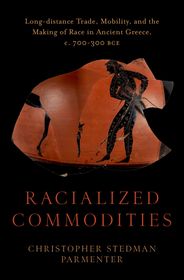
Racialized Commodities
Long-distance Trade, Mobility, and the Making of Race in Ancient Greece, c. 700-300 BCE
-
10% KEDVEZMÉNY?
- A kedvezmény csak az 'Értesítés a kedvenc témákról' hírlevelünk címzettjeinek rendeléseire érvényes.
- Kiadói listaár GBP 78.00
-
35 217 Ft (33 540 Ft + 5% áfa)
Az ár azért becsült, mert a rendelés pillanatában nem lehet pontosan tudni, hogy a beérkezéskor milyen lesz a forint árfolyama az adott termék eredeti devizájához képest. Ha a forint romlana, kissé többet, ha javulna, kissé kevesebbet kell majd fizetnie.
- Kedvezmény(ek) 10% (cc. 3 522 Ft off)
- Kedvezményes ár 31 695 Ft (30 186 Ft + 5% áfa)
Iratkozzon fel most és részesüljön kedvezőbb árainkból!
Feliratkozom
35 217 Ft

Beszerezhetőség
Megrendelésre a kiadó utánnyomja a könyvet. Rendelhető, de a szokásosnál kicsit lassabban érkezik meg.
Why don't you give exact delivery time?
A beszerzés időigényét az eddigi tapasztalatokra alapozva adjuk meg. Azért becsült, mert a terméket külföldről hozzuk be, így a kiadó kiszolgálásának pillanatnyi gyorsaságától is függ. A megadottnál gyorsabb és lassabb szállítás is elképzelhető, de mindent megteszünk, hogy Ön a lehető leghamarabb jusson hozzá a termékhez.
A termék adatai:
- Kiadó OUP USA
- Megjelenés dátuma 2024. december 23.
- ISBN 9780197757116
- Kötéstípus Keménykötés
- Terjedelem400 oldal
- Méret 237x164x24 mm
- Súly 703 g
- Nyelv angol
- Illusztrációk 51, b/w 675
Kategóriák
Rövid leírás:
Racialized Commodities traces how Greece's "racial imaginary"--a confluence of thinking about cultural geography, commodity production, and human physiognomy--emerged from cross-cultural trade between Greece and its Mediterranean neighbors during the Archaic and Classical Periods.
TöbbHosszú leírás:
Between c. 700-300 BCE, the ancient Greeks developed a vivid imaginary of the world's peoples. Ranging from the light-skinned, "gray-eyed Thracians" of the distant north to the "dark-skinned Ethiopians" of the far south, as the poet Xenophanes described them around 540 BCE, Greeks envisioned a world populated by human groups with distinct physiognomies. Racialized Commodities traces how Greece's "racial imaginary"--a confluence of thinking about cultural geography, commodity production, and human physiognomy--emerged from cross-cultural trade between Greece and its Mediterranean neighbors during the Archaic and Classical Periods. It adopts the model of a "commodity biography" to investigate how trade led to the entanglement of cultures, bodies, and things in Archaic and Classical Greece. For merchants, the racial imaginary might be used to play up the "exotic" provenance of their goods to consumers. It might also circulate practical information about customs, pricing, navigation, and doing business in foreign ports.
Archaic Greek attempts to explain foreign bodies were rarely pejorative, and Racialized Commodities begins with some of their earliest images of African peoples, described by Greeks as Egyptians or Ethiopians, before seeking to explain what changed in the early Classical Period. As the Persian Empire loomed and Greek cities became increasingly dependent on enslaved labor, negative stereotypes of Thracians and Scythians became widespread and coalesced into the charged idea of the barbarous--the "barbarian."
This is a landmark intervention in the study of race in antiquity as well as studies in ancient slavery and Greek culture more broadly. This exciting, innovative, and thought-provoking book breaks new ground by linking the emergence of an ancient Greek idea of 'race' to the dramatic upsurge in long distance trade during the seventh and sixth centuries BCE. This is a persuasive and altogether timely demonstration of how race operated in ancient Greece.
Tartalomjegyzék:
Introduction
Part I: The world of the Elephantine papyrus
Chapter 1: A short history of natron
Chapter 2: Egypt in your hand
Chapter 3: From ancestor to 'Other'
Part II: Letters from the Pontus
Chapter 4: Journeys into slavery
Chapter 5: Slavery and the balance of trade
Chapter 6: Inventing whiteness
Postscript
Appendices
Bibliography

