

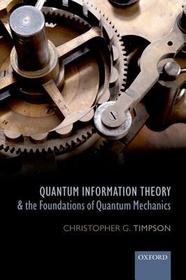
Quantum Information Theory and the Foundations of Quantum Mechanics
-
10% KEDVEZMÉNY?
- A kedvezmény csak az 'Értesítés a kedvenc témákról' hírlevelünk címzettjeinek rendeléseire érvényes.
- Kiadói listaár GBP 39.99
-
18 055 Ft (17 195 Ft + 5% áfa)
Az ár azért becsült, mert a rendelés pillanatában nem lehet pontosan tudni, hogy a beérkezéskor milyen lesz a forint árfolyama az adott termék eredeti devizájához képest. Ha a forint romlana, kissé többet, ha javulna, kissé kevesebbet kell majd fizetnie.
- Kedvezmény(ek) 10% (cc. 1 806 Ft off)
- Kedvezményes ár 16 249 Ft (15 476 Ft + 5% áfa)
Iratkozzon fel most és részesüljön kedvezőbb árainkból!
Feliratkozom
18 055 Ft

Beszerezhetőség
Megrendelésre a kiadó utánnyomja a könyvet. Rendelhető, de a szokásosnál kicsit lassabban érkezik meg.
Why don't you give exact delivery time?
A beszerzés időigényét az eddigi tapasztalatokra alapozva adjuk meg. Azért becsült, mert a terméket külföldről hozzuk be, így a kiadó kiszolgálásának pillanatnyi gyorsaságától is függ. A megadottnál gyorsabb és lassabb szállítás is elképzelhető, de mindent megteszünk, hogy Ön a lehető leghamarabb jusson hozzá a termékhez.
A termék adatai:
- Kiadó OUP Oxford
- Megjelenés dátuma 2015. december 3.
- ISBN 9780198748137
- Kötéstípus Puhakötés
- Terjedelem308 oldal
- Méret 232x157x17 mm
- Súly 468 g
- Nyelv angol 0
Kategóriák
Rövid leírás:
Christopher G. Timpson provides the first full-length philosophical treatment of quantum information theory and the questions it raises for our understanding of the quantum world. He argues for an ontologically deflationary account of the nature of quantum information, which is grounded in a revisionary analysis of the concepts of information.
TöbbHosszú leírás:
Quantum Information Theory and the Foundations of Quantum Mechanics is a conceptual analysis of one the most prominent and exciting new areas of physics, providing the first full-length philosophical treatment of quantum information theory and the questions it raises for our understanding of the quantum world.
Beginning from a careful, revisionary, analysis of the concepts of information in the everyday and classical information-theory settings, Christopher G. Timpson argues for an ontologically deflationary account of the nature of quantum information. Against what many have supposed, quantum information can be clearly defined (it is not a primitive or vague notion) but it is not part of the material contents of the world. Timpson's account sheds light on the nature of nonlocality and information flow in the presence of entanglement and, in particular, dissolves puzzles surrounding the remarkable process of quantum teleportation. In addition it permits a clear view of what the ontological and methodological lessons provided by quantum information theory are; lessons which bear on the gripping question of what role a concept like information has to play in fundamental physics. Topics discussed include the slogan 'Information is Physical', the prospects for an informational immaterialism (the view that information rather than matter might fundamentally constitute the world), and the status of the Church-Turing hypothesis in light of quantum computation.
With a clear grasp of the concept of information in hand, Timpson turns his attention to the pressing question of whether advances in quantum information theory pave the way for the resolution of the traditional conceptual problems of quantum mechanics: the deep problems which loom over measurement, nonlocality and the general nature of quantum ontology. He marks out a number of common pitfalls to be avoided before analysing in detail some concrete proposals, including the radical quantum Bayesian programme of Caves, Fuchs, and Schack. One central moral which is drawn is that, for all the interest that the quantum information-inspired approaches hold, no cheap resolutions to the traditional problems of quantum mechanics are to be had.
Timpson's is an important and highly informative work that touches on significant elements of the philosophical critique of quantum information theory. It also addresses the best-known novel information-focused proto-interpretations of quantum mechanics. The book very clearly treats its subject matter and carefully lays out its territory at each stage. It is recommended for both philosophers of science and physicists with a strong interest in quantum information theory or the foundations of quantum theory.
Tartalomjegyzék:
Introduction
What is Information?
Quantum Information Theory
Case Study: Teleportation
The Deutsch-Hayden Approach: Nonlocality, Entanglement, and Information Flow
Quantum Computation and the Church-Turing Hypothesis
Information and the Foundations of Quantum Mechanics: Preliminaries
Some Information-Theoretic Approaches
Quantum Bayesianism 1: The Proposal
Quantum Bayesianism 2: Challenges
Conclusions
A Review of the Quantum Formalism
Generalized Uncertainty Measures: Uffink's Axioms
Bibliography
Index

