

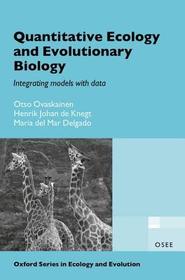
Quantitative Ecology and Evolutionary Biology
Integrating models with data
Sorozatcím: Oxford Series in Ecology and Evolution;
-
10% KEDVEZMÉNY?
- A kedvezmény csak az 'Értesítés a kedvenc témákról' hírlevelünk címzettjeinek rendeléseire érvényes.
- Kiadói listaár GBP 59.00
-
26 638 Ft (25 370 Ft + 5% áfa)
Az ár azért becsült, mert a rendelés pillanatában nem lehet pontosan tudni, hogy a beérkezéskor milyen lesz a forint árfolyama az adott termék eredeti devizájához képest. Ha a forint romlana, kissé többet, ha javulna, kissé kevesebbet kell majd fizetnie.
- Kedvezmény(ek) 10% (cc. 2 664 Ft off)
- Kedvezményes ár 23 975 Ft (22 833 Ft + 5% áfa)
Iratkozzon fel most és részesüljön kedvezőbb árainkból!
Feliratkozom
26 638 Ft

Beszerezhetőség
Megrendelésre a kiadó utánnyomja a könyvet. Rendelhető, de a szokásosnál kicsit lassabban érkezik meg.
Why don't you give exact delivery time?
A beszerzés időigényét az eddigi tapasztalatokra alapozva adjuk meg. Azért becsült, mert a terméket külföldről hozzuk be, így a kiadó kiszolgálásának pillanatnyi gyorsaságától is függ. A megadottnál gyorsabb és lassabb szállítás is elképzelhető, de mindent megteszünk, hogy Ön a lehető leghamarabb jusson hozzá a termékhez.
A termék adatai:
- Kiadó OUP Oxford
- Megjelenés dátuma 2016. május 12.
- ISBN 9780198714873
- Kötéstípus Puhakötés
- Terjedelem304 oldal
- Méret 233x166x15 mm
- Súly 524 g
- Nyelv angol 0
Kategóriák
Rövid leírás:
This is an integration of empirical data and theory in quantitative ecology and evolution through the use of mathematical models and statistical methods.
TöbbHosszú leírás:
This novel, interdisciplinary text achieves an integration of empirical data and theory with the aid of mathematical models and statistical methods. The emphasis throughout is on spatial ecology and evolution, especially on the interplay between environmental heterogeneity and biological processes. The book provides a coherent theme by interlinking the modelling approaches used for different subfields of spatial ecology: movement ecology, population ecology, community ecology, and genetics and evolutionary ecology (each being represented by a separate chapter). Each chapter starts by describing the concept of each modelling approach in its biological context, goes on to present the relevant mathematical models and statistical methods, and ends with a discussion of the benefits and limitations of each approach. The concepts and techniques discussed throughout the book are illustrated throughout with the help of empirical examples.
This is an advanced text suitable for any biologist interested in the integration of empirical data and theory in spatial ecology/evolution through the use of quantitative/statistical methods and mathematical models. The book will also be of relevance and use as a textbook for graduate-level courses in spatial ecology, ecological modelling, theoretical ecology, and statistical ecology.
The book is a highly fascinating read for ecologists and evolutionary biologists interested in learning more about modelling approaches.It mightlikewise be interesting for mathematicians, statisticians and computer scientists interested in ecological and evolutionary questions.It is an advanced but essential text that surely stimulates further reading.
Tartalomjegyzék:
Approaches to ecological modelling
Movement ecology
Population ecology
Community ecology
Genetics and evolutionary ecology
Appendix A: Mathematical methods
Appendix B: Statistical methods

