

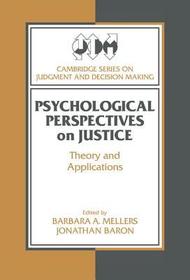
Psychological Perspectives on Justice
Theory and Applications
Sorozatcím: Cambridge Series on Judgment and Decision Making;
-
20% KEDVEZMÉNY?
- A kedvezmény csak az 'Értesítés a kedvenc témákról' hírlevelünk címzettjeinek rendeléseire érvényes.
- Kiadói listaár GBP 116.00
-
52 374 Ft (49 880 Ft + 5% áfa)
Az ár azért becsült, mert a rendelés pillanatában nem lehet pontosan tudni, hogy a beérkezéskor milyen lesz a forint árfolyama az adott termék eredeti devizájához képest. Ha a forint romlana, kissé többet, ha javulna, kissé kevesebbet kell majd fizetnie.
- Kedvezmény(ek) 20% (cc. 10 475 Ft off)
- Kedvezményes ár 41 899 Ft (39 904 Ft + 5% áfa)
- A kedvezmény érvényes eddig: 2026. június 30.
Iratkozzon fel most és részesüljön kedvezőbb árainkból!
Feliratkozom
52 374 Ft

Beszerezhetőség
Becsült beszerzési idő: A Prosperónál jelenleg nincsen raktáron, de a kiadónál igen. Beszerzés kb. 3-5 hét..
A Prosperónál jelenleg nincsen raktáron.
Why don't you give exact delivery time?
A beszerzés időigényét az eddigi tapasztalatokra alapozva adjuk meg. Azért becsült, mert a terméket külföldről hozzuk be, így a kiadó kiszolgálásának pillanatnyi gyorsaságától is függ. A megadottnál gyorsabb és lassabb szállítás is elképzelhető, de mindent megteszünk, hogy Ön a lehető leghamarabb jusson hozzá a termékhez.
A termék adatai:
- Kiadó Cambridge University Press
- Megjelenés dátuma 1993. szeptember 24.
- ISBN 9780521431996
- Kötéstípus Keménykötés
- Terjedelem362 oldal
- Méret 237x157x26 mm
- Súly 622 g
- Nyelv angol 0
Kategóriák
Rövid leírás:
Explores how the distribution of costs and benefits determine our intuition about fairness to provide a balanced look at the psychology of justice.
TöbbHosszú leírás:
Justice, equity, and fairness are central concerns of everyday life, whether we are assessing the fairness of individual acts, social programmes, or institutional policies. This book explores how the distribution of costs and benefits determine our intuition about fairness and why individual behaviour sometimes deviates from normative theories of justice. To make any comparison, one must first state how fair distributions of resources or burdens should be made. Here, competing theories, such as utilitarianism and economic efficiency, are discussed. The chapters cover many topics including an investigation of various rules and heuristics that people use to make fair distributions; the motivation for people to conform to rules of fairness even when they conflict with self-interest; differences between the views of liberals and conservatives; societal rules for the distribution or allocation of critical or scarce resources; and implications for public policy. This mixture of theoretical and applied perspectives provides a balanced look at the psychology of justice.
"The present tightly edited volume provides innovative and rigorous additions to this growing body of theoretical and empirical work....although the present volume clearly illustrates the usefulness of a behavioral decision theory in the study of justice, its greatest contribution lies in demonstrating how social goals and strategies, such as the pursuit of justice and fairness influence judgments and decisions about the allocation of valued resources." Terry L. Boles and Charles G. McClintock, Contemporary Psychology
Tartalomjegyzék:
1. Introductory remarks; Part I. Psychological Perspectives: 2. Equality as a decision heuristic David Messick; 3. Two insights occasioned by attempts to pin down the equity formula Richard Harris; 4. Judgments of justice Maya Bar-Hillel and Menahem Yaari; Part II. Economic Perspectives: 5. Justice in organised groups: comparing the self-interest and social identity perspectives Tom Tyler and Robyn Dawes; 6. Heuristics and biases in equity judgments: a utilitarian approach Jonathan Baron; 7. Tradeoffs in fairness and preference judgments Lisa Ordoñez and Barbara Mellers; 8. Information, fairness, and efficiency in bargaining Colin Camerer and George Loewenstein; Part III. Variations in Perspectives of Justice: 9. The unfolding of justice: a developmental perspective on reward allocations Colleen Moore, Sheri E. Hembree, and Robert D. Enright; 10. Of Ants and Grasshoppers: the political psychology of allocating scarce resources Linda Skitka and Philip E. Tetlock; 11. Liberal and conservative approaches to justice: conflicting psychopolitical perspectives Philip E. Tetlock and Gregory Mitchell; Part IV. Policy Perspectives: Justice and the allocation of scarce resources Jon Elster; 12. Models of equity in public risk Rakesh Sarin; 13. Fairness of distributions of risks with applications to Antarctica Ivy Broder and Robin Keller; Part V: Postscript.
Több
