

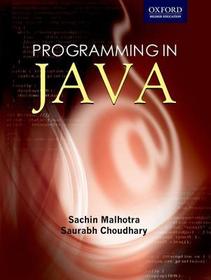
Programming in JAVA
-
10% KEDVEZMÉNY?
- A kedvezmény csak az 'Értesítés a kedvenc témákról' hírlevelünk címzettjeinek rendeléseire érvényes.
- Kiadói listaár GBP 20.99
-
10 027 Ft (9 550 Ft + 5% áfa)
Az ár azért becsült, mert a rendelés pillanatában nem lehet pontosan tudni, hogy a beérkezéskor milyen lesz a forint árfolyama az adott termék eredeti devizájához képest. Ha a forint romlana, kissé többet, ha javulna, kissé kevesebbet kell majd fizetnie.
- Kedvezmény(ek) 10% (cc. 1 003 Ft off)
- Kedvezményes ár 9 025 Ft (8 595 Ft + 5% áfa)
Iratkozzon fel most és részesüljön kedvezőbb árainkból!
Feliratkozom
10 027 Ft

Beszerezhetőség
Bizonytalan a beszerezhetőség. Érdemes még egyszer keresni szerzővel és címmel. Ha nem talál másik, kapható kiadást, forduljon ügyfélszolgálatunkhoz!
Why don't you give exact delivery time?
A beszerzés időigényét az eddigi tapasztalatokra alapozva adjuk meg. Azért becsült, mert a terméket külföldről hozzuk be, így a kiadó kiszolgálásának pillanatnyi gyorsaságától is függ. A megadottnál gyorsabb és lassabb szállítás is elképzelhető, de mindent megteszünk, hogy Ön a lehető leghamarabb jusson hozzá a termékhez.
A termék adatai:
- Kiadó OUP India
- Megjelenés dátuma 2010. május 27.
- ISBN 9780198063582
- Kötéstípus Puhakötés
- Terjedelem656 oldal
- Méret 243x186x25 mm
- Súly 810 g
- Nyelv angol
- Illusztrációk 101 line drawings; 1 picture 0
Kategóriák
Rövid leírás:
Java Programming is designed to serve as a textbook for undergraduate students of computer science and engineering and computer applications. The book covers the concepts of Object Oriented Programming before commencing with the fundamentals of JAVA. The reasons behind evolution of JAVA and the reasons for the replacement of C++ by JAVA as an Object Oriented Programming are also discussed.
TöbbHosszú leírás:
Java Programming is designed to serve as a textbook for undergraduate students of computer science and engineering and computer applications.
The book covers the concepts of Object Oriented Programming before commencing with the fundamentals of JAVA. The reasons behind evolution of JAVA and the reasons for the replacement of C++ by JAVA as an Object Oriented Programming are also discussed. It includes topics such as Java Sockets, Applets, Swings, and Java Collections and Iterators. The book also encompasses all the modifications and enhancements related to JAVA 5.0 and JAVA 6. Numerous programming exercises are interspersed in the
chapters for the better understanding of concepts.
Besides having detailed exercises at the end of each chapter, the book has some key review questions along with their answers at the end, which could be helpful to the readers in revising the concepts learnt.
Tartalomjegyzék:
Introduction to OOP
1.1 Introduction
1.2 Need of Object Oriented Programming
1.2.1 Procedural languages
1.2.2 Object-Oriented Modeling
1.2.2.1 Attributes
1.2.2.2 Behavior
1.3 Principles of Object Oriented Languages
1.3.1 Classes
1.3.2 Objects
1.3.3 Abstraction
1.3.4 Inheritance
1.3.5 Encapsulation
1.3.6 Polymorphism
1.4 Comparison between PO and OO Language
1.5 OOAD using UML
1.7 Application of OO Programming
Summary
Review Exercises
Getting Started with Java
2.1 Introduction
2.2 History of Java
2.3 Java's Journey-from Embedded Systems Middle Tier Applications
2.4 Java Essentials
2.5 Java Runtime
2.6 Java Features
2.6.1 Platform Independence
2.6.2 Object Oriented
2.6.3 Both Compiled & Interpreted
2.6.3.1 Interpretation
2.6.3.2 Compilation
2.6.3.3 The Java Approach
2.6.4 Java is Robust
2.6.5 JAVA Language Security Features
2.6.5.1 Java Security Model
2.6.5.2 The sandbox defined
2.6.6 Java is Multi-Threaded
2.6.7 Other Features
2.6.7.1 Automatic Memory Management
2.6.7.2 Dynamic Binding
2.6.7.3 Good Performance
2.6.7.4 Built-in Networking
2.7 JAVA Improvements
2.7.1 Java 5.0 Improvements
2.7.1.1 Quality, Stability, and Compatibility
2.7.1.2 Performance and Scalability
2.7.1.3 Ease of Development
2.7.1.4 Monitoring and Manageability
2.7.1.5 Improved Desktop Client
2.7.2 Java 5.0 Features
2.7.2.1 Autoboxing and unboxing
2.7.2.2 Enhanced for loop
2.7.2.3 Metadata
2.7.2.4 Formatted input and output and varargs
2.7.2.5 Static import
2.7.2.6 Graphics system improvements
2.7.2.7 New concurrency features
2.7.2.8 Generics
2.7.2.9 Enumerated types
2.7.2.10 String Builder class
2.7.3 about Java 6
2.7.4 Brief Comparison of different releases
2.8 Some more Java Facts
2.8.1 Garbage Collection
2.8.2 No Pointers
2.8.3 No Global Variables
2.9 Differences between Java and C++
2.10 Java Virtual Machine
2.11 Program Structure
2.11.1 Why save as Example.java?
2.12 Installation of JDK1.6
2.12.1 Getting Started with the Java Developer's Kit
2.12.2 JDK Installation Notes
2.12.1 Run the JDK installer, if necessary
2.12.2.2 Update PATH and CLASSPATH variables
2.12.2.3 Testing the Installation
2.12.3 Exploring the Java Developer's Kit
2.13 Integrated Development Environment (IDE)
SUMMARY
REVIEW EXERCISES
Programming Exercise
Java Programming Constructs
3.1 Variables
3.2 Primitive Data Types
3.3 Identifier
3.3.1 Rules for Naming
3.3.2 Naming Convention
3.3.3 Keywords
3.4 Literals
3.5 Operators
3.5.1 Binary Operators
3.5.1.1 Assignment Operator (=)
3.5.1.2 Arithmetic Operators (+, -, *, /, %)
3.5.1.3 Relational Operators
3.5.1.4 Boolean Logical Operators
3.5.1.4.1 Logical Operators
3.5.1.4.2 Conditional OR (
3.5.2 Unary Operators
3.5.2.1 Increment and Decrement Operators
3.5.2.1.1 Prefix Increment / Decrement Operation
3.5.2.1.2 Postfix Increment / Decrement Operation
3.5.3 Ternary Operator
3.6 Expressions
3.7 Precedence rules and Associativity
3.8 Primitive Type Conversion and Casting
3.9 Flow of Control
3.9.1 Conditional Statements
3.9.1.1 Ifelse
3.9.1.2 switch-case
3.9.2 Loops
3.9.2.1 for loop
3.9.2.2 While Loop
3.9.2.3 do..while loop
3.9.2.4 for-each
3.9.3 Branching Mechanism
3.9.3.1 The break Statement
3.9.3.2 continue Statement
Summary
Review Exercises
Programming Exercises
Classes and Objects
4.1 Classes
4.1.1 How to declare Class in JAVA?
4.1.2 The Class Body
4.2 Objects
4.2.1 Difference between Objects and Classes
4.2.2 Why should we use Objects and Classes?
4.3 Creating Objects
4.3.1 Declaring an Object
4.3.2 Instantiating an Object
4.3.3 Initializing an Object
4.3.3.1 Instance Variables
4.3.3.2 Accessing Variables and Methods
4.3.3.3Assigning Values to Variables and Methods
4.4 Methods
4.4.1 Why use methods?
4.4.2 Method Declaration
4.4.3 Method Invocation
4.4.4 Method Overloading
4.5 Constructors
4.5.1 Constructor Overloading
4.6 Cleaning Up Unused Objects
4.6.1 The Garbage Collector
4.6.2 Finalization
4.7 Class Variable and Methods - "static" Keyword
4.7.1 Static Variables
4.7.2 Static Methods
4.8 Arrays
4.8.1 One-dimensional arrays:
4.8.1.1 Creation of Array:
4.8.1.2 How to use for loop with array
4.8.1.3 Sorting an array
4.8.2 Two-Dimensional Arrays
4.8.3 Using for-each with arrays
4.9 'this' keyword
4.10 Command Line Arguments
Summary
Review Exercises
Programming Exercise
Inheritance
5.1 Inheritance Vs Aggregation
5.1.1 Types of Inheritance
5.1.1.2 Single Level Inheritance
5.1.1.2 Multi Level Inheritance
5.1.1.3 Multiple Inheritance
5.1.2 Deriving Classes using extends Keyword
5.2 Method Overriding
5.3 super Keyword
5.4 final Keyword
5.5 Abstract Class
Summary
Review Exercises
Programming Exercise
Interfaces Packages and Enumeration
6.1 Interface
6.1.1 Variables in Interface
6.1.2 Extending Interfaces
6.1.3 Interface Vs Abstract classes
6.2 Packages
6.2.2 Creating packages
6.2.2.1 Saving Compiling and executing packages
6.2.2.2 Setting the Class Path
6.2.2.3 Sub Packages
6.2.3 Using packages
6.2.3.1 Static Import
6.2.4 Access protection
6.3 Java. Lang package
6.3.1 The java.lang.Object class
6.3.2 Java Wrapper classes
6.3.2.1 Wrapper classes: Constructor and Methods
6.3.2.2 Autoboxing and Unboxing Of Wrappers
6.3.3 String Class
6.3.3.1 String Manipulation
6.3.3.2 String Methods
6.3.4 StringBuffer Class
6.3.5 StringBuilder Class
6.3.6 Splitting Strings
6.4 Enum type
6.4.1 Naming convention
6.4.2 Enumerated type inside a class
6.4.3 Printing enum values
6.4.4 Using if or switch Statements with an Enumerated Variable
6.4.5 Processing Enumerated Values Using for Loop:
6.4.6 Enumerated Types with Attributes and Methods
Summary
Review Exercises
Programming Exercise
Exception Assertions and Logging
7.1 Introduction
7.1.1 Exception Types
7.2 Exception Handling Techniques
7.2.1 Try .. Catch
7.2.2 Throw
7.2.3 Throws
7.2.4 Finally block
7.3 User Defined Exception
7.4 Exception Encapsulation and Enrichment
7.5 Assertions
7.6 Logging
Summary
Review Questions
Programming Exercises
Multithreading in Java
8.1 Introduction
8.2 Multithreading in Java
8.3 java.lang.Thread
8.4 The Main Thread
8.5 Creation of New Threads
8.5.1 By extending the thread class
8.5.2 Implementing the Runnable interface
8.6 Thread. State in Java
8.6.1 Thread States
8.7 Thread Priority
8.8 Synchronization
8.8.1 Synchronized methods
8.8.2 Synchronized statements
8.9 Multithreading - Using is Alive () and join ()
8.10 Suspending and Resuming Threads
8.11 Communicating Between Threads
Summary
Review Exercises
Programming Exercises
Input/Output, Serialization
9.1 Introduction
9.1.1The java.io.Input Stream and java.io.Output Stream
9.2 The java.io.File class
9.3 Reading and Writing Data
9.3.1 Reading/Writing Files using Byte Stream
9.3.2 Reading/Writing Console (User Input)
9.3.3 Reading/Writing Files using Character Stream
9.3.4 Reading/Writing Using Buffered Stream Classes
9.3.4.1 Reading/Writing using Buffered byte stream classes
9.3.4.2 Reading/Writing using Buffered Character stream classes
9.4 Randomly Accessing a File
9.5 Reading and Writing Files using new I/O package
9.6 Serialization
Summary
Review Questions
Programming Exercises
java.util and Generics
10.1 Introduction
10.2 Generics
10.2.1 Using Generics in Arguments and return types
10.2.2 Wildcards
10.2.3 Bounded Wildcards
10.2.4 Defining your own Generic classes
10.3 Linked List
10.5 Set
10.5.1 Hashing
10.5.2 HashSet class
10.5.3 TreeSet class
10.6 Maps
10.6.1 HashMap class
10.6.2 TreeMap class
10.7 Collections class
10.8 Legacy classes and interfaces
10.8.1 Difference between Vector Vs ArrayList
10.8.2 Difference between Enumerations Vs Iterator
Summary
Review Exercises
Programming Exercises
Network Programming
11.1 Introduction
11.1.1 TCP/IP Protocol suite
11.2 Sockets
11.2.1 TCP Client and Server
11.2.2 UDP Client and Server
11.3 URL class
11.4 Multithreaded sockets
11.5 Network Interface
Summary
Review Exercises
Applet
12.1 Introduction
12.2 Applet class
12.3 Applet Structure
12.4 An example applet program
12.4.1 How to run an applet
12.5 Applet life cycle
12.6 Common methods used in displaying the output
12.7 paint ( ), update ( ) and repaint ( ):
12.7.1 Paint ()
12.7.2 Update () method
12.7.3 Repaint () method
12.8 More about APPLET tag
12.9 getDocumentBase () and getCodeBase()
12.10 AppletContext Interface
12.10.1 Communication between two applets
12.11 How to use an audio clip
12.12 Graphics class
12.12.1 An Example Applet using Graphics
12.13 Color
12.14 Font
12.15 FontMetrics
Summary
Review Questions
Programming Exercise
Event Handling in Java
13.1 Introduction
13.2 Event Delegation Model
13.3 java.awt event Description
13.3.1 Event Classes
13.3.1.1 Action Event Class
13.4 Sources of Events
13.5 Event Listeners
13.6 How does the model work?
13.6.1 An example showing the use of Mouse Motion Listener
13.7 Adapter Classes
13.7.1 How to use Adapter Classes
13.7.2 Adapter Classes in Java
13.8 Inner Classes
Summary
Review Exercises
Programming Exercises
AWT (Abstract Windowing Toolkit)
14.1 Introduction
14.1.1 Why AWT?
14.1.2 Java.awt package
14.2 Components and containers
14.2.1 Component
14.2.2 Components as event generator
14.3 Button
14.4 Label
14.5 Checkbox
14.6 RADIO BUTTONS
14.7 LIST BOXES
14.8 CHOICE BOXES
14.9 TEXTFIELD & TEXTAREA
14.10 Container class
14.10.1 Types of containers
14.10.2 Panels
14.10.2.1 How to Use Panels
14.10.3 Window
14.10.4 Frame
14.11 Layouts
14.11.1 Flow Layout
14.11.2 Border Layout
14.11.3 Card Layout
14.11.4 Grid Layout
14.11.5 Grid Bag Layout
14.12 MENU
14.13 Scrollbar
Summary
REVIEW EXERCISES
PROGRAMMING EXERCISE
Swing
15.1 Introduction
15.1.1 Features of Swing
15.1.2 Differences between Swing and AWT
15.2 JFrame
15.3 JApplet
15.4 JPanel
15.5 Components in swings
15.6 Layout Managers
15.6.1 Spring Layout
15.6.2 Box Layout
15.7 JList & JScroll Pane
15.8 Split Pane
15.9 JTabbed Pane
15.10 Dialog Box
15.11 Pluggable Look and Feel
Summary
Review Exercises
Programming Exercises
Introduction to Advanced Java
16.1 Database Handling using JDBC
16.1.1 Load the Driver
16.1.1.1 Type 1: Jdbc Odbc Bridge Driver
16.1.1.2 Type 2: Native-API/partly Java driver
16.1.1.3 Type 3: Net-protocol driver
16.1.1.4 Type 4: Pure java driver
16.1.2 Establish Connection
16.1.3 Create statement
16.1.4 Execute Query
16.1.5 Iterate Result Set
16.1.6 An Example
16.2 Servlets
16.2.1 Life cycle of Servlets
16.2.2 First Servlet
16.2.3 Reading Client Data
16.2.5 Http Redirects
16.2.6 Cookies
16.4 Remote Method Invocation
16.4.1 RMI Networking Model
16.4.1.1 Stub & Skeleton
16.4.2 Creating an RMI Application
16.4.2.1 Creating an Interface
16.4.2.2 Server class
16.4.2.3 RMI registry
16.4.2.4 Stub
16.4.2.5 Client
16.4.2.5 Executing RMI Server and Client
Summary
Review Exercises
Programming Exercises

