

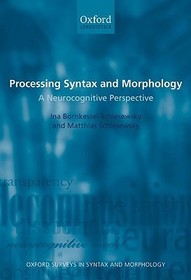
Processing Syntax and Morphology
A Neurocognitive Perspective
Sorozatcím: Oxford Surveys in Syntax & Morphology; 6;
-
10% KEDVEZMÉNY?
- A kedvezmény csak az 'Értesítés a kedvenc témákról' hírlevelünk címzettjeinek rendeléseire érvényes.
- Kiadói listaár GBP 76.00
-
34 314 Ft (32 680 Ft + 5% áfa)
Az ár azért becsült, mert a rendelés pillanatában nem lehet pontosan tudni, hogy a beérkezéskor milyen lesz a forint árfolyama az adott termék eredeti devizájához képest. Ha a forint romlana, kissé többet, ha javulna, kissé kevesebbet kell majd fizetnie.
- Kedvezmény(ek) 10% (cc. 3 431 Ft off)
- Kedvezményes ár 30 883 Ft (29 412 Ft + 5% áfa)
Iratkozzon fel most és részesüljön kedvezőbb árainkból!
Feliratkozom
34 314 Ft

Beszerezhetőség
Megrendelésre a kiadó utánnyomja a könyvet. Rendelhető, de a szokásosnál kicsit lassabban érkezik meg.
Why don't you give exact delivery time?
A beszerzés időigényét az eddigi tapasztalatokra alapozva adjuk meg. Azért becsült, mert a terméket külföldről hozzuk be, így a kiadó kiszolgálásának pillanatnyi gyorsaságától is függ. A megadottnál gyorsabb és lassabb szállítás is elképzelhető, de mindent megteszünk, hogy Ön a lehető leghamarabb jusson hozzá a termékhez.
A termék adatai:
- Kiadó OUP Oxford
- Megjelenés dátuma 2009. szeptember 3.
- ISBN 9780199207817
- Kötéstípus Keménykötés
- Terjedelem376 oldal
- Méret 253x177x26 mm
- Súly 830 g
- Nyelv angol
- Illusztrációk Figures 0
Kategóriák
Rövid leírás:
This book explores interdisciplinary work on the mental processing of syntax and morphology. It is divided into four parts concerned with word structure, sentence structure, processing syntax and morphology at the interfaces, and a comparison of different models of syntactic and morphological processing in the neurophysiological domain.
TöbbHosszú leírás:
This book reviews interdisciplinary work on the mental processing of syntax and morphology. It focuses on the fundamental questions at the centre of this research, for example whether language processing proceeds in a serial or a parallel manner; which areas of the brain support the processing of syntactic and morphological information; whether there are neurophysiological correlates of language processing; and the degree to which neurolinguistic findings on syntactic and morphological processing are consistent with theoretical conceptions of syntax and morphology. The authors describe the outcomes of methods in neurophysiology (for example, functional magnetic resonance imaging), behavioural psycholinguistics, and neuropsychological lesion studies, and provide brief introductions to the methods themselves. They extend basic findings at the word and sentence level by considering how the mental processing of syntax and morphology relates to prosody, discourse, semantics, and world knowledge. They have divided the work into four parts concerned with word structure, sentence structure, processing syntax and morphology at the interfaces, and a comparison of different models of syntactic and morphological processing in the neurophysiological domain. The book is directed at graduate students and researchers in theoretical linguistics, psycho- and neurolinguistics, neurophysiology, and psychology.
Beautifully presented ... The book gives a clearly written and reliable overview of what has been achieved over the past couple of decades in neurolinguistic research into morphosyntactic issues ... The book offers many insights that will give sustenance to theories.
Tartalomjegyzék:
Introduction
Methodological Prerequisites
Part I: Syntax and Morphology at the Word Level
Basic Categories: The Noun-Verb Distinction
Inflectional Morphology
Derivational Morphology
Syntax and Morphology at the Word Level: Summary and Critical Evaluation
Part II: Syntax and Morphology in Sentence processing
Mapping Form Onto Meaning: The Requirements for a Sentence Processor
Constituent Order
Relational Structure
The Processing of Complex Structures
The Processing of Modifiers
On The Functional Interpretation of late Positive ERP Effects in Language Processing
Part III: Processing Syntax and Morphology at the Interfaces
The Influence of Prosody
Information Structure
Part IV: Neurocognitive Models of Syntactic and Morphological Processing
Neurocognitive Models of Language Comprehension
Future Directions
References
Index of Subjects
Index of Authors

