

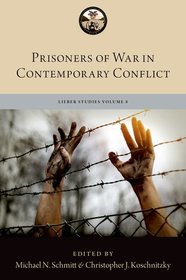
Prisoners of War in Contemporary Conflict
Sorozatcím: LIEBER STUDIES SERIES;
-
20% KEDVEZMÉNY?
- A kedvezmény csak az 'Értesítés a kedvenc témákról' hírlevelünk címzettjeinek rendeléseire érvényes.
- Kiadói listaár GBP 120.00
-
54 180 Ft (51 600 Ft + 5% áfa)
Az ár azért becsült, mert a rendelés pillanatában nem lehet pontosan tudni, hogy a beérkezéskor milyen lesz a forint árfolyama az adott termék eredeti devizájához képest. Ha a forint romlana, kissé többet, ha javulna, kissé kevesebbet kell majd fizetnie.
- Kedvezmény(ek) 20% (cc. 10 836 Ft off)
- Kedvezményes ár 43 344 Ft (41 280 Ft + 5% áfa)
- A kedvezmény érvényes eddig: 2026. június 30.
Iratkozzon fel most és részesüljön kedvezőbb árainkból!
Feliratkozom
54 180 Ft

Beszerezhetőség
Becsült beszerzési idő: A Prosperónál jelenleg nincsen raktáron, de a kiadónál igen. Beszerzés kb. 3-5 hét..
A Prosperónál jelenleg nincsen raktáron.
Why don't you give exact delivery time?
A beszerzés időigényét az eddigi tapasztalatokra alapozva adjuk meg. Azért becsült, mert a terméket külföldről hozzuk be, így a kiadó kiszolgálásának pillanatnyi gyorsaságától is függ. A megadottnál gyorsabb és lassabb szállítás is elképzelhető, de mindent megteszünk, hogy Ön a lehető leghamarabb jusson hozzá a termékhez.
A termék adatai:
- Kiadó OUP USA
- Megjelenés dátuma 2023. április 27.
- ISBN 9780197663288
- Kötéstípus Keménykötés
- Terjedelem480 oldal
- Méret 164x237x37 mm
- Súly 826 g
- Nyelv angol 299
Kategóriák
Rövid leírás:
This volume examines the rules governing the designation and treatment of POWs in contemporary conflict. Each chapter examines specific topics around POWs that the contributors identify as unsettled, operationally problematic, or inadequately addressed in existing literature.
TöbbHosszú leírás:
In 2021, the International Committee of the Red Cross released its Commentary on the 1949 Geneva Convention Relative to the Treatment of Prisoners of War (POWs). The new document updated the 1960 "Pictet Commentary." As a result, the attention of the law-of-armed-conflict community was refocused on the designation and treatment of POWs. The Lieber Institute for Law and Warfare at West Point launched a project to further examine the subject. The result is this book. Sadly, world events have made that examination especially timely.
Unlike the ICRC's updated Commentary, this book is not meant to be a comprehensive treatment of the international law relating to POWs. Rather, it is a collection of capita selecta identified by the contributors as meriting further examination - either because they are unsettled, inadequately addressed in the literature, or operationally problematic. The work is in three parts. Part I examines qualification for POW status. Discussion then moves in Part II to the treatment to which POWs are entitled. Part III concludes with a consideration of the historical relevance of, and perspectives on, the international law governing POWs.
As the drafters of the Third Geneva Convention emphasized over seventy years ago, the aim of the law is "to mitigate as far as possible, the inevitable rigours [of a war] and to alleviate the condition of prisoners of war." It is through that lens that scholars and practitioners should consider the rules governing POWs, and with which they should approach this book.
Tartalomjegyzék:
Foreword
Preface
PART ONE: Prisoner of War Status
Chapter 1. Prisoners of War (POWs) in Proxy Warfare: The Application of Geneva Convention III to Organized Armed Groups Detaining POWs of Territorial States or Detained as POWs by Territorial States
Marco Sass--li & Eug--nie Duss
Chapter 2. The Application of the Third Geneva Convention in Fluid Conflicts
Laurie Blank
Chapter 3. The Regular Armed Forces, Uniforms, and Prisoner of War Status
Michael N. Schmitt & Christopher J. Koschnitzky
Chapter 4. "Accompanying the Force" in Modern Armed Conflict
Eric Talbot Jensen
Chapter 5. Lev--e en Masse in 21st Century Armed Conflict
Winston S. Williams & Robert Lawless
Chapter 6. Prisoner of War Status in the Context of Naval Warfare: On the Status of Masters and Crews of Neutral Merchant Vessels
Wolff Heintschel von Heinegg
Chapter 7. Prisoners of War in Space?
Rob McLaughlin
PART TWO: Prisoner of War Protections & Transfers and Release
Chapter 8. Protecting Prisoners of War in Contemporary Conflicts
Derek P. Jinks
Chapter 9. Military Assimilation and the 1949 Third Geneva Convention on Prisoners of War
Sean Watts
Chapter 10. The Use of Force against Prisoners of War: Operationalizing Article 42
Bruce Oswald & Christopher Hanna
Chapter 11. Parole of Prisoners of War under Article 21 of the Third Geneva Convention: Past, Present, and Future
Emily Crawford
Chapter 12. Detention of Suspected Terrorists in Connection with Armed Conflict: A Focus on Release and Repatriation
Pavle Kilibarda & Gloria Gaggioli
PART THREE: History & Perspectives
Chapter 13. The Lieber Code and Prisoners of War: A Legacy of Practical Humanitarianism
David Wallace & Shane Reeves
Chapter 14. The Role of Judge Advocates in Prisoner of War and Detention Operations in the U.S. Army: A Short History
Fred Borch
Chapter 15. The Updated ICRC Commentary on the Third Geneva Convention: A New Tool to Protect Prisoners of War in the Twenty-First Century
Jemma Arman, Jean-Marie Henckaerts, Heleen Hiemstra & Kvitoslava Krotiuk
Chapter 16. ICRC Perspectives on the Interpretation of the Third Geneva Convention More Than Seventy Years after Its Adoption
Jean-Marie Henckaerts, Kubo Ma----k, Mikhail Orkin & Ellen Policinski
Chapter 17. A Perspective on the Updated Third Geneva Convention Commentary from a United States Practitioner
Michael W. Meier

