

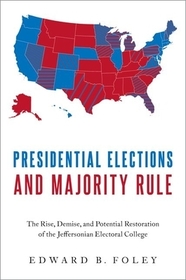
Presidential Elections and Majority Rule
The Rise, Demise, and Potential Restoration of the Jeffersonian Electoral College
-
10% KEDVEZMÉNY?
- A kedvezmény csak az 'Értesítés a kedvenc témákról' hírlevelünk címzettjeinek rendeléseire érvényes.
- Kiadói listaár GBP 19.49
-
8 799 Ft (8 380 Ft + 5% áfa)
Az ár azért becsült, mert a rendelés pillanatában nem lehet pontosan tudni, hogy a beérkezéskor milyen lesz a forint árfolyama az adott termék eredeti devizájához képest. Ha a forint romlana, kissé többet, ha javulna, kissé kevesebbet kell majd fizetnie.
- Kedvezmény(ek) 10% (cc. 880 Ft off)
- Kedvezményes ár 7 919 Ft (7 542 Ft + 5% áfa)
Iratkozzon fel most és részesüljön kedvezőbb árainkból!
Feliratkozom
8 799 Ft

Beszerezhetőség
Becsült beszerzési idő: A Prosperónál jelenleg nincsen raktáron, de a kiadónál igen. Beszerzés kb. 3-5 hét..
A Prosperónál jelenleg nincsen raktáron.
Why don't you give exact delivery time?
A beszerzés időigényét az eddigi tapasztalatokra alapozva adjuk meg. Azért becsült, mert a terméket külföldről hozzuk be, így a kiadó kiszolgálásának pillanatnyi gyorsaságától is függ. A megadottnál gyorsabb és lassabb szállítás is elképzelhető, de mindent megteszünk, hogy Ön a lehető leghamarabb jusson hozzá a termékhez.
A termék adatai:
- Kiadó OUP USA
- Megjelenés dátuma 2021. október 13.
- ISBN 9780197582060
- Kötéstípus Puhakötés
- Terjedelem256 oldal
- Méret 159x238x16 mm
- Súly 372 g
- Nyelv angol 145
Kategóriák
Rövid leírás:
In his latest book, Presidential Elections and Majority Rule, Edward Foley asks how the American electoral system can better represent the people. What kind of winner truly reflects the nation's votes: the plurality winners of winner-takes-all elections, as currently used, or the majority-preferred winners of a reformed system? How do third-party candidates affect American presidential elections? What, if anything, would change in a two-candidate run-off? And how can electoral reform be implemented without sowing chaos? Ultimately, Foley outlines a solution in which the Electoral College can be restored to its original majoritarian ideals through state law rather than Constitutional amendment.
TöbbHosszú leírás:
A timely look into and argument for the Jeffersonian Electoral College.
The Electoral College that governs America has been with us since 1804, when Thomas Jefferson's supporters redesigned it for his re-election. The Jeffersonians were motivated by the principle of majority rule. Gone were the days when a president would be elected by acclamation, as George Washington had been. Instead, given the emergence of intense two-party competition, the Jeffersonians wanted to make sure that the Electoral College awarded the presidency to the candidate of the majority, rather than minority, party. They also envisioned that a candidate would win by amassing a majority of Electoral College votes secured from states where the candidate's party was in the majority.
For most of American history, this system has worked as intended, producing presidents who won Electoral College victories derived from state-based majorities. In the last quarter-century, however, there have been three significant aberrations from the Jeffersonian design: 1992, 2000, and 2016. In each of these years, the Electoral College victory depended on states where the winner received only a minority of votes.
In this authoritative history of the American Electoral College system, Edward Foley analyzes the consequences of the unparalleled departure from the Jeffersonians' original intent-and delineates what we can do about it. He explains how states, by simply changing their Electoral College procedures, could restore the original Jeffersonian commitment to majority rule. There are various ways to do this, all of which comply with the Constitution. If only a few states had done so before 2016, the outcome might have been different. Doing so before future elections can prevent another victory that, contrary to the original Jeffersonian intent, a majority of voters did not want.
Nobody writes more thoughtfully about the theory and historical practices of American elections than Foley.--This book is a model of careful argument
Tartalomjegyzék:
Preface
Introduction
Part One: The Rise of the Jeffersonian Electoral College
1: The Electoral College of 1787
2: The First Four Elections
3: The Electoral College of 1803
Part Two: The Demise of the Jeffersonian Electoral College
4: The Jeffersonian Electoral College in the 19th Century
5: The Jeffersonian Electoral College in the 20th Century
Part Three: The Potential Restoration of the Jeffersonian Electoral College
7: A Recommitment to Majority Rule
8: An Exploration of Alternatives
9: A Feasible Reform
Conclusion
Notes
Index

