

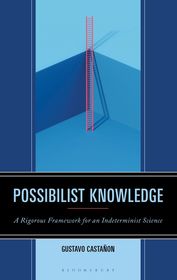
Possibilist Knowledge
A Rigorous Framework for an Indeterminist Science
-
20% KEDVEZMÉNY?
- A kedvezmény csak az 'Értesítés a kedvenc témákról' hírlevelünk címzettjeinek rendeléseire érvényes.
- Kiadói listaár GBP 80.00
-
36 120 Ft (34 400 Ft + 5% áfa)
Az ár azért becsült, mert a rendelés pillanatában nem lehet pontosan tudni, hogy a beérkezéskor milyen lesz a forint árfolyama az adott termék eredeti devizájához képest. Ha a forint romlana, kissé többet, ha javulna, kissé kevesebbet kell majd fizetnie.
- Kedvezmény(ek) 20% (cc. 7 224 Ft off)
- Kedvezményes ár 28 896 Ft (27 520 Ft + 5% áfa)
- A kedvezmény érvényes eddig: 2026. június 30.
Iratkozzon fel most és részesüljön kedvezőbb árainkból!
Feliratkozom
36 120 Ft

Beszerezhetőség
Még nem jelent meg, de rendelhető. A megjelenéstől számított néhány héten belül megérkezik.
Why don't you give exact delivery time?
A beszerzés időigényét az eddigi tapasztalatokra alapozva adjuk meg. Azért becsült, mert a terméket külföldről hozzuk be, így a kiadó kiszolgálásának pillanatnyi gyorsaságától is függ. A megadottnál gyorsabb és lassabb szállítás is elképzelhető, de mindent megteszünk, hogy Ön a lehető leghamarabb jusson hozzá a termékhez.
A termék adatai:
- Kiadó Bloomsbury Publishing (UK)
- Megjelenés dátuma 2026. május 28.
- ISBN 9781666953961
- Kötéstípus Keménykötés
- Terjedelem272 oldal
- Méret 232x160x22 mm
- Súly 540 g
- Nyelv angol 700
Kategóriák
Rövid leírás:
Possibilist knowledge is the kind of scientific knowledge about what makes something possible or impossible in a given context, given the satisfaction or absence of a necessary condition.
TöbbHosszú leírás:
"
Possibilist knowledge is the kind of scientific knowledge about what makes something possible or impossible in a given context, given the satisfaction or absence of a necessary condition, and which is formed by possibilist laws and explanations.
Unlike knowledge of physical necessity, which states what must occur, or probabilistic knowledge, which indicates what is likely to occur, possibilist knowledge delineates the boundaries of what can and cannot happen. Possibilist laws are strict laws stating necessary conditions for events, and possibilist explanations show how apparently impossible or improbable phenomena could have occurred under specified conditions.
Building on new tools such as permissive and preventive conditions, this book rectifies longstanding problems in the philosophy of science, from the ""how-possibly"" explanations to mechanisms and negative causation, reconsidering the deductive-nomological model of explanation in a renewed light. Drawing examples from physics, biology, social sciences, psychology, and neuroscience, it demonstrates that possibilist reasoning is already pervasive, though unacknowledged, and essential for understanding multicausality and constraints in complex systems. In psychology, possibilist knowledge provides a methodological basis for unifying the discipline and reconciling scientific rigor with human freedom. More broadly, possibilism challenges the modern identification of science with determinism, showing that we can preserve exact science without assuming a deterministic universe. By offering a framework that compatibilizes scientific laws with the presumption of agency and responsibility, the book contributes to resolving one of the most enduring cultural conflicts: the tension between determinism, free will, and the authority of science.
Tartalomjegyzék:
Dedication
Preface
Introduction
Chapter 1: Possibilism
Chapter 2: Laws and Possibilism
Chapter 3: Explanations and Possibilism
Chapter 4: Mechanisms and Possibilism
Chapter 5: Sciences and Possibilism
Chapter 6: Psychology and Possibilism
Chapter 7: Metaphysics and Possibilism
Conclusion
References
Annex 1
Index

