

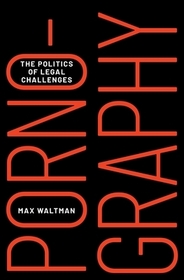
Pornography
The Politics of Legal Challenges
-
20% KEDVEZMÉNY?
- A kedvezmény csak az 'Értesítés a kedvenc témákról' hírlevelünk címzettjeinek rendeléseire érvényes.
- Kiadói listaár GBP 28.99
-
13 088 Ft (12 465 Ft + 5% áfa)
Az ár azért becsült, mert a rendelés pillanatában nem lehet pontosan tudni, hogy a beérkezéskor milyen lesz a forint árfolyama az adott termék eredeti devizájához képest. Ha a forint romlana, kissé többet, ha javulna, kissé kevesebbet kell majd fizetnie.
- Kedvezmény(ek) 20% (cc. 2 618 Ft off)
- Kedvezményes ár 10 471 Ft (9 972 Ft + 5% áfa)
- A kedvezmény érvényes eddig: 2026. június 30.
Iratkozzon fel most és részesüljön kedvezőbb árainkból!
Feliratkozom
13 088 Ft

Beszerezhetőség
Becsült beszerzési idő: A Prosperónál jelenleg nincsen raktáron, de a kiadónál igen. Beszerzés kb. 3-5 hét..
A Prosperónál jelenleg nincsen raktáron.
Why don't you give exact delivery time?
A beszerzés időigényét az eddigi tapasztalatokra alapozva adjuk meg. Azért becsült, mert a terméket külföldről hozzuk be, így a kiadó kiszolgálásának pillanatnyi gyorsaságától is függ. A megadottnál gyorsabb és lassabb szállítás is elképzelhető, de mindent megteszünk, hogy Ön a lehető leghamarabb jusson hozzá a termékhez.
A termék adatai:
- Kiadó OUP USA
- Megjelenés dátuma 2021. november 30.
- ISBN 9780197598535
- Kötéstípus Keménykötés
- Terjedelem560 oldal
- Méret 166x236x42 mm
- Súly 871 g
- Nyelv angol 150
Kategóriák
Rövid leírás:
This book offers a cutting-edge, cross-disciplinary analysis of how the explosive spread of pornography contributes to violence against women, including prostitution, while presenting a political and legal theory on how to effectively stop it. It guides the reader through fifty years of significant empirical research on the harms, including a vast array of different studies illuminating pornography's powerful impact on men, a majority of whom consume it. In a comparative analysis of legal challenges in Canada, Sweden, and the United States, it demonstrates why civil rights, not criminal laws, can empower those hurt, subordinated, and exploited while efficiently dismantling the sex industry, consistent with free speech guarantees.
TöbbHosszú leírás:
Pornography has long proven a polarizing and vexing subject in legal and feminist debates. Women's social movements have fought ferociously against pornography since the 1970s, emphasizing its contribution to violence against women. At least two to four of ten young men consume it three times or more per week. The pornography industry exploits poor populations, who are multiply and intersectionally disadvantaged based on gender, race, or other vulnerabilities. A thorough analytical review of empirical studies using complementing methods demonstrates that using pornography substantially contributes to consumers becoming more sexually aggressive, on average desensitizing them and contributing to a demand for more subordinating, aggressive, and degrading materials. Consumers are also often found wishing to imitate pornography with unwilling partners; many demand sex from prostituted people, who have few or no alternatives. While the supporting scientific evidence of harm is growing exponentially, the politics of legal challenges to pornography still constitutes an amalgam of some of the most intractable, thorny, and adversarial obstacles to change.
This book assesses American, Canadian, and Swedish legal challenges to the explosive spread of pornography within their significantly different democratic systems, and constructs a political and legal theory for effectively challenging the sex industry under law. The obstacles to this challenge are exposed as more ideological and political than strictly legal, although they often play out in the legal arena. Legal challenges to the harms are shown to be more effective under legal systems that promote equality and when the laws empower those most harmed, in contrast to state-enforced regulations (e.g., criminal obscenity laws). Drawing on feminist and intersectional theory, among others, this book argues that pornography is among the linchpins of sex inequality, contending that civil rights legislation and a civil society forum can empower those harmed with representatives who have more substantial incentives to address them.
This book explains why democracies fail to address the harms of pornography, and offers a political and legal theory for changing the status quo. These insights can be applied to other intractable problems associated with hierarchies, and will appeal profoundly to political theorists and those invested in civil and human rights.
Nothing comes close to Waltman's magisterial penetrating analysis of the law and politics of pornography today. His accessible up-to-date treatment of the empirical evidence on pornography's harms rebuts brainwashing campaigns of disinformation that pass for research. His compelling comparative accounts of pornography's hegemonic legal status and politics are unparalleled. His calm critique of democratic systems' tolerance, even embrace, of pornography in the face of its documented harms to disadvantaged groups used to make it, and targeted through its consumers, is devastating. His exploration of civil rights as a tool for democratic change offers hope. If you care about equality, or are curious about a powerful and profitable industry routinely lied about, that gets away with it; if you want to make up your own mind about this vicious force for sexual abuse hidden in plain sight, affecting us all, Waltman's book is for you.

