

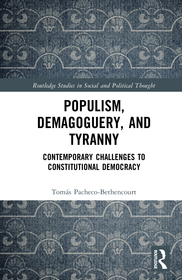
Populism, Demagoguery, and Tyranny
Contemporary Challenges to Constitutional Democracy
Sorozatcím: Routledge Studies in Social and Political Thought;
-
20% KEDVEZMÉNY?
- A kedvezmény csak az 'Értesítés a kedvenc témákról' hírlevelünk címzettjeinek rendeléseire érvényes.
- Kiadói listaár GBP 155.00
-
69 982 Ft (66 650 Ft + 5% áfa)
Az ár azért becsült, mert a rendelés pillanatában nem lehet pontosan tudni, hogy a beérkezéskor milyen lesz a forint árfolyama az adott termék eredeti devizájához képest. Ha a forint romlana, kissé többet, ha javulna, kissé kevesebbet kell majd fizetnie.
- Kedvezmény(ek) 20% (cc. 13 996 Ft off)
- Kedvezményes ár 55 986 Ft (53 320 Ft + 5% áfa)
- A kedvezmény érvényes eddig: 2026. június 30.
Iratkozzon fel most és részesüljön kedvezőbb árainkból!
Feliratkozom
62 984 Ft

Beszerezhetőség
Még nem jelent meg, de rendelhető. A megjelenéstől számított néhány héten belül megérkezik.
Why don't you give exact delivery time?
A beszerzés időigényét az eddigi tapasztalatokra alapozva adjuk meg. Azért becsült, mert a terméket külföldről hozzuk be, így a kiadó kiszolgálásának pillanatnyi gyorsaságától is függ. A megadottnál gyorsabb és lassabb szállítás is elképzelhető, de mindent megteszünk, hogy Ön a lehető leghamarabb jusson hozzá a termékhez.
A termék adatai:
- Kiadás sorszáma 1
- Kiadó Routledge
- Megjelenés dátuma 2026. július 8.
- ISBN 9781041052418
- Kötéstípus Keménykötés
- Terjedelem192 oldal
- Méret 229x152 mm
- Nyelv angol 700
Kategóriák
Rövid leírás:
This book examines the political challenges posed by populism to constitutional democracy, clarifying its impact and addressing it effectively. He combines conceptual history, history of political thought, political history and political philosophy to help analyze the political impact of populism on constitutional democracies.
TöbbHosszú leírás:
In Populism, Demagoguery, and Tyranny, Tomás Pacheco-Bethencourt examines the political challenges posed by populism to constitutional democracy, with a twofold aim of clarifying its impact and addressing it effectively. He combines conceptual history, history of political thought, political history, and political philosophy to help analyze the political impact of populism on constitutional democracies.
Pacheco-Bethencourt begins his analysis by demonstrating that lessons can be learned by bringing ancient Greece’s institutional framework to the discussion. It was during this time that republican procedures and practices of constitutionalism were born, explored, and refined by new oversight strategies. To underpin the argument, Pacheco-Bethencourt dives into examples of populist movements in Argentina, Venezuela, Hungary, Poland, France, and Spain to establish how the theory and real politics meet. It is here that the connection between populist rhetoric and political opportunism is exemplified. Politicians use populism as a tool to strategically reach power or push their political agenda, bridging strategy and politics. Opportunism has an ethical dimension that has to do with self-serving actions and willingness to deceive, akin to what could be compared to the negative connotations of classical demagoguery, also explored herein.
This book will be of great interest to researchers studying populism and its future in modern politics, in addition to undergraduate and postgraduate students of populist rhetoric.
TöbbTartalomjegyzék:
Introduction. Part I: Unravelling Populism: Genealogy and Enduring Themes 1. Mapping European Populism: The Narodnichestvo and the Völkisch Movements in the Russian Empire and Germany 2. Contemporary Populism: Evolving Theories for a Shifting Landscape Part II: Foreseeing Tyranny: The Constitution of the Athenians and the Legacies of Republicanism 3. Lessons from Ancient Athens: The Demagogue and the Politeia 4. Two Legacies of Republicanism Part III: The Populist, the Demagogue, and the Constitution 5. Preventing Authoritarianism: Constitutional Provisions and Populist Rhetoric 6. The Ethos of Political Opportunism: Populist Rhetoric in Europe. Conclusions
Több

