

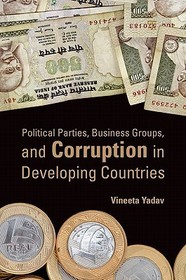
Political Parties, Business Groups, and Corruption in Developing Countries
-
10% KEDVEZMÉNY?
- A kedvezmény csak az 'Értesítés a kedvenc témákról' hírlevelünk címzettjeinek rendeléseire érvényes.
- Kiadói listaár GBP 32.49
-
14 669 Ft (13 970 Ft + 5% áfa)
Az ár azért becsült, mert a rendelés pillanatában nem lehet pontosan tudni, hogy a beérkezéskor milyen lesz a forint árfolyama az adott termék eredeti devizájához képest. Ha a forint romlana, kissé többet, ha javulna, kissé kevesebbet kell majd fizetnie.
- Kedvezmény(ek) 10% (cc. 1 467 Ft off)
- Kedvezményes ár 13 202 Ft (12 573 Ft + 5% áfa)
Iratkozzon fel most és részesüljön kedvezőbb árainkból!
Feliratkozom
14 669 Ft

Beszerezhetőség
Megrendelésre a kiadó utánnyomja a könyvet. Rendelhető, de a szokásosnál kicsit lassabban érkezik meg.
Why don't you give exact delivery time?
A beszerzés időigényét az eddigi tapasztalatokra alapozva adjuk meg. Azért becsült, mert a terméket külföldről hozzuk be, így a kiadó kiszolgálásának pillanatnyi gyorsaságától is függ. A megadottnál gyorsabb és lassabb szállítás is elképzelhető, de mindent megteszünk, hogy Ön a lehető leghamarabb jusson hozzá a termékhez.
A termék adatai:
- Kiadó OUP USA
- Megjelenés dátuma 2011. május 5.
- ISBN 9780199735914
- Kötéstípus Puhakötés
- Terjedelem288 oldal
- Méret 231x155x20 mm
- Súly 386 g
- Nyelv angol
- Illusztrációk 49 black and white illustrations 0
Kategóriák
Rövid leírás:
In Political Parties, Business Groups, and Corruption in Developing Countries, Vineeta Yadav examines corruption levels in sixty-four developing democracies over a twenty-year period, with a comparative focus on Brazil and India.
TöbbHosszú leírás:
Political corruption is one of the globe's most pressing yet seemingly permanent problems. It is a root cause of low growth and inequality, and plagues numerous nations throughout the world in varying degrees. In the past, it proved difficult to measure, and the political science literature on it was thin. In recent years, political scientists have greatly improved their analytical tools for analyzing and contextualizing corruption, and it is now a hot topic in the discipline.
In Political Parties, Business Groups, and Corruption in Developing Countries, Vineeta Yadav examines corruption levels in sixty-four developing democracies over a twenty-year period. Her comparative focus is on Brazil and India, two of the most important developing nations. Drawing from a 2005-06 survey of Brazilian and Indian businesses that she conducted, Yadav finds that legislative institutions are central in determining the degree and type of corruption. Most importantly, in legislatures where the party holds sway (as opposed to individual legislators), the level of corruption is higher. Party costs are higher than that of any one legislator, which explains part of the difference. More fundamentally, the fact that different systems offer different incentives to business groups and legislatures explains why some systems are less corrupt than others. Given structural variation across democratic political systems, her book allows to predict which states are most susceptible to political corruption, and which reforms might best alleviate the problem.
Vineeta Yadav's book is full of brilliant insights, fascinating paradoxes, and compelling empirical narratives about corruption and lobbying Brazil, India, and other developing countries. Counter-intuitively, Yadav finds that strong political parties in developing country democracies can lead firms' lobbying efforts to tend toward political corruption. Yadav's book is essential reading for scholars, policy makers, and managers who do business in emerging markets.
Tartalomjegyzék:
Acknowledgements
1 Introduction
2 Institutions, Lobbying and Corruption: A Theoretical Framework
3 Case Studies: Legislative Institutions in Brazil and India
4 Brazil and India: Legislative Institutions and Lobbying Behavior
5 Brazil and India: Business Lobbying and Corruption
6 Institutions, Party Control and Corruption: The Empirical Evidence
7 Conclusion
References
Appendix

