

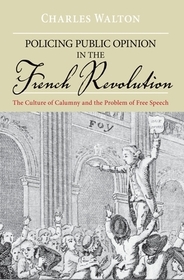
Policing Public Opinion in the French Revolution
The Culture of Calumny and the Problem of Free Speech
-
10% KEDVEZMÉNY?
- A kedvezmény csak az 'Értesítés a kedvenc témákról' hírlevelünk címzettjeinek rendeléseire érvényes.
- Kiadói listaár GBP 36.49
-
16 475 Ft (15 690 Ft + 5% áfa)
Az ár azért becsült, mert a rendelés pillanatában nem lehet pontosan tudni, hogy a beérkezéskor milyen lesz a forint árfolyama az adott termék eredeti devizájához képest. Ha a forint romlana, kissé többet, ha javulna, kissé kevesebbet kell majd fizetnie.
- Kedvezmény(ek) 10% (cc. 1 648 Ft off)
- Kedvezményes ár 14 827 Ft (14 121 Ft + 5% áfa)
Iratkozzon fel most és részesüljön kedvezőbb árainkból!
Feliratkozom
16 475 Ft

Beszerezhetőség
Megrendelésre a kiadó utánnyomja a könyvet. Rendelhető, de a szokásosnál kicsit lassabban érkezik meg.
Why don't you give exact delivery time?
A beszerzés időigényét az eddigi tapasztalatokra alapozva adjuk meg. Azért becsült, mert a terméket külföldről hozzuk be, így a kiadó kiszolgálásának pillanatnyi gyorsaságától is függ. A megadottnál gyorsabb és lassabb szállítás is elképzelhető, de mindent megteszünk, hogy Ön a lehető leghamarabb jusson hozzá a termékhez.
A termék adatai:
- Kiadó OUP USA
- Megjelenés dátuma 2011. augusztus 11.
- ISBN 9780199795802
- Kötéstípus Puhakötés
- Terjedelem352 oldal
- Méret 234x156x18 mm
- Súly 490 g
- Nyelv angol
- Illusztrációk 11 hts 0
Kategóriák
Rövid leírás:
This study traces the problem of free speech from the Old Regime to the French Revolution, showing how longstanding obsessions with honour, religion, and morality persisted after the declaration of free speech in 1789, contributed to the Revolution's radicalization and, eventually, the Terror of 1793-1794.
TöbbHosszú leírás:
In the 1789 Declaration of the Rights of Man and of the Citizen, French revolutionaries proclaimed the freedom of speech, religion, and opinion. Censorship was abolished, and France appeared to be on a path towards tolerance, pluralism, and civil liberties. A mere four years later, the country descended into a period of political terror, as thousands were arrested, tried, and executed for crimes of expression and opinion.
In Policing Public Opinion in the French Revolution, Charles Walton traces the origins of this reversal back to the Old Regime. He shows that while early advocates of press freedom sought to abolish pre-publication censorship, the majority still firmly believed injurious speech--or calumny-constituted a crime, even treason if it undermined the honor of sovereign authority or sacred collective values, such as religion and civic spirit.
With the collapse of institutions responsible for regulating honor and morality in 1789, calumny proliferated, as did obsessions with it. Drawing on wide-ranging sources, from National Assembly debates to local police archives, Walton shows how struggles to set legal and moral limits on free speech led to the radicalization of politics, and eventually to the brutal liquidation of "calumniators" and fanatical efforts to rebuild society's moral foundation during the Terror of 1793-1794.
With its emphasis on how revolutionaries drew upon cultural and political legacies of the Old Regime, this study sheds new light on the origins of the Terror and the French Revolution, as well as the history of free expression.
extensive argument and analysis
Tartalomjegyzék:
Introduction
Part I: The Old Regime
Policing in the Old Regime
The Culture of Calumny and Honour
Press Freedom and Limits in the Enlightenment
From the Cahiers de doléances to the Declaration of Rights
Part II: The French Revolution
From Lèse-nation to the Law of Suspects: Legislating Limits
Oaths, Honour, and the Sacred Foundations of Authority
From Local Repression to High Justice: Limits in Action
Policing the Moral Limits: Public Spirit, Surveillance, and the Remaking of Meurs
Conclusion
Works Cited
Index

