

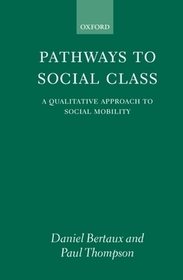
Pathways to Social Class
A Qualitative Approach to Social Mobility
-
10% KEDVEZMÉNY?
- A kedvezmény csak az 'Értesítés a kedvenc témákról' hírlevelünk címzettjeinek rendeléseire érvényes.
- Kiadói listaár GBP 137.50
-
65 690 Ft (62 562 Ft + 5% áfa)
Az ár azért becsült, mert a rendelés pillanatában nem lehet pontosan tudni, hogy a beérkezéskor milyen lesz a forint árfolyama az adott termék eredeti devizájához képest. Ha a forint romlana, kissé többet, ha javulna, kissé kevesebbet kell majd fizetnie.
- Kedvezmény(ek) 10% (cc. 6 569 Ft off)
- Kedvezményes ár 59 121 Ft (56 306 Ft + 5% áfa)
Iratkozzon fel most és részesüljön kedvezőbb árainkból!
Feliratkozom
65 690 Ft

Beszerezhetőség
Megrendelésre a kiadó utánnyomja a könyvet. Rendelhető, de a szokásosnál kicsit lassabban érkezik meg.
Why don't you give exact delivery time?
A beszerzés időigényét az eddigi tapasztalatokra alapozva adjuk meg. Azért becsült, mert a terméket külföldről hozzuk be, így a kiadó kiszolgálásának pillanatnyi gyorsaságától is függ. A megadottnál gyorsabb és lassabb szállítás is elképzelhető, de mindent megteszünk, hogy Ön a lehető leghamarabb jusson hozzá a termékhez.
A termék adatai:
- Kiadó OUP Oxford
- Megjelenés dátuma 1997. január 16.
- ISBN 9780198279310
- Kötéstípus Keménykötés
- Terjedelem344 oldal
- Méret 225x144x23 mm
- Súly 524 g
- Nyelv angol
- Illusztrációk figures, tables 0
Kategóriák
Rövid leírás:
A group of leading sociologists present a new and compelling analysis of social mobility, one of the central topics in contemporary sociology.
TöbbHosszú leírás:
Calling for a broader, new approach to social mobility research, Daniel Bertaux and Paul Thompson here move beyond pure statistics to use qualitative techniques - such as life stories and family case studies - to examine more closely the dynamics of mobility and address more fundamental sociological questions.
Up to now, the extensive sociological literature on mobility has been based around the survey method. As a result, we have access to abundant statistical data, but there is little information available to explain how and why people follow particular life paths. To overcome these limitations, the authors have developed an alternative, complementary approach using life stories, case histories of whole families over several generations, or case studies of local communities. Employing the case-study approach does not prevent the identification of structural trends; on the contrary, it allows us to analyse those collective processes through their local effects, restoring the links with the classics of sociological thought.
The authors, together with a group of researchers who have worked closely with them, tackle problems such as:
- What exactly is transmitted between generations: is it wealth or land, occupational models or skills, social networks, or values and orientations?
- What kind of assets can immigrants draw on?
- How can a social elite survive the upheaval of a popular revolution?
- What is the impact of marriage on the mobility of men and women?
- How far can belonging to one locality rather than another, or choosing a particular house, shape mobility paths and aspirations?
- Do dreams of mobility matter?
The many studies make poetic and insightful reading about family trajectories through changing circumstances and hardships, but also about the capacity of cultural and material resources to reinvent themselves to continue to serve, mostly those that already have. The iron-law of social reproduction is reaffirmed, but with new twists and with the parameters for maneuver within it widened ... This book passionately presents a set of stories rich in both structural analysis and personal compassion. Methodology, like the study of identity, should not be couched in the straight jacket of a discourse of 'either - or', but in a more open and ultimately more enlightening and tolerant logic of 'both - and'. This book is a testament not only to how difficult it is to carry out that project in practice, but also to how worthwhile it is to try.

