

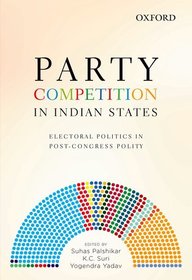
Party Competition in Indian States
Electoral Politics in Post-Congress Polity
-
10% KEDVEZMÉNY?
- A kedvezmény csak az 'Értesítés a kedvenc témákról' hírlevelünk címzettjeinek rendeléseire érvényes.
- Kiadói listaár GBP 45.99
-
20 764 Ft (19 775 Ft + 5% áfa)
Az ár azért becsült, mert a rendelés pillanatában nem lehet pontosan tudni, hogy a beérkezéskor milyen lesz a forint árfolyama az adott termék eredeti devizájához képest. Ha a forint romlana, kissé többet, ha javulna, kissé kevesebbet kell majd fizetnie.
- Kedvezmény(ek) 10% (cc. 2 076 Ft off)
- Kedvezményes ár 18 687 Ft (17 798 Ft + 5% áfa)
Iratkozzon fel most és részesüljön kedvezőbb árainkból!
Feliratkozom
20 764 Ft

Beszerezhetőség
Csak rendelésre kapható a kiadónál, kissé időigényes.
Why don't you give exact delivery time?
A beszerzés időigényét az eddigi tapasztalatokra alapozva adjuk meg. Azért becsült, mert a terméket külföldről hozzuk be, így a kiadó kiszolgálásának pillanatnyi gyorsaságától is függ. A megadottnál gyorsabb és lassabb szállítás is elképzelhető, de mindent megteszünk, hogy Ön a lehető leghamarabb jusson hozzá a termékhez.
A termék adatai:
- Kiadó OUP India
- Megjelenés dátuma 2014. május 22.
- ISBN 9780198099178
- Kötéstípus Keménykötés
- Terjedelem600 oldal
- Méret 223x147x45 mm
- Súly 772 g
- Nyelv angol
- Illusztrációk 9 line drawings 0
Kategóriák
Rövid leírás:
This volume presents the picture of competitive politics in as many as 24 states of India. It addresses the issue of relationship between parliamentary election and assembly election as it evolved during 2008-2013. Making the best use of the National Election Study of 2009, the chapters in the book open before the reader the different patterns of party competition at the state level. The main objective of the book is to contribute to the understanding of electoral politics in Indian states.
TöbbHosszú leírás:
Ever since the Congress system finally collapsed and the post-Congress polity emerged in 1989, state has arisen as the most crucial terrain at which electoral outcomes are shaped. This book presents analyses of electoral politics in 24 states of India during the period 2008-2013. This period is of great interest because in the post-2004 period, Congress started adapting itself to the compulsions of the post-Congress polity and survive as one of the competitors in electoral politics. In a sense, the period under study here is the period of a stable post-Congress polity. Apart from the parliamentary election of 2009 that brought the Congress-led UPA back to power with an increased strength of the Congress party, this period also witnessed assembly elections in each of the states discussed here. The chapters look both at the Parliamentary election of 2009 and the Assembly election from each state to investigate how the two impact each other and what broader patterns emerge from their interaction. While the all-India picture of competitive politics presented the picture of routineness of electoral competition, many states threw up characteristics of a much more fluid competitive politics. This volume brings out this complex pattern of electoral politics at the state level and seeks to contribute to our understanding of state level political processes by using the rich data set of post-election surveys done by the Centre for the Study of Developing Societies, New Delhi over the years.
TöbbTartalomjegyzék:
Preface
Acknowledgements
List of Tables
List of Abbreviations
Introduction: Normalization of the 'Post-Congress Polity'
Suhas Palshikar, K.C. Suri and Yogendra Yadav
Between fortuna and virtu: Explaining Congress' ambiguous victory in 2009
Yogendra Yadav and Suhas Palshikar
Modi's Political Craft and Limping Congress
Ghanshyam Shah and Mahashweta Jani
Rajasthan: Stable Two-party competition
Sanjay Lodha
Punjab: Towards Consolidation of a Bipolar Polity
Ashutosh Kumar and Jagroop Singh Sekhon
Congress win reverses the trend of Lok Sabha Elections in Haryana
Kushal Pal and Praveen Rai
Himachal Pradesh: Continued Bi-party competition
Shreyas Sardesai
2009 Parliamentary Elections in Jammu and Kashmir
Rekha Chowdhary
Delhi Elections: Mandate for Policy Consonance
Biswajit Mohanty
Uttarakhand: Resurgence of the Congress
Annpurna Nautiyal
Uttar Pradesh: The ebb and flow of party support
Mirza Asmer Beg, Sudhir Kumar and A.K. Verma
Bihar: Development finally delivered
Sanjay Kumar and Rakesh Ranjan
Permanent Incumbency Shattered: Development dilemma and electoral choice in West Bengal
Jyotiprasad Chatterjee and Suprio Basu
Sikkim: A case of dominance of the ruling party
Banasmita Bora
Arunachal Pradesh: Ruling Party Syndrome
Nani Bath
Nagaland: Electoral Politics amidst Insurgency
Amongla N. Jamir
Meghalaya's Fluid Party Alignments
R.K. Satapathy
Triumph for Congress in Assam
Sandhya Goswami
Jharkhand: Defies the National Trend
Harishwar Dayal and B. K. Sinha
Madhya Pradesh: Unexpected Gains for Congress
Yatindra Singh Sisodia
Chief Minister Wins Chhattisgarh for BJP
Anupama Saxena and Pravin Rai
Survival in the Midst of Decline: A Decade (1999-2009) of Congress Rule in Maharashtra
Suhas Palshikar, Rajeshwari Deshpande and Nitin Birmal
Goa: Decline of the North-South Divide?
Maria Do Ceu Rodrigues
Karnataka -2008-09: BJP penetrates the South
Sandeep Shastri and Veena Devi
Andhra Pradesh: Political shifts and electoral volatility
K.C. Suri, P. Narasimha Rao and V. Anji Reddy
Kerala's Electoral Pendulum Swings Back and Forth
K.M. Sajad Ibrahim
Appendix I
Appendix 2
CIndex
About the Editors and Contributors

