

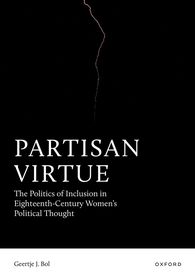
Partisan Virtue
The Politics of Inclusion in Eighteenth-Century Women’s Political Thought
-
10% KEDVEZMÉNY?
- A kedvezmény csak az 'Értesítés a kedvenc témákról' hírlevelünk címzettjeinek rendeléseire érvényes.
- Kiadói listaár GBP 88.00
-
39 732 Ft (37 840 Ft + 5% áfa)
Az ár azért becsült, mert a rendelés pillanatában nem lehet pontosan tudni, hogy a beérkezéskor milyen lesz a forint árfolyama az adott termék eredeti devizájához képest. Ha a forint romlana, kissé többet, ha javulna, kissé kevesebbet kell majd fizetnie.
- Kedvezmény(ek) 10% (cc. 3 973 Ft off)
- Kedvezményes ár 35 759 Ft (34 056 Ft + 5% áfa)
Iratkozzon fel most és részesüljön kedvezőbb árainkból!
Feliratkozom
39 732 Ft

Beszerezhetőség
Még nem jelent meg, de rendelhető. A megjelenéstől számított néhány héten belül megérkezik.
Why don't you give exact delivery time?
A beszerzés időigényét az eddigi tapasztalatokra alapozva adjuk meg. Azért becsült, mert a terméket külföldről hozzuk be, így a kiadó kiszolgálásának pillanatnyi gyorsaságától is függ. A megadottnál gyorsabb és lassabb szállítás is elképzelhető, de mindent megteszünk, hogy Ön a lehető leghamarabb jusson hozzá a termékhez.
A termék adatai:
- Kiadó OUP Oxford
- Megjelenés dátuma 2026. július 1.
- ISBN 9780198989349
- Kötéstípus Keménykötés
- Terjedelem192 oldal
- Méret 234x156 mm
- Nyelv angol 700
Kategóriák
Rövid leírás:
Partisan Virtue focuses on two women political thinkers from opposite ends of the political spectrum: the Tory conservative and early feminist Mary Astell and the historian and radical republican Catharine Macaulay.
TöbbHosszú leírás:
Historians of political thought interested in partisanship have long privileged the perspective of male canonical thinkers. Scholars have turned to Thucydides and Plato for insights on stasis, Aristotle on civic friendship, Niccolò Machiavelli on tumults, David Hume and Edmund Burke on political parties, and The Federalist on faction. Even political theorists who are primarily concerned with contemporary theories of partisanship often turn to these “usual suspects” to strengthen their otherwise largely non-historical arguments. Yet this narrow focus on canonical men has led scholars to neglect an important if counterintuitive perspective on partisanship which we find in the political thought of eighteenth-century women, for whom partisanship offered an unexpected but essential means to political inclusion.
Partisan Virtue focuses on two such women political thinkers from opposite ends of the political spectrum: the Tory conservative and early feminist Mary Astell and the historian and radical republican Catharine Macaulay. Their identity as women and partisans placed them on the margins of politics--neither fully excluded nor included. As women, they were not allowed to hold public office or cast votes. Yet they were nonetheless partisans who belonged to a political group and intervened in the principal debates of their time. This marginal position enabled Astell and Macaulay to appreciate both the benefits of partisanship as a mechanism of political inclusion for those formally excluded from politics--a mechanism their male contemporaries ignored--and the dangers of the political virtues these men advocated to bridle partisanship.
The book argues that the approach to political ethics that emerges from Astell and Macaulay's works should be of continuing interest to contemporary political theorists. Not only does it speak more satisfactorily to current political concerns about polarisation and echo chambers, but theirs is a far more inclusive kind of partisanship than the one offered by their male contemporaries and present-day scholars. It does not ask of people on the margins to get rid of their anger, indignation, or righteousness, before becoming partisans. Instead, Astell and Macaulay embrace these features, and recognise that partisanship, when done right, is precisely the vehicle for the political inclusion of those on the margins.

