

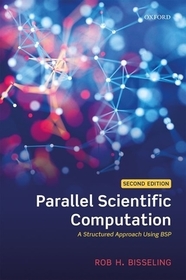
Parallel Scientific Computation
A Structured Approach Using BSP
-
10% KEDVEZMÉNY?
- A kedvezmény csak az 'Értesítés a kedvenc témákról' hírlevelünk címzettjeinek rendeléseire érvényes.
- Kiadói listaár GBP 48.49
-
21 893 Ft (20 850 Ft + 5% áfa)
Az ár azért becsült, mert a rendelés pillanatában nem lehet pontosan tudni, hogy a beérkezéskor milyen lesz a forint árfolyama az adott termék eredeti devizájához képest. Ha a forint romlana, kissé többet, ha javulna, kissé kevesebbet kell majd fizetnie.
- Kedvezmény(ek) 10% (cc. 2 189 Ft off)
- Kedvezményes ár 19 703 Ft (18 765 Ft + 5% áfa)
Iratkozzon fel most és részesüljön kedvezőbb árainkból!
Feliratkozom
21 893 Ft

Beszerezhetőség
Megrendelésre a kiadó utánnyomja a könyvet. Rendelhető, de a szokásosnál kicsit lassabban érkezik meg.
Why don't you give exact delivery time?
A beszerzés időigényét az eddigi tapasztalatokra alapozva adjuk meg. Azért becsült, mert a terméket külföldről hozzuk be, így a kiadó kiszolgálásának pillanatnyi gyorsaságától is függ. A megadottnál gyorsabb és lassabb szállítás is elképzelhető, de mindent megteszünk, hogy Ön a lehető leghamarabb jusson hozzá a termékhez.
A termék adatai:
- Kiadás sorszáma 2
- Kiadó OUP Oxford
- Megjelenés dátuma 2020. szeptember 30.
- ISBN 9780198788355
- Kötéstípus Puhakötés
- Terjedelem410 oldal
- Méret 234x155x19 mm
- Súly 660 g
- Nyelv angol 33
Kategóriák
Rövid leírás:
Parallel Scientific Computation presents a methodology for designing parallel algorithms and writing parallel computer programs for modern computer architectures with multiple processors.
TöbbHosszú leírás:
Building upon the wide-ranging success of the first edition, Parallel Scientific Computation presents a single unified approach to using a range of parallel computers, from a small desktop computer to a massively parallel computer. The author explains how to use the bulk synchronous parallel (BSP) model to design and implement parallel algorithms in the areas of scientific computing and big data, and provides a full treatment of core problems in these areas, starting from a high-level problem description, via a sequential solution algorithm to a parallel solution algorithm and an actual parallel program written in BSPlib.
Every chapter of the book contains a theoretical section and a practical section presenting a parallel program and numerical experiments on a modern parallel computer to put the theoretical predictions and cost analysis to the test. Every chapter also presents extensive bibliographical notes with additional discussions and pointers to relevant literature, and numerous exercises which are suitable as graduate student projects.
The second edition provides new material relevant for big-data science such as sorting and graph algorithms, and it provides a BSP approach towards new hardware developments such as hierarchical architectures with both shared and distributed memory. A single, simple hybrid BSP system suffices to handle both types of parallelism efficiently, and there is no need to master two systems, as often happens in alternative approaches. Furthermore, the second edition brings all algorithms used up to date, and it includes new material on high-performance linear system solving by LU decomposition, and improved data partitioning for sparse matrix computations.
The book is accompanied by a software package BSPedupack, freely available online from the author's homepage, which contains all programs of the book and a set of test driver programs. This package written in C can be run using modern BSPlib implementations such as MulticoreBSP for C or BSPonMPI.
The author presents a detailed study describing how parallel computation can be applied to a collection of numerical problems. He considers LU decomposition of dense matrices, the fast Fourier transform (FFT), multiplication of a sparse matrix by a dense vector, as well as matching vertices in a sparse graph and sorting. He uses these to teach design and implementation of well-structured efficient parallel algorithms...The book is best suited for a graduate course in parallel scientific processing for mathematics or computer science students.

