

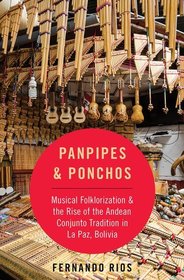
Panpipes & Ponchos
Musical Folklorization and the Rise of the Andean Conjunto Tradition in La Paz, Bolivia
Sorozatcím: Currents in Latin American and Iberian Music;
-
10% KEDVEZMÉNY?
- A kedvezmény csak az 'Értesítés a kedvenc témákról' hírlevelünk címzettjeinek rendeléseire érvényes.
- Kiadói listaár GBP 102.50
-
46 278 Ft (44 075 Ft + 5% áfa)
Az ár azért becsült, mert a rendelés pillanatában nem lehet pontosan tudni, hogy a beérkezéskor milyen lesz a forint árfolyama az adott termék eredeti devizájához képest. Ha a forint romlana, kissé többet, ha javulna, kissé kevesebbet kell majd fizetnie.
- Kedvezmény(ek) 10% (cc. 4 628 Ft off)
- Kedvezményes ár 41 651 Ft (39 668 Ft + 5% áfa)
Iratkozzon fel most és részesüljön kedvezőbb árainkból!
Feliratkozom
46 278 Ft

Beszerezhetőség
Megrendelésre a kiadó utánnyomja a könyvet. Rendelhető, de a szokásosnál kicsit lassabban érkezik meg.
Why don't you give exact delivery time?
A beszerzés időigényét az eddigi tapasztalatokra alapozva adjuk meg. Azért becsült, mert a terméket külföldről hozzuk be, így a kiadó kiszolgálásának pillanatnyi gyorsaságától is függ. A megadottnál gyorsabb és lassabb szállítás is elképzelhető, de mindent megteszünk, hogy Ön a lehető leghamarabb jusson hozzá a termékhez.
A termék adatai:
- Kiadó OUP USA
- Megjelenés dátuma 2020. október 22.
- ISBN 9780190692278
- Kötéstípus Keménykötés
- Terjedelem296 oldal
- Méret 241x159x20 mm
- Súly 567 g
- Nyelv angol
- Illusztrációk 7 music examples 48
Kategóriák
Rövid leírás:
Panpipes and Ponchos offers the first detailed historical study of the Bolivian folkloric music movement, showing how musical practices developed by the politically dominant, nonindigenous residents of twentieth-century La Paz city came to be misrepresented as pre-Columbian, indigenous folk music.
TöbbHosszú leírás:
Melodious panpipes and kena flutes. The shimmering strums of a charango. Poncho-clad musicians playing "El Cóndor Pasa" at subway stops or street corners while selling their recordings. These sounds and images no doubt come to mind for many "world music" fans when they recall their early encounters with Andean music groups. Ensembles of this type — known as "Andean conjuntos" or "pan-Andean bands" — have long formed part of the world music circuit in the Global North. In the major cities of Latin America, too, Andean conjuntos have been present in the local music scene for decades, not only in Peru, Bolivia, and Ecuador (i.e., in the Andean countries), but also in Argentina, Chile, Colombia, and Mexico. It is solely in Bolivia, however, that the Andean conjunto has represented the preeminent folkloric-popular music ensemble configuration for interpreting national musical genres from the late 1960s onward.
Despite its frequent association with indigenous villages, the music of Andean conjuntos bears little resemblance to the indigenous musical expressions of the Southern Andes. Created by urban criollo and mestizo folkloric artists, the Andean conjunto tradition represents a form of mass-mediated folkloric music, one that is only loosely based on indigenous musical practices. Panpipes & Ponchos reveals that in the early-to-mid 20th century, a diverse range of musicians and ensembles, including estudiantinas, female vocal duos, bolero trios, art-classical composers, and mestizo panpipe groups, laid the groundwork for the Andean conjunto format to eventually take root in the Bolivian folklore scene amid the boom decade of the 1960s. Author Fernando Rios analyzes local musical trends in conjunction with government initiatives in nation-building and the ideologies of indigenismo and mestizaje. Beyond the local level, Rios also examines key developments in Bolivian national musical practices through their transnational links with trends in Peru, Argentina, Chile, Mexico, and France. As the first book-length study that chronicles how Bolivia's folkloric music movement articulated, on the one hand, with Bolivian state projects, and on the other, with transnational artistic currents, for the pivotal era spanning the 1920s to 1960s, Panpipes & Ponchos offers new perspectives on the Andean conjunto's emergence as Bolivia's favored ensemble line-up in the field of national folkloric-popular music.
Fernando Rios' meticulously researched and fascinating history is an indispensable resource for understanding how Andean folk music came to take the world by storm. Although powerfully invoking ideas and images of indigenous Andean culture, Panpipes and Ponchos demonstrates that the conjunto (with its standard line-up of kena flute, charango, guitar, bombo drum, and later panpipes) was thoroughly transnational, middle class, and rooted in Bolivia's turbulent twentieth-century history.
Tartalomjegyzék:
Acknowledgments
Chapter 1: Introduction
Part One - Foundations of the Bolivian Folkloric Music Movement
Chapter 2: Musical Dimensions of Indigenismo
Chapter 3: Estudiantinas and Female Vocal Duos
Part Two - Musical Folklorization in the Period of Revolutionary Nationalism (1952-1964)
Chapter 4: State-Sponsored Folklorization of Music-Dance Traditions in the MNR Era
Chapter 5: Bolero Trios, Urban Mestizo Panpipe Groups, and Early Incarnations of the Andean Conjunto
Part Three - The Folklore Boom and Its Legacies
Chapter 6: 1965, The Onset of the Folkloric Music Boom
Chapter 7: Los Jairas, Peña Naira, and the Folklore Boom
Chapter 8: Postlude
References
Index

