

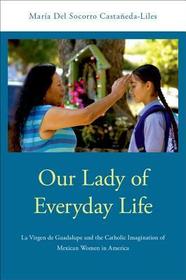
Our Lady of Everyday Life
La Virgen de Guadalupe and the Catholic Imagination of Mexican Women in America
-
10% KEDVEZMÉNY?
- A kedvezmény csak az 'Értesítés a kedvenc témákról' hírlevelünk címzettjeinek rendeléseire érvényes.
- Kiadói listaár GBP 122.50
-
55 308 Ft (52 675 Ft + 5% áfa)
Az ár azért becsült, mert a rendelés pillanatában nem lehet pontosan tudni, hogy a beérkezéskor milyen lesz a forint árfolyama az adott termék eredeti devizájához képest. Ha a forint romlana, kissé többet, ha javulna, kissé kevesebbet kell majd fizetnie.
- Kedvezmény(ek) 10% (cc. 5 531 Ft off)
- Kedvezményes ár 49 778 Ft (47 408 Ft + 5% áfa)
Iratkozzon fel most és részesüljön kedvezőbb árainkból!
Feliratkozom
55 308 Ft

Beszerezhetőség
Megrendelésre a kiadó utánnyomja a könyvet. Rendelhető, de a szokásosnál kicsit lassabban érkezik meg.
Why don't you give exact delivery time?
A beszerzés időigényét az eddigi tapasztalatokra alapozva adjuk meg. Azért becsült, mert a terméket külföldről hozzuk be, így a kiadó kiszolgálásának pillanatnyi gyorsaságától is függ. A megadottnál gyorsabb és lassabb szállítás is elképzelhető, de mindent megteszünk, hogy Ön a lehető leghamarabb jusson hozzá a termékhez.
A termék adatai:
- Kiadó OUP USA
- Megjelenés dátuma 2018. április 26.
- ISBN 9780190280390
- Kötéstípus Keménykötés
- Terjedelem298 oldal
- Méret 163x236x22 mm
- Súly 641 g
- Nyelv angol 0
Kategóriák
Rövid leírás:
Our Lady of Everyday Life is an ethnographic study of three generations of Mexican origin women (college students, mothers, and older women) and their experiences growing up Catholic. The book focuses on their relationship with Our Lady of Guadalupe as central to what Casta--eda-Liles calls their "Mexican Catholic imagination."
TöbbHosszú leírás:
Our Lady of Everyday Life examines the lived religion, from childhood to adulthood, of three generations of Mexican-origin Catholic women. The book provides an in-depth analysis of the Catholic beliefs that the women in this study inherited from their mothers, and the ways these beliefs become the religious/cultural template from which they first learn to see themselves as people of faith. Our Lady of Everyday Life also offers a comprehensive analysis of the ways Catholic culture sets the parameters within which Mexican-origin women learn how to be good girls in a manner that reduces a girl's agency to rubble. Casta--eda-Liles demonstrates how women develop a type of Mexican Catholic imagination that moves them to challenge and reject the sanctification of shame, guilt, and aguante (endurance at all cost). This imagination allows these women to transgress limiting notions of what a good Catholic woman should be while retaining the aspects of Catholicism they find life-givingwhile still identifying as Catholics. This transgression is most visible in their relationship to La Virgen de Guadalupe, which is not fixed but fluid and deeply engaged in their process of self-awareness in everyday life.
Our Lady of Everyday Life applies an intersectional analysis that centers religion along with race, class, gender, and sexuality to the study of women. This ethnography provides an in-depth cross-sectional analysis of three generations of Mexican-origin women between the ages of 18 and 82 (single and in college, mothers and older women). It is a multi-method study, including structured and unstructured interviews, focus groups, photographic and video documentation, and participant observation in M--xico and the United States.
An important work, sure to stimulate wide-ranging discussion, this book would be as valuable in courses on theory and method for religious studies as for courses on American religion, Mariology, Latinx religion, or religion and gender.
Tartalomjegyzék:
Acknowledgments
Introduction
Chapter 1: "Here It Is Told"
Chapter 2: Our Lady of Caf-- con Leche: The Social Construction of Catholic Devotion
Chapter 3: Catholicizing Girlhood: Socializing Girls into Institutional Catholicism
Chapter 4: The Making of Girls in the Mexican Catholic Imagination: Obedience, Respect, and Responsibility
Chapter 5: Becoming Se--oritas: If You Can't Talk About in Church, You Can't Talk About It Anywhere
Chapter 6: Our Lady of Everyday Life
Chapter 7: Perceptions of Our Lady of Guadalupe's Relationship to Feminism: "The Time is Now"
Chapter 8: Why do they paint her this way? She is our mother
Conclusion
Appendix
Notes
Bibliography

