

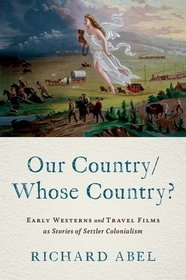
Our Country/Whose Country?
Early Westerns and Travel Films as Stories of Settler Colonialism
-
10% KEDVEZMÉNY?
- A kedvezmény csak az 'Értesítés a kedvenc témákról' hírlevelünk címzettjeinek rendeléseire érvényes.
- Kiadói listaár GBP 75.00
-
33 862 Ft (32 250 Ft + 5% áfa)
Az ár azért becsült, mert a rendelés pillanatában nem lehet pontosan tudni, hogy a beérkezéskor milyen lesz a forint árfolyama az adott termék eredeti devizájához képest. Ha a forint romlana, kissé többet, ha javulna, kissé kevesebbet kell majd fizetnie.
- Kedvezmény(ek) 10% (cc. 3 386 Ft off)
- Kedvezményes ár 30 476 Ft (29 025 Ft + 5% áfa)
Iratkozzon fel most és részesüljön kedvezőbb árainkból!
Feliratkozom
33 862 Ft

Beszerezhetőség
Megrendelésre a kiadó utánnyomja a könyvet. Rendelhető, de a szokásosnál kicsit lassabban érkezik meg.
Why don't you give exact delivery time?
A beszerzés időigényét az eddigi tapasztalatokra alapozva adjuk meg. Azért becsült, mert a terméket külföldről hozzuk be, így a kiadó kiszolgálásának pillanatnyi gyorsaságától is függ. A megadottnál gyorsabb és lassabb szállítás is elképzelhető, de mindent megteszünk, hogy Ön a lehető leghamarabb jusson hozzá a termékhez.
A termék adatai:
- Kiadó OUP USA
- Megjelenés dátuma 2024. február 12.
- ISBN 9780197744048
- Kötéstípus Keménykötés
- Terjedelem254 oldal
- Méret 156x235x18 mm
- Súly 494 g
- Nyelv angol
- Illusztrációk 50 B&W halftones 478
Kategóriák
Rövid leírás:
This book offers an original analysis of early westerns and travel pictures through the lens of settler colonialism, exploring their remarkable vision of white settlers' westward expansion and how they revealed a profound transformation in American culture and the vision of "American Progress."
TöbbHosszú leírás:
The concept of settler colonialism offers an invaluable lens to reframe early westerns and travel pictures as re-enactments of the United States' repressed past. Westerns in particular propose a remarkable vision of white settlers' westward expansion that reveals a transformation in what "American Progress" came to mean.
Initially, these films tracked settlers moving westward across the Appalachians, Great Plains, and Rockies. Their seizure of "empty land" provoked continual resistance from Indigenous peoples and Mexicans; "pioneers" suffered extreme hardships, but heroic male figures usually scattered or wiped out those "aliens." Some films indulged in nostalgic empathy for the Indian as a "Vanishing American." In the early 1910s, westerns became increasingly popular. In Indian pictures, Native Americans ranged from devious savages, victims of white violence, and "Noble Savages" to "in-between" figures caught between cultures and "mixed-descent peoples" partnered for security or advantage. Mexicans took positions across a similar spectrum. In cowboy and cowgirl films, "ordinary" whites became heroes and heroines fighting outlaws; and bandits like Broncho Billy underwent transformation into "good badmen."
The mid to late 1910s saw a shift, as Indian pictures and cowgirl films faded and male figures, embodied by movie stars, dominated popular series. In different ways, William S. Hart and Harry Carey reinvented the "good badman" as a stoic, if troubled, figure of white masculinity. In cowboy films of comic romance, Tom Mix engaged in dangerous stunts and donned costumes that made him a fashionable icon. In parodies, Douglas Fairbanks subverted the myth of "American Progress," sporting a nonchalant grin of effortless self-confidence. Nearly all of their films assumed firmly settled white communities, rarely threatened by Indians or Mexicans. Masked as "Manifest Destiny," the expropriation of the West seemed settled once and for all.
Our Country/Whose Country? offers a rich and expansive examination of the significance of early westerns and travel pictures in the ideological foundations of "our country."
Tartalomjegyzék:
Introduction
Chapter 1: "Wild West" Subjects to 1910
Touring the West 1
Chapter 2: Single-Reel Westerns, 1910-1913
Touring the West 2
Chapter 3: Multiple-Reel Westerns, 1912-1914
Touring the West 3
Chapter 4: William S. Hart, "The Silent Man"
Touring the West 4
Chapter 5: Harry Carey, Tom Mix, Douglas Fairbanks
Afterword
Bibliography
Endnotes
Index

