

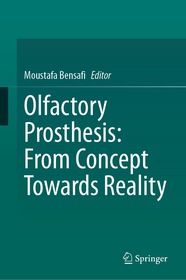
Olfactory Prosthesis: From Concept Towards Reality
-
20% KEDVEZMÉNY?
- A kedvezmény csak az 'Értesítés a kedvenc témákról' hírlevelünk címzettjeinek rendeléseire érvényes.
- Kiadói listaár EUR 213.99
-
83 584 Ft (79 604 Ft + 5% áfa)
Az ár azért becsült, mert a rendelés pillanatában nem lehet pontosan tudni, hogy a beérkezéskor milyen lesz a forint árfolyama az adott termék eredeti devizájához képest. Ha a forint romlana, kissé többet, ha javulna, kissé kevesebbet kell majd fizetnie.
- Kedvezmény(ek) 20% (cc. 16 717 Ft off)
- Kedvezményes ár 66 867 Ft (63 683 Ft + 5% áfa)
- A kedvezmény érvényes eddig: 2026. június 30.
Iratkozzon fel most és részesüljön kedvezőbb árainkból!
Feliratkozom
73 554 Ft

Beszerezhetőség
Még nem jelent meg, de rendelhető. A megjelenéstől számított néhány héten belül megérkezik.
Why don't you give exact delivery time?
A beszerzés időigényét az eddigi tapasztalatokra alapozva adjuk meg. Azért becsült, mert a terméket külföldről hozzuk be, így a kiadó kiszolgálásának pillanatnyi gyorsaságától is függ. A megadottnál gyorsabb és lassabb szállítás is elképzelhető, de mindent megteszünk, hogy Ön a lehető leghamarabb jusson hozzá a termékhez.
A termék adatai:
- Kiadó Springer Nature Switzerland
- Megjelenés dátuma 2026. május 27.
- ISBN 9783032217400
- Kötéstípus Keménykötés
- Terjedelem266 oldal
- Méret 235x155 mm
- Nyelv angol
- Illusztrációk IX, 266 p. 36 illus., 12 illus. in color. 700
Kategóriák
Hosszú leírás:
"
Although the sense of smell is often taken for granted, approximately 20% of the population experiences some degree of olfactory dysfunction, ranging from partial impairment (hyposmia) to complete loss (anosmia). These individuals find that their olfactory dysfunction not only handicaps them in their daily life, but also affects their physical and psychological health. Various paradigms exist for restoring the sense of smell, but these methods are not effective for all patients, leaving many to suffer a degraded quality of life. These patients are seeking solutions, including prosthetic technology. While implants and prostheses already exist for other sensory modality such as hearing, developing an olfactory prosthesis technology is more complex, as it must overcome the dual obstacles of the detection of odorous molecules and neural stimulation.
This book provides a comprehensive overview of the state-of-the art. Tackling existing challenges through an interdisciplinary approach, Olfactory Prosthesis: From Concept Towards Reality brings together researchers in nanotechnology to develop appropriate olfactory sensors, in microtechnology, medicine and neuroscience to develop neural stimulators capable of targeting the olfactory system, in biotechnology and machine learning to combine sensor and stimulator technologies, and in mechanical design and cognitive sciences to make these integrated devices usable in real life. Finally, the book presents an initial proof of concept for an olfactory substitution prosthesis.
" TöbbTartalomjegyzék:
The olfactory system.- Chapter 1: Neurobiology of the human sense of smell.- Chapter 2: Human olfactory perception.- Chapter 3: Inter-individual variability in human olfaction.- Olfactory deficits.- Chapter 4: Olfactory deficits: causes, types and prevalence.- Chapter 5: Diagnosis of olfactory deficits.- Chapter 6: Effects of olfactory deficits on quality of life and needs of patients.- Therapies to cure olfactory deficits.- Chapter 7: Existing therapies in olfactory deficits.- Chapter 8: Olfactory training.- Chapter 9: Possible future technologies.- Olfactory sensor technologies.- Chapter 10: Electronic noses.- Chapter 11: Biomimetic sensors (optical sensors).- Chapter 12: Miniaturizable sensors (cMUT).- Olfactory stimulation technologies.- Chapter 13: Stimulation electrode devices.- Chapter 14: Electrical stimulation in the brain.- Chapter 15: Electrical stimulation in the nasal cavity.- Substitution of olfaction with other senses.- Chapter 16: Which senses can substitute olfaction?.- Chapter 17: The trigeminal system as a substitution system.- Chapter 18: Designing a substitution system.- A proof of concept to substitute olfaction and future directions.- Chapter 19: Acceptability of a substitution device.- Chapter 20: A proof of concept to substitute olfaction via the trigeminal system.- Chapter 21: Future directions.
Több
