

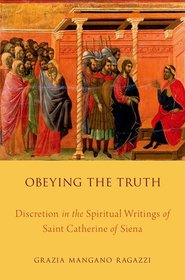
Obeying the Truth
Discretion in the Spiritual Writings of Saint Catherine of Siena
-
10% KEDVEZMÉNY?
- A kedvezmény csak az 'Értesítés a kedvenc témákról' hírlevelünk címzettjeinek rendeléseire érvényes.
- Kiadói listaár GBP 60.00
-
27 090 Ft (25 800 Ft + 5% áfa)
Az ár azért becsült, mert a rendelés pillanatában nem lehet pontosan tudni, hogy a beérkezéskor milyen lesz a forint árfolyama az adott termék eredeti devizájához képest. Ha a forint romlana, kissé többet, ha javulna, kissé kevesebbet kell majd fizetnie.
- Kedvezmény(ek) 10% (cc. 2 709 Ft off)
- Kedvezményes ár 24 381 Ft (23 220 Ft + 5% áfa)
Iratkozzon fel most és részesüljön kedvezőbb árainkból!
Feliratkozom
27 090 Ft

Beszerezhetőség
Megrendelésre a kiadó utánnyomja a könyvet. Rendelhető, de a szokásosnál kicsit lassabban érkezik meg.
Why don't you give exact delivery time?
A beszerzés időigényét az eddigi tapasztalatokra alapozva adjuk meg. Azért becsült, mert a terméket külföldről hozzuk be, így a kiadó kiszolgálásának pillanatnyi gyorsaságától is függ. A megadottnál gyorsabb és lassabb szállítás is elképzelhető, de mindent megteszünk, hogy Ön a lehető leghamarabb jusson hozzá a termékhez.
A termék adatai:
- Kiadó OUP USA
- Megjelenés dátuma 2014. január 30.
- ISBN 9780199344512
- Kötéstípus Keménykötés
- Terjedelem218 oldal
- Méret 147x211x25 mm
- Súly 363 g
- Nyelv angol 0
Kategóriák
Rövid leírás:
Grazia Mangano Ragazzi offers an in-depth examination of the concept of discretion in the spiritual writings of Saint Catherine of Siena (1347-1380), who is honored as one of the few female ''Doctors'' of the Catholic Church.
TöbbHosszú leírás:
Grazia Mangano Ragazzi offers an in-depth examination of the concept of discretion in the spiritual writings of Saint Catherine of Siena (1347-1380), who is honored as one of the few female ''Doctors'' of the Catholic Church and who in 2000 was named a co-patroness of Europe by Pope John Paul II. Despite her illiteracy, which necessitated that she dictate to a scribe, Catherine is revered for her writings, which reveal spiritual reflection of remarkable depth. At the same time she is an inspiring example of one who remained active in the political and ecclesiastical life of her time without sacrificing an intense contemplative life.
This book investigates the concept of "discretion," to which Catherine dedicates chapters IX to XI of her Dialogue and letter 213. Discretion, Ragazzi argues, is a helpful tool for interpreting the whole edifice of Catherine's spirituality. The term evades precise definition but can be summarized as a form of self-knowledge that leads to an authentic knowledge of God. Ragazzi first examines the role played by scribes in the composition of Catherine's writings, and whether it is possible to consider such writings as authentic representations of her thought, then provides a detailed analysis of Catherine's works to determine the meaning and importance of discretion in her spirituality, and how it relates to the concept of prudence. Ragazzi finds that the clearest influence on Catherine's thought was that of Dominican spirituality: her spiritual director, Raymond of Capua, was a Dominican, as was the majority of those belonging to her circle. But Franciscan mysticism, which was prevalent in religious life during the thirteenth and fourteenth centuries, also seems to have exerted considerable influence.
Ragazzi's meticulous study shows how Catherine's way of being a theologian exemplifies the principle that any person authentically striving to live a Christian life, if gifted with great faith and intellectual ability, can engage in theology in a creative manner without the abstract and specialized speculation reserved for academic theologians.
The book makes constructive contributions to our knowledge of this Sienese saint. Ragazzi's treatment of Catherine of Siena's literacy is one of the most straightforward and informative presentation of a contested topic to appear in recent years. ... Ragazzi's assessment of Catherine's theology is an insightful guide of how to understand the contours and significance of the Sienese saint's doctrines in our twenty-first century world.
Tartalomjegyzék:
Preface
Abbreviations
General Introduction
Part 1: Textual Criticism
1. Textual criticism of Catherine's writings
2. Composition and authenticity of the Letters
3. Composition and authenticity of the Dialogue
4. Composition and authenticity of the Prayers
Part 2: Analysis
5. A first approach: discretion in the Dialogue
6. A different perspective: discretion in the Letters
7. A final step: discretion in the Prayers
Part 3: Comparison in Historical Perspective
8. A brief sketch of the tradition of discretio (including discretio spirituum)
9. From Augustine to Aquinas's synthesis of the tradition of discretio with the Aristotelian teaching on prudence
10. Domenico Cavalca and some contemporaries of Catherine
Part 4: Synthesis
Discretion Between Mysticism and Morality
11. Catherine's reflection as an exemple of supernatural Christian mysticism
12. The central role of discretion in Catherine's spirituality
General Conclusions
Notes
Select Bibliography
Index

