

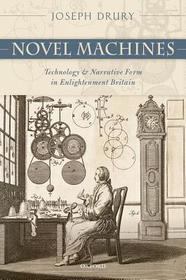
Novel Machines
Technology and Narrative Form in Enlightenment Britain
-
10% KEDVEZMÉNY?
- A kedvezmény csak az 'Értesítés a kedvenc témákról' hírlevelünk címzettjeinek rendeléseire érvényes.
- Kiadói listaár GBP 100.00
-
45 150 Ft (43 000 Ft + 5% áfa)
Az ár azért becsült, mert a rendelés pillanatában nem lehet pontosan tudni, hogy a beérkezéskor milyen lesz a forint árfolyama az adott termék eredeti devizájához képest. Ha a forint romlana, kissé többet, ha javulna, kissé kevesebbet kell majd fizetnie.
- Kedvezmény(ek) 10% (cc. 4 515 Ft off)
- Kedvezményes ár 40 635 Ft (38 700 Ft + 5% áfa)
Iratkozzon fel most és részesüljön kedvezőbb árainkból!
Feliratkozom
45 150 Ft

Beszerezhetőség
Megrendelésre a kiadó utánnyomja a könyvet. Rendelhető, de a szokásosnál kicsit lassabban érkezik meg.
Why don't you give exact delivery time?
A beszerzés időigényét az eddigi tapasztalatokra alapozva adjuk meg. Azért becsült, mert a terméket külföldről hozzuk be, így a kiadó kiszolgálásának pillanatnyi gyorsaságától is függ. A megadottnál gyorsabb és lassabb szállítás is elképzelhető, de mindent megteszünk, hogy Ön a lehető leghamarabb jusson hozzá a termékhez.
A termék adatai:
- Kiadó OUP Oxford
- Megjelenés dátuma 2017. november 30.
- ISBN 9780198792383
- Kötéstípus Keménykötés
- Terjedelem286 oldal
- Méret 244x164x22 mm
- Súly 594 g
- Nyelv angol
- Illusztrációk 8 black and white illustrations 0
Kategóriák
Rövid leírás:
Novel Machines explores the ideas of technological modernity and the machinery of narrative fiction in the eighteenth-century British novel.
TöbbHosszú leírás:
Eighteenth-century fiction is full of mechanical devices and contrivances: Robinson Crusoe uses his gun and compass to master his island and its inhabitants; Tristram Shandy's conception is interrupted by a question about a clock and he has his nose damaged at birth by a man-midwife's forceps; Ann Radcliffe's gothic heroines play musical instruments to soothe their troubled minds. In Novel Machines, however, Joseph Drury argues that the most important machine in any eighteenth-century novel is the narrative itself. Like other kinds of machine, a narrative is an artificial construction composed of different parts that combine to produce a sequence of causally linked actions. Like other machines, a narrative is designed to produce predictable effects and can therefore be put to certain uses. Such affinities had been apparent to critics since Aristotle, but they began to assume a particular urgency in the eighteenth century as authors sought to organize their narratives according to the new ideas about nature, art, and the human subject that emerged out of the Scientific Revolution.
Reading works by Eliza Haywood, Henry Fielding, Laurence Sterne, and Ann Radcliffe, Novel Machines tracks the consequences of the effort to transform the novel into an Enlightenment machine. On the one hand, the rationalization of the novel's narrative machinery helped establish its legitimacy, such that by the end of the century it could be celebrated as a modern 'invention' that provided valuable philosophical knowledge about human nature. On the other hand, conceptualizing the novel as a machine opened up a new line of attack for the period's moralists, whose polemics against the novel were often framed in the same terms used to reflect on the uses and effects of machines in other contexts. Eighteenth-century novelists responded by adapting the novel's narrative machinery, devising in the process some of the period's most characteristic and influential formal innovations.
Novel Machines stands to energize the literary history of the novel in large part because it is not limited to the familiar critiques of deleterious social and moral effects of modern convenience.
Tartalomjegyzék:
Introduction
Narratives and Machines in Enlightenment Britain
Libertines and Machines in Love in Excess
Realism's Ghosts: Science and Spectacle in Tom Jones
The Speed of Tristram Shandy
The Machine in the Ghost: Sounds and Sensibility in The Mysteries of Udolpho
Coda: The Novel and the Industrial Revolution

