

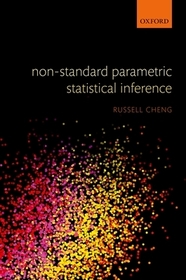
Non-Standard Parametric Statistical Inference
-
10% KEDVEZMÉNY?
- A kedvezmény csak az 'Értesítés a kedvenc témákról' hírlevelünk címzettjeinek rendeléseire érvényes.
- Kiadói listaár GBP 127.50
-
57 566 Ft (54 825 Ft + 5% áfa)
Az ár azért becsült, mert a rendelés pillanatában nem lehet pontosan tudni, hogy a beérkezéskor milyen lesz a forint árfolyama az adott termék eredeti devizájához képest. Ha a forint romlana, kissé többet, ha javulna, kissé kevesebbet kell majd fizetnie.
- Kedvezmény(ek) 10% (cc. 5 757 Ft off)
- Kedvezményes ár 51 810 Ft (49 343 Ft + 5% áfa)
Iratkozzon fel most és részesüljön kedvezőbb árainkból!
Feliratkozom
57 566 Ft

Beszerezhetőség
Megrendelésre a kiadó utánnyomja a könyvet. Rendelhető, de a szokásosnál kicsit lassabban érkezik meg.
Why don't you give exact delivery time?
A beszerzés időigényét az eddigi tapasztalatokra alapozva adjuk meg. Azért becsült, mert a terméket külföldről hozzuk be, így a kiadó kiszolgálásának pillanatnyi gyorsaságától is függ. A megadottnál gyorsabb és lassabb szállítás is elképzelhető, de mindent megteszünk, hogy Ön a lehető leghamarabb jusson hozzá a termékhez.
A termék adatai:
- Kiadó OUP Oxford
- Megjelenés dátuma 2017. június 22.
- ISBN 9780198505044
- Kötéstípus Keménykötés
- Terjedelem430 oldal
- Méret 235x173x28 mm
- Súly 848 g
- Nyelv angol 0
Kategóriák
Rövid leírás:
This research monograph gives a unified view of non-standard estimation problems. It provides an overall mathematical framework, but also draws together and studies in detail a large number of practical problems, previously only treated separately, offering solution methods and numerical procedures for each.
TöbbHosszú leírás:
This book discusses the fitting of parametric statistical models to data samples. Emphasis is placed on: (i) how to recognize situations where the problem is non-standard when parameter estimates behave unusually, and (ii) the use of parametric bootstrap resampling methods in analyzing such problems.
A frequentist likelihood-based viewpoint is adopted, for which there is a well-established and very practical theory. The standard situation is where certain widely applicable regularity conditions hold. However, there are many apparently innocuous situations where standard theory breaks down, sometimes spectacularly. Most of the departures from regularity are described geometrically, with only sufficient mathematical detail to clarify the non-standard nature of a problem and to allow formulation of practical solutions.
The book is intended for anyone with a basic knowledge of statistical methods, as is typically covered in a university statistical inference course, wishing to understand or study how standard methodology might fail. Easy to understand statistical methods are presented which overcome these difficulties, and demonstrated by detailed examples drawn from real applications. Simple and practical model-building is an underlying theme.
Parametric bootstrap resampling is used throughout for analyzing the properties of fitted models, illustrating its ease of implementation even in non-standard situations. Distributional properties are obtained numerically for estimators or statistics not previously considered in the literature because their theoretical distributional properties are too hard to obtain theoretically. Bootstrap results are presented mainly graphically in the book, providing an accessible demonstration of the sampling behaviour of estimators.
This book will be of interest for practitioners, and might be used as an advanced undergraduate or introductory graduate textbook for a course in applied statistics and/or econometrics.
Tartalomjegyzék:
Introduction
Non-Standard Problems: Some Examples
Standard Asymptotic Theory
Bootstrap Analysis
Embedded Model Problem
Examples of Embedded Distributions
Embedded Distributions: Two Numerical Examples
Infinite Likelihood
The Pearson and Johnson Systems
Box-Cox Transformations
Change-Point Models
The Skew Normal Distribution
Randomized-Parameter Models
Indeterminacy
Nested Nonlinear Regression Models
Bootstrapping Linear Models
Finite Mixture Models
Finite Mixture Examples: MAPIS Details

