

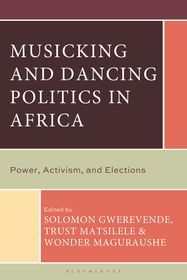
Musicking and Dancing Politics in Africa
Power, Activism, and Elections
-
20% KEDVEZMÉNY?
- A kedvezmény csak az 'Értesítés a kedvenc témákról' hírlevelünk címzettjeinek rendeléseire érvényes.
- Kiadói listaár GBP 90.00
-
40 635 Ft (38 700 Ft + 5% áfa)
Az ár azért becsült, mert a rendelés pillanatában nem lehet pontosan tudni, hogy a beérkezéskor milyen lesz a forint árfolyama az adott termék eredeti devizájához képest. Ha a forint romlana, kissé többet, ha javulna, kissé kevesebbet kell majd fizetnie.
- Kedvezmény(ek) 20% (cc. 8 127 Ft off)
- Kedvezményes ár 32 508 Ft (30 960 Ft + 5% áfa)
- A kedvezmény érvényes eddig: 2026. június 30.
Iratkozzon fel most és részesüljön kedvezőbb árainkból!
Feliratkozom
40 635 Ft

Beszerezhetőség
Megrendelésre a kiadó utánnyomja a könyvet. Rendelhető, de a szokásosnál kicsit lassabban érkezik meg.
Why don't you give exact delivery time?
A beszerzés időigényét az eddigi tapasztalatokra alapozva adjuk meg. Azért becsült, mert a terméket külföldről hozzuk be, így a kiadó kiszolgálásának pillanatnyi gyorsaságától is függ. A megadottnál gyorsabb és lassabb szállítás is elképzelhető, de mindent megteszünk, hogy Ön a lehető leghamarabb jusson hozzá a termékhez.
A termék adatai:
- Kiadó Bloomsbury Publishing (UK)
- Megjelenés dátuma 2026. április 30.
- ISBN 9781666979169
- Kötéstípus Keménykötés
- Terjedelem296 oldal
- Méret 228.6x152.4 mm
- Nyelv angol
- Illusztrációk 1 b&w illus 700
Kategóriák
Rövid leírás:
Explores how African musical traditions and dance act as political commentary and forms of resistance in postcolonial Africa
TöbbHosszú leírás:
"
Bringing together interdisciplinary scholars, this book explores how African musical traditions and dance act as political commentary and forms of resistance in Africa.
The volume draws on Christopher Small's concept of ""musicking"" to explore the intersection between music, dance, and politics across the diverse cultural landscapes in Africa, particularly South Africa, Malawi, Nigeria, and Zimbabwe. Chapters cover case studies of how music and dance have been used as tools of political messaging and means of performing, visualizing and localizing activism, resistance, propaganda, and power in politics.
It is structured into three main parts. The first part examines how music and dance serve as vessels for communal memory and heritage. Part two explores the role of music and dance as a tool to fight for democracy and justice. Part three highlights the role of dance and music in elections.
This book is essential for scholars and students interested in music and dance as conceptual tools for studying politics as a cultural phenomenon in Africa.
Tartalomjegyzék:
List of Figures
Preface
Acknowledgments
Part I: From the Past to the Present: Music, Dance, Power, Memory, and Heritage
Introduction: Musicking and Dancing Politics: An Interdisciplinary Introduction
Solomon Gwerevende (University of Music and Performing Arts Vienna, Austria), Wonder Maguraushe (Midland State University, Zimbabwe), and Trust Matsilele (Birmingham Cit University, UK)
1. Memory in Song: Whose Memory and to What End?
Jacob Mapara (Chinhoyi University of Technology, Zimbabwe)
2. The Politics of Liberation Heritage: Commemorative Practices and Remembering Revolutionary Musicians in Two Southern African Countries
Alfred Ndlovu (University of Pretoria, South Africa) and Solomon Gwerevende (University of Music and Performing Arts Vienna, Austria)
3. Singing and Dancing Dubula Ibhunu: Maintaining Liberation Heritage Versus Challenging Hate Speech in South Africa
Josephat Mutangadura (Tshwane University of Technology, South Africa), Khatija Bibi Khan (University of South Africa, South Africa), and Solomon Gwerevende (University of Music and Performing Arts Vienna, Austria)
Part II: Performing Political Discourse, Democracy, and Activism for Justice
4. The Apolitical Musician? Oliver Mtukudzi's Contribution to Zimbabwe's Political Discourse Through Music (1970s-2019)
James Hlongwana (Great Zimbabwe University, Zimbabwe) and Liketso Dube (Great Zimbabwe University, Zimbabwe)
5. Zimdancehall as Youth Voices: Winky D's Recruitment of Young Musicians in the Chimurenga Against Economic and Political Challenges in Zimbabwe
Solomon Gwerevende (University of Music and Performing Arts Vienna, Austria), Alois Maluleke (Independent Scholar), and Shadreck Dzingayi (Great Zimbabwe University, Zimbabwe)
6. Singing for Democracy: The Politics of Music in Zimbabwe's Securocratic State
Pedzisai Ruhanya (University of Johannesburg, South Africa), Bekezela Gumbo (Zimbabwe Democracy Institute, Zimbabwe), and Linda Mujuru (Midlands State University, Zimbabwe)
7. Breaking the Loud Silence of Oppression through Theatrical Dance and Music Activism in Nigeria
Oluwatoyin Olokodana-James (Obafemi Awolowo University, Nigeria) and Florence Ewomazino Nweke (University of Lagos, Nigeria)
Part III: Performing Political Transition and Electoral Politics
8. The Sounds of Politics: Popular Music in Malawi's Political Transitions Since 1964
Richard Gracious Gadama (Mzuzu University, Malawi)
9. Music and Dance as Election Campaign Strategies in Nigerian Elections
Florence Ewomazino Nweke(University of Lagos, Nigeria) and Oluwatoyin Olokodana-James (Obafemi Awolowo University, Nigeria)
10. The Politics of Spectacle: Music and Dance as Election Campaign Strategies in Nigeria
Toyin Segun Onayinka (Federal University Oye-Ekiti, Nigeria), Omolola Oluwasola (University of Ibadan, Nigeria), Mustapha Olalekan Rufai (Federal University Oye-Ekiti, Nigeria), and Chinyere Mercy Ignatius (Federal University Oye-Ekiti, Nigeria)
Index
List of Contributors

