

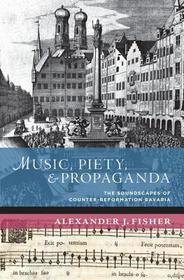
Music, Piety, and Propaganda
The Soundscape of Counter-Reformation Bavaria
Sorozatcím: The New Cultural History of Music Series;
-
10% KEDVEZMÉNY?
- A kedvezmény csak az 'Értesítés a kedvenc témákról' hírlevelünk címzettjeinek rendeléseire érvényes.
- Kiadói listaár GBP 75.00
-
33 862 Ft (32 250 Ft + 5% áfa)
Az ár azért becsült, mert a rendelés pillanatában nem lehet pontosan tudni, hogy a beérkezéskor milyen lesz a forint árfolyama az adott termék eredeti devizájához képest. Ha a forint romlana, kissé többet, ha javulna, kissé kevesebbet kell majd fizetnie.
- Kedvezmény(ek) 10% (cc. 3 386 Ft off)
- Kedvezményes ár 30 476 Ft (29 025 Ft + 5% áfa)
Iratkozzon fel most és részesüljön kedvezőbb árainkból!
Feliratkozom
33 862 Ft

Beszerezhetőség
Megrendelésre a kiadó utánnyomja a könyvet. Rendelhető, de a szokásosnál kicsit lassabban érkezik meg.
Why don't you give exact delivery time?
A beszerzés időigényét az eddigi tapasztalatokra alapozva adjuk meg. Azért becsült, mert a terméket külföldről hozzuk be, így a kiadó kiszolgálásának pillanatnyi gyorsaságától is függ. A megadottnál gyorsabb és lassabb szállítás is elképzelhető, de mindent megteszünk, hogy Ön a lehető leghamarabb jusson hozzá a termékhez.
A termék adatai:
- Kiadó OUP USA
- Megjelenés dátuma 2014. január 23.
- ISBN 9780199764648
- Kötéstípus Keménykötés
- Terjedelem384 oldal
- Méret 165x236x35 mm
- Súly 680 g
- Nyelv angol
- Illusztrációk 23 bw line, 8 bw halftones 0
Kategóriák
Rövid leírás:
Music, Piety, and Propaganda: The Soundscapes of Counter-Reformation Bavaria explores the nature of sound as a powerful yet ambivalent force in the religious struggles that permeated Germany during the Counter-Reformation.
TöbbHosszú leírás:
Music, Piety, and Propaganda: The Soundscapes of Counter-Reformation Bavaria explores the nature of sound as a powerful yet ambivalent force in the religious struggles that permeated Germany during the Counter-Reformation. Author Alexander J. Fisher goes beyond a musicological treatment of composers, styles, and genres to examine how music, and more broadly sound itself, shaped the aural landscape of Bavaria as the duchy emerged as a militant Catholic bulwark. Fisher focuses particularly on the ways in which sound--including bell-ringing, gunfire, and popular song, as well as cultivated polyphony--not only was deployed by Catholic secular and clerical elites to shape the religious identities of Bavarian subjects, but also carried the potential to challenge and undermine confessional boundaries.
Surviving literature, archival documents, and music illustrate the ways in which Bavarian authorities and their allies in the Catholic clergy and orders deployed sound to underline crucial theological differences with their Protestant antagonists, notably the cults of the Virgin Mary, the Eucharist, and the saints. Official and popular rituals like divine worship, processions, and pilgrimages all featured distinctive sounds and music that shaped and reflected an emerging Catholic identity. Although officials imposed a severe regime of religious surveillance, the Catholic state's dominance of the soundscape was hardly assured. Fisher traces archival sources that show the resilience of Protestant vernacular song in Bavaria, the dissemination and performance of forbidden, anti-Catholic songs, the presence of Lutheran chorales in nominally Catholic church services into the late 16th century, and the persistence of popular "noise" more generally. Music, Piety, and Propaganda thus reveals historical, theological, and cultural issues of the period through the piercing dimension of its sounds, bringing into focus the import of sound as a strategic cultural tool with significant impact on the flow of history.
In this book, musicologist Alexander Fisher gives us an ear-opening account of the soundscape of early modern Bavaria. Music is his chief concern and, as well as the prolific and central output of Orlando di Lasso (died Munich, 1594), he looks at the work of lesser-known composers, hymn writers, song collectors, street performers, and pamphlet publishers.
Tartalomjegyzék:
Table of Contents
Acknowledgments
Abbreviations for Source Locations
I. Sound, Space, and Confession in Counter-Reformation Bavaria
Historical soundscapes
Sound, space, and place
Identity, discipline, and confessionalization
The soundscapes of Counter-Reformation Bavaria
The structure and scope of the book
II. Sound and the Spaces of Worship
Public churches and the experience of liturgical space
Congregational song
St. Michael in Munich, the Jesuits, and Counter-Reformation worship
Cathedral, Collegiate, and Parish churches in the age of Tridentine reform
The cathedral of Freising
Unsere Liebe Frau in Munich
St. Peter in Munich
Liturgy in the religious orders
Courtly spaces for liturgy: the Bavarian court chapel
The court chapel of St. George and liturgical music in the sixteenth
century
The new court chapel of Mary of the Immaculate Conception and
liturgical music under Maximilian I
III. Sound and Spaces of Devotion
Devotional polyphony for cultivated spaces
Monastic devotion
Confraternities and congregations
The Marian Congregations
Marian, Eucharistic, and other confraternities
Corporate devotional services and gatherings
Funerals and burials
Salve services
Seasonal devotions for Christmas and Lent
Supplications and Celebrations
Song and the soundscape
IV. Sound and Confession in the Civic Sphere
Bells and the urban soundscape
Regulating the sounds of profane life
Song in the public sphere
Sound in public religious spectacles
V. Music, Sound, and Processional Culture
Corpus Christi processions
The Corpus Christi procession in Munich
Good Friday processions
Processions of supplication and triumph
VI. Sound, Pilgrimage, and the Spiritual Geography of Counter-Reformation Bavaria
Pilgrimage in the Reformation and Counter-Reformation
The music of pilgrimage: songs and litanies
Bavarian pilgrimage songs
The litany in Bavarian pilgrimage
Sound in the practice of pilgrimage
Departure
En route and upon arrival
A pilgrimage to St. Benno in Munich
Bibliography
Index

