

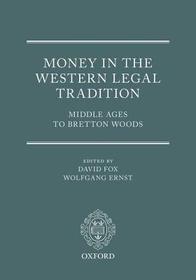
Money in the Western Legal Tradition
Middle Ages to Bretton Woods
-
10% KEDVEZMÉNY?
- A kedvezmény csak az 'Értesítés a kedvenc témákról' hírlevelünk címzettjeinek rendeléseire érvényes.
- Kiadói listaár GBP 225.00
-
101 587 Ft (96 750 Ft + 5% áfa)
Az ár azért becsült, mert a rendelés pillanatában nem lehet pontosan tudni, hogy a beérkezéskor milyen lesz a forint árfolyama az adott termék eredeti devizájához képest. Ha a forint romlana, kissé többet, ha javulna, kissé kevesebbet kell majd fizetnie.
- Kedvezmény(ek) 10% (cc. 10 159 Ft off)
- Kedvezményes ár 91 429 Ft (87 075 Ft + 5% áfa)
Iratkozzon fel most és részesüljön kedvezőbb árainkból!
Feliratkozom
101 587 Ft

Beszerezhetőség
Megrendelésre a kiadó utánnyomja a könyvet. Rendelhető, de a szokásosnál kicsit lassabban érkezik meg.
Why don't you give exact delivery time?
A beszerzés időigényét az eddigi tapasztalatokra alapozva adjuk meg. Azért becsült, mert a terméket külföldről hozzuk be, így a kiadó kiszolgálásának pillanatnyi gyorsaságától is függ. A megadottnál gyorsabb és lassabb szállítás is elképzelhető, de mindent megteszünk, hogy Ön a lehető leghamarabb jusson hozzá a termékhez.
A termék adatai:
- Kiadó OUP Oxford
- Megjelenés dátuma 2016. január 28.
- ISBN 9780198704744
- Kötéstípus Keménykötés
- Terjedelem920 oldal
- Méret 249x182x54 mm
- Súly 1774 g
- Nyelv angol 0
Kategóriák
Rövid leírás:
Spanning two great Western legal traditions, the common law of the Anglo-American legal world and the civil law systems of continental Europe, this book analyses monetary law as it has been understood by legal scholars and legal practitioners of the past 800 years.
TöbbHosszú leírás:
Monetary law is essential to the functioning of private transactions and international dealings by the state: nearly every legal transaction has a monetary aspect. Money in the Western Legal Tradition presents the first comprehensive analysis of Western monetary law, covering the civil law and Anglo-American common law legal systems from the High Middle Ages up to the middle of the 20th century. Weaving a detailed tapestry of the changing concepts of money and private transactions throughout the ages, the contributors investigate the special contribution made by legal scholars and practitioners to our understanding of money and the laws that govern it.
Divided in five parts, the book begins with the coin currency of the Middle Ages, moving through the invention of nominalism in the early modern period to cashless payment and the rise of the banking system and paper money, then charting the progression to fiat money in the modern era. Each part commences with an overview of the monetary environment for the historical period written by an economic historian or numismatist. These are followed by chapters describing the legal doctrines of each period in civil and common law. Each section contains examples of contemporary litigation or statute law which engages with the distinctive issues affecting the monetary law of the period. This interdisciplinary approach reveals the distinctive conception of money prevalent in each period, which either facilitated or hampered the implementation of economic policy and the operation of private transactions.
The text should be of value to academics and others with an interest in the theory of money, whether from a legal, economic or historical perspective. It may also provide inspiration to practitioners searching for novel solutions to legal dilemmas created by ever more complex developments in the international monetary system.
Tartalomjegyzék:
Introduction
Money as a Legal Institution
Part I. The Late Middle Ages: Coins and the Law
Currency Depreciation and Debasement in Medieval Europe
Money in Medieval PhilosophyThe Last Scholastic on Money: Gabriel Biel's Monetary Theory
Part II. Civil Law
Money in the Roman Law Texts
The Legists' Doctrines on Money and the Law from the Eleventh to Fifteenth Centuries
Money in Medieval Canon Law
The 'Reduction' of Money in the Low Countries c. 1489-1515.
Part III. Money in the Early Modern Period: The Triumph of Nominalism
Monetary Reforms in the Holy Roman Empire in the Fifteenth and Sixteenth Centuries
The Enforcement of Nominal Values to Money in the Medieval and Early Modern Common Law
The Case of Mixt Monies (1604)The Effect of Debasements on Pre-existing Debts in Early Modern Jurisprudence
Spanish Scholastics on Money and Credit
German Law Faculties and Benches of Jurymen (Schöffenstühle) on Loans and Inflation: Legal Doctrine and Seventeenth Century Legal Practice
Monetary and Currency Problems in the Light of Early Modern Litigation
Part III. The Evolution of Cashless Payment: Bank Money
Early Public Banks I: Ledger-Money Banks
'Bank Money': The Rise, Fall, and Metamorphosis of the 'Transferable Deposit'
Early English Law of Checks
The Order to Pay Money in Medieval Continental Europe
Giro Payments and the Beginning of the Modern Cashless Payment System
Part IV. The Eighteenth and Nineteenth Centuries: The Emergence of Paper Money
Early Public Banks II: Banks of Issue
Deposit Banking and the Use of Monetary Instruments
Early English Law of Bank Notes
Banknotes and their Vindication in Eighteenth-Century Scotland
Multiple Currency Clauses and Currency Reform: The Austrian Coupon Cases
Part V. The Twentieth Century: Fiat Money
Putting the 'System' in the International Monetary System
The Bretton Woods System: Design and Operation
From the State Theory of Money to Modern Money: An Alternative to Ecomomic Orthodoxy
Hyperinflations of the Early Twentieth Century
Responses to Crisis: Refiguring the Monetary and the Fiscal in the Great Depression
Monetary Obligations and the Fragmentation of the Sterling Monetary Union
The German Hyperinflation of the 1920s
Case Study: Swedish Government Bonds, their Gold Dollar Clause, and the 1933 Roosevelt Act - Georges Sauser-Halls Opinion on Loans issued by the Government of Sweden

