

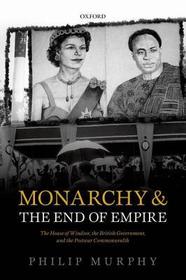
Monarchy and the End of Empire
The House of Windsor, the British Government, and the Postwar Commonwealth
-
10% KEDVEZMÉNY?
- A kedvezmény csak az 'Értesítés a kedvenc témákról' hírlevelünk címzettjeinek rendeléseire érvényes.
- Kiadói listaár GBP 45.99
-
20 764 Ft (19 775 Ft + 5% áfa)
Az ár azért becsült, mert a rendelés pillanatában nem lehet pontosan tudni, hogy a beérkezéskor milyen lesz a forint árfolyama az adott termék eredeti devizájához képest. Ha a forint romlana, kissé többet, ha javulna, kissé kevesebbet kell majd fizetnie.
- Kedvezmény(ek) 10% (cc. 2 076 Ft off)
- Kedvezményes ár 18 687 Ft (17 798 Ft + 5% áfa)
Iratkozzon fel most és részesüljön kedvezőbb árainkból!
Feliratkozom
20 764 Ft

Beszerezhetőség
Megrendelésre a kiadó utánnyomja a könyvet. Rendelhető, de a szokásosnál kicsit lassabban érkezik meg.
Why don't you give exact delivery time?
A beszerzés időigényét az eddigi tapasztalatokra alapozva adjuk meg. Azért becsült, mert a terméket külföldről hozzuk be, így a kiadó kiszolgálásának pillanatnyi gyorsaságától is függ. A megadottnál gyorsabb és lassabb szállítás is elképzelhető, de mindent megteszünk, hogy Ön a lehető leghamarabb jusson hozzá a termékhez.
A termék adatai:
- Kiadó OUP Oxford
- Megjelenés dátuma 2015. november 12.
- ISBN 9780198757696
- Kötéstípus Puhakötés
- Terjedelem258 oldal
- Méret 235x159x14 mm
- Súly 422 g
- Nyelv angol
- Illusztrációk 2 maps, 16-page plate section 0
Kategóriák
Rövid leírás:
Examines the relationship between the British government, the Palace, and the modern Commonwealth since 1945 and argues that the monarchy's relationship with the Commonwealth, which was initially promoted by the UK as a means of strengthening imperial ties, increasingly became an impediment to British foreign policy.
TöbbHosszú leírás:
This unique and meticulously-researched study examines the triangular relationship between the British government, the Palace, and the modern Commonwealth since 1945. It has two principal areas of focus: the monarch's role as sovereign of a series of Commonwealth Realms, and quite separately as head of the Commonwealth. It traces how, in the early part of the twentieth century, the British government promoted the Crown as a counterbalance to the centrifugal forces that were drawing the Empire apart. Ultimately, however, with newly-independent India's determination to become a republic in the late 1940s, Britain had to accept that allegiance to the Crown could no longer be the common factor binding the Commonwealth together. It therefore devised the notion of the headship of the Commonwealth as a means of enabling a republican India 'to continue to give the monarchy a pivotal symbolic role and therefore to remain in the Commonwealth.'
In the years of rapid decolonization which followed 1945, it became clear that this elaborate constitutional infrastructure posed significant problems for British foreign policy. The system of Commonwealth Realms was a recipe for confusion and misunderstanding. Policy makers in the UK increasingly saw it as a liability in terms of Britain's relations with its former colonies, so much so that by the early 1960s they actively sought to persuade African nationalist leaders to adopt republican constitutions on independence. The headship of the Commonwealth also became a cause for concern, partly because it offered opportunities for the monarch to act without ministerial advice, and partly because it tended to tie the British government to what many within the UK had begun to regard as a largely redundant institution. Philip Murphy employs a large amount of previously-unpublished documentary evidence to argue that the monarchy's relationship with the Commonwealth, which was initially promoted by the UK as a means of strengthening Imperial ties, increasingly became an source of frustration for British foreign policy makers.
Professor Murphy's book by a country mile the most important and well-informed to have been written about the contemporary British monarchy
Tartalomjegyzék:
Preface and Acknowledgements
The Holy Family: an introduction
'The Pivot of Empire': Monarchy and the Commonwealth, 1918-1945
'A Common Act of Will': The Making of the New Commonwealth, 1945-1952
'A Personal and Living Bond': Accession, Coronation, and Commonwealth Tour, 1952-1954
Winds of Change and the Royal Family
'A poor sort of courtesy to Her Majesty': Republics, Realms and Rebels, 1960-1970
'A Fragile Flower': Britain and the Headship of the Commonwealth
'A Royal Duty': Commonwealth Heads of Government Meetings in the 1970s
'De-Dominionisation' in the 1970s
'On Her Own': The Queen and the Commonwealth in the 1980s
The Fall and Rise of the Royal Commonwealth
Bibliography

