

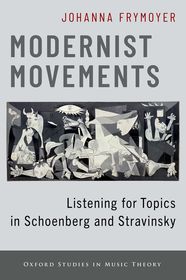
Modernist Movements
Listening for Topics in Schoenberg and Stravinsky
Sorozatcím: Oxford Studies in Music Theory;
-
10% KEDVEZMÉNY?
- A kedvezmény csak az 'Értesítés a kedvenc témákról' hírlevelünk címzettjeinek rendeléseire érvényes.
- Kiadói listaár GBP 71.00
-
33 920 Ft (32 305 Ft + 5% áfa)
Az ár azért becsült, mert a rendelés pillanatában nem lehet pontosan tudni, hogy a beérkezéskor milyen lesz a forint árfolyama az adott termék eredeti devizájához képest. Ha a forint romlana, kissé többet, ha javulna, kissé kevesebbet kell majd fizetnie.
- Kedvezmény(ek) 10% (cc. 3 392 Ft off)
- Kedvezményes ár 30 528 Ft (29 075 Ft + 5% áfa)
Iratkozzon fel most és részesüljön kedvezőbb árainkból!
Feliratkozom
33 920 Ft

Beszerezhetőség
Becsült beszerzési idő: Várható beérkezés: 2026. január vége.
A Prosperónál jelenleg nincsen raktáron.
Why don't you give exact delivery time?
A beszerzés időigényét az eddigi tapasztalatokra alapozva adjuk meg. Azért becsült, mert a terméket külföldről hozzuk be, így a kiadó kiszolgálásának pillanatnyi gyorsaságától is függ. A megadottnál gyorsabb és lassabb szállítás is elképzelhető, de mindent megteszünk, hogy Ön a lehető leghamarabb jusson hozzá a termékhez.
A termék adatai:
- Kiadó OUP USA
- Megjelenés dátuma 2028. augusztus 19.
- ISBN 9780197641347
- Kötéstípus Keménykötés
- Terjedelem408 oldal
- Méret 237x167x31 mm
- Súly 739 g
- Nyelv angol
- Illusztrációk 71 figures 0
Kategóriák
Rövid leírás:
Modernist Movements: Listening for Topics in Schoenberg and Stravinsky expands topic theory to include insights from cognition, categorization, and prototypicality. Innovative analyses of Schoenberg and Stravinsky illustrate how listeners engage bodily with works whose harmonic and metric complexity exceeds that of the late eighteenth century when topics first appeared. Readers gain insights into how topics preserve in social memory qualities of movement long after the actual dance steps fall out of practice.
TöbbHosszú leírás:
Topic theory examines the lexicon of conventions that emerged in the late eighteenth century through which composers evoked dances, marches, hunting, the pastoral, and the supernatural. While scholars have explored ad hoc applications of the theory in later repertories, author Johanna Frymoyer begins with fundamental methodological questions of if, why, and how analysts ought to apply topic theory--a method tailored to eighteenth-century historical and aesthetic contingencies--to modernist repertory.
Advancing topic theory beyond its foundations in semiotics to incorporate insights from cognition, Frymoyer argues that topical identification and interpretation are governed by mental categories and prototypicality effects, and that topics function as mnemonics of bodily movement (such as dance). Her approach explains how listeners past and present, though they may not be able to dance a minuet or march in synchronized military procession, nonetheless preserve these historically--embedded patterns of movement in memory. Topic theory therefore provides important insight into how listeners engage imaginatively--choreographically, one could say--with musical meaning in ways that are experienced as transhistorical, embodied, and intersubjective.
Illuminated by innovative analyses of Schoenberg and Stravinsky and placing topics in dialogue with considerations of twelve-tone style, metrical irregularity, accessibility, and agency, Modernist Movements is an important contribution to topic theory, modernist studies, and embodied cognition.
Tartalomjegyzék:
Part I: Defining
Chapter 1. Topic Theory and Modernism
Chapter 2. Categories, Prototypicality Effects, and Memory
Part II: Hearing
Chapter 3. Harmony: Topics in Schoenberg's Twelve-Tone Style
Chapter 4. Meter: Stravinsky's Dance Topics
Part III: Moving
Chapter 5. History, Memory, Usage: A Case Study of the Russian Supernatural
Chapter 6. Body, Agency, and Intersubjectivity in Topical Listening
Bibliography
Index

