

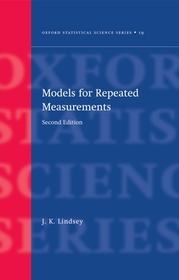
Models for Repeated Measurements
Sorozatcím: Oxford Statistical Science Series; 19;
-
10% KEDVEZMÉNY?
- A kedvezmény csak az 'Értesítés a kedvenc témákról' hírlevelünk címzettjeinek rendeléseire érvényes.
- Kiadói listaár GBP 147.50
-
66 596 Ft (63 425 Ft + 5% áfa)
Az ár azért becsült, mert a rendelés pillanatában nem lehet pontosan tudni, hogy a beérkezéskor milyen lesz a forint árfolyama az adott termék eredeti devizájához képest. Ha a forint romlana, kissé többet, ha javulna, kissé kevesebbet kell majd fizetnie.
- Kedvezmény(ek) 10% (cc. 6 660 Ft off)
- Kedvezményes ár 59 937 Ft (57 083 Ft + 5% áfa)
Iratkozzon fel most és részesüljön kedvezőbb árainkból!
Feliratkozom
66 596 Ft

Beszerezhetőség
Megrendelésre a kiadó utánnyomja a könyvet. Rendelhető, de a szokásosnál kicsit lassabban érkezik meg.
Why don't you give exact delivery time?
A beszerzés időigényét az eddigi tapasztalatokra alapozva adjuk meg. Azért becsült, mert a terméket külföldről hozzuk be, így a kiadó kiszolgálásának pillanatnyi gyorsaságától is függ. A megadottnál gyorsabb és lassabb szállítás is elképzelhető, de mindent megteszünk, hogy Ön a lehető leghamarabb jusson hozzá a termékhez.
A termék adatai:
- Kiadás sorszáma 2
- Kiadó OUP Oxford
- Megjelenés dátuma 1999. július 29.
- Kötetek száma laminated boards
- ISBN 9780198505594
- Kötéstípus Keménykötés
- Terjedelem536 oldal
- Méret 241x160x33 mm
- Súly 883 g
- Nyelv angol 0
Kategóriák
Rövid leírás:
This second edition of Models for Repeated Measurements has been comprehensively revised and updated to reflect the huge amount of research that has been carried out in the subject in recent years. A wide variety of useful new models is now available, models that haved the revolutionized the analysis of such data. The second edition contains three new chapters on models for continuous non-normal data, on various design issues specific to repeated measurements, and on missing data and dropouts.
TöbbHosszú leírás:
This second edition of Models for Repeated Measurements has been comprehensively revised and updated, taking into account the huge amount of research that has been carried out in the subject in recent years. A wide variety of useful new models is now available, models that have revolutionized the analysis of such data. The second edition contains three new chapters on models for continuous non-normal data, on various design issues specific to repeated measurements, and on missing data and dropouts. Exercises have been added at the ends of most chapters, and the programming functions needed to carry out the analyses in the book are publicly available. Models for Repeated Measurements is an essential reference for research statisticians in agriculture, medicine, economics, and psychology, and for the many consulting statisticians who want an up-to-date expository account of this important topic. The book is organized into four parts. In the first part, the general context of repeated measurements is presented. The three basic types of response variables, continuous (normal), categorical and count, and duration, are introduced. There is a discussion of the ways in which such repeated observations are interdependent. The book also develops a framework for constructing suitable models, with the introduction of the necessary concepts of multivariate distributions and stochastic processes. In the following three parts, a large number of specific examples, including data tables, is presented to illustrate the models available. Each of these parts corresponds to one of the types of responses mentioned above. FROM REVIEWS OF THE FIRST EDITION . . . a timely book . . . useful both as a graduate text and as a consulting source. Statistical Methods in Medical Research
" ... good consulting nad reference source and one that I expect to use, especially given the software libraries that the author has made avavilable to accompany the text. Owners of the first edition will certainly want to consider obtaining this edition, and most statistics libraries should buy a copy The Statistician
Tartalomjegyzék:
I. INTRODUCTION
1. Basic concepts
2. Fundamentals of modelling
3. Multivariate distributions
II. CONTINUOUS MEASUREMENTS
4. Heterogeneous populations
5. Longitudinal studies
6. Non-normal responses
III. CATEGORICAL AND COUNT DATA
7. Overdispersion
8. Longitudinal discrete data
IV. DURATION DATA
9. Frailty
10. Event histories
V. PLANNING A STUDY
11. Design issues
12. Modelling missing data and dropouts
APPENDICES
A. Data tables for the examples
B. Data tables for the exercisesIndex
Bibliography
Index
Bibliography
Index

