

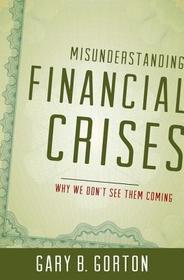
Misunderstanding Financial Crises
Why We Don't See Them Coming
-
10% KEDVEZMÉNY?
- A kedvezmény csak az 'Értesítés a kedvenc témákról' hírlevelünk címzettjeinek rendeléseire érvényes.
- Kiadói listaár GBP 27.99
-
12 637 Ft (12 035 Ft + 5% áfa)
Az ár azért becsült, mert a rendelés pillanatában nem lehet pontosan tudni, hogy a beérkezéskor milyen lesz a forint árfolyama az adott termék eredeti devizájához képest. Ha a forint romlana, kissé többet, ha javulna, kissé kevesebbet kell majd fizetnie.
- Kedvezmény(ek) 10% (cc. 1 264 Ft off)
- Kedvezményes ár 11 373 Ft (10 832 Ft + 5% áfa)
Iratkozzon fel most és részesüljön kedvezőbb árainkból!
Feliratkozom
12 637 Ft

Beszerezhetőség
Megrendelésre a kiadó utánnyomja a könyvet. Rendelhető, de a szokásosnál kicsit lassabban érkezik meg.
Why don't you give exact delivery time?
A beszerzés időigényét az eddigi tapasztalatokra alapozva adjuk meg. Azért becsült, mert a terméket külföldről hozzuk be, így a kiadó kiszolgálásának pillanatnyi gyorsaságától is függ. A megadottnál gyorsabb és lassabb szállítás is elképzelhető, de mindent megteszünk, hogy Ön a lehető leghamarabb jusson hozzá a termékhez.
A termék adatai:
- Kiadó OUP USA
- Megjelenés dátuma 2012. december 27.
- ISBN 9780199922901
- Kötéstípus Keménykötés
- Terjedelem296 oldal
- Méret 236x157x22 mm
- Súly 567 g
- Nyelv angol 0
Kategóriák
Rövid leírás:
An explanation and history of financial crises.
TöbbHosszú leírás:
Prior to the financial crisis of 2007-2008, economists thought that no such crisis could or would ever happen again in the United States, that financial events of such magnitude were a thing of the distant past. In fact, observers of that distant past--the period from the half century prior to the Civil War up to the passage of deposit insurance during the Great Depression, which was marked by repeated financial crises--note that while legislation immediately after crises reacted to their effects, economists and policymakers continually failed to grasp the true lessons to be learned.
Gary Gorton, considered by many to be the authority on the financial crisis of our time, holds that economists fundamentally misunderstand financial crises--what they are, why they occur, and why there were none in the U.S. between 1934 and 2007. In Misunderstanding Financial Crises, he illustrates that financial crises are inherent to the production of bank debt, which is used to conduct transactions, and that unless the government designs intelligent regulation, crises will continue. Economists, he writes, looked from a certain point of view and missed everything that was important: the evolution of capital markets and the banking system, the existence of new financial instruments, and the size of certain money markets like the sale and repurchase market. Delving into how such a massive intellectual failure could have happened, Gorton offers a back-to-basics elucidation of financial crises, and shows how they are not rare, idiosyncratic, unfortunate events caused by a coincidence of unconnected factors. By looking back to the "Quiet Period " from 1934 to 2007 when there were no systemic crises, and to the "Panic of 2007-2008, " he brings together such issues as bank debt and liquidity, credit booms and manias, and moral hazard and too-big-too-fail, to illustrate the costs of bank failure and the true causes of financial crises. He argues that the successful regulation that prevented crises did not adequately keep pace with innovation in the financial sector, due in large part to economists' misunderstandings. He then looks forward to offer both a better way for economists to conceive of markets, as well as a description of the regulation necessary to address the historical threat of financial crises.
Gorton brings to the question a combination of historical perspective, academic expertise and, unlike most academics, personal experience...his book is a refreshing and valuable account that should take its place among the essential reading of any student of crises.
Tartalomjegyzék:
Preface
I. Introduction
II. Creating the Quiet Period
III. Financial Crises
IV. Liquidity and Secrets
V. Credit Booms and Manias
VI. The Timing of Crises
VII. Economic Theory without History
VIII. Debt During Crises
IX. The Quiet Period and Its End
X. Moral Hazard and Too-Big-To-Fail
XI. Bank Capital
XII. Fat Cats, Crisis Costs, and the Paradox of Financial Crises
XIII. The Panic of 2007-2008
XIV. The Theory and Practice of Seeing
Bibliographic Notes
Notes
References
Index

