

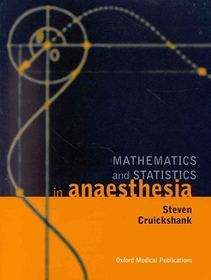
Mathematics and Statistics in Anaesthesia
-
10% KEDVEZMÉNY?
- A kedvezmény csak az 'Értesítés a kedvenc témákról' hírlevelünk címzettjeinek rendeléseire érvényes.
- Kiadói listaár GBP 125.00
-
56 437 Ft (53 750 Ft + 5% áfa)
Az ár azért becsült, mert a rendelés pillanatában nem lehet pontosan tudni, hogy a beérkezéskor milyen lesz a forint árfolyama az adott termék eredeti devizájához képest. Ha a forint romlana, kissé többet, ha javulna, kissé kevesebbet kell majd fizetnie.
- Kedvezmény(ek) 10% (cc. 5 644 Ft off)
- Kedvezményes ár 50 794 Ft (48 375 Ft + 5% áfa)
Iratkozzon fel most és részesüljön kedvezőbb árainkból!
Feliratkozom
56 437 Ft

Beszerezhetőség
Megrendelésre a kiadó utánnyomja a könyvet. Rendelhető, de a szokásosnál kicsit lassabban érkezik meg.
Why don't you give exact delivery time?
A beszerzés időigényét az eddigi tapasztalatokra alapozva adjuk meg. Azért becsült, mert a terméket külföldről hozzuk be, így a kiadó kiszolgálásának pillanatnyi gyorsaságától is függ. A megadottnál gyorsabb és lassabb szállítás is elképzelhető, de mindent megteszünk, hogy Ön a lehető leghamarabb jusson hozzá a termékhez.
A termék adatai:
- Kiadó OUP Oxford
- Megjelenés dátuma 1998. augusztus 27.
- ISBN 9780192623126
- Kötéstípus Puhakötés
- Terjedelem268 oldal
- Méret 246x189x15 mm
- Súly 528 g
- Nyelv angol
- Illusztrációk numerous tables and cartoons 0
Kategóriák
Rövid leírás:
Mathematics and Statistics in Anaesthesia presents simple mathematical ideas, and explains how these can be used to model and understand problems which arise in clinical anaesthesia. The common features of the underlying mathematics are emphasized through a pictorial/graphical approach, in preference to vast amounts of algebra. The book presents statistics in an informal and less intimidating style that most standard statistical texts, incorporating illustrations and cartoons throughout. The book will be valuable to anaesthetists, in guiding them through what can be an intimidating part of their training.
TöbbHosszú leírás:
Anaesthetic trainees often have enormous trouble understanding the quantitative aspects of the basic sciences underlying clinical anaesthetic practice. The subjects of pharmokinetics and statistics are often unpopular with trainees, and studied with little enthusiasm. In spite of their reluctance, this is an area that they are required to study and understand as a core part of their training for postgraduate exams. Mathematics and statistics for anaesthetists presents simple mathematical ideas, and explains how these can be used to model and understand problems which arise in clinical anaesthesia. The common features of the underlying mathematics are emphasised through a pictorial/graphical approach, in preference to vast amounts of algebra. The book presents statistics in an informal and less intimidating style that most standard statistical texts, incorporating illustrations and cartoons throughout. The book will be valuable to anaesthetists, in guiding them through what can be an intimidating part of their training.
TöbbTartalomjegyzék:
Section 1 Physiological and pharmacological modelling
Introduction
The input-output principle
Steady-states: Alveolar ventillation & PaCO2
Gas laws
Flux & the Fick principle
Fick & cardiac output; dilution methods
Fick & cerebral blood flow
Apnoeic oxygenation
Nitrogen washout and preoxygeneration
Time constants
Step change in ventilation
Air embolism
Pharmacokinetic models
Drug-receptor interaction
Drug antagonism
Oscillating systems
Damped oscillations
Forced oscillation
Modelling arterial pressure waves
Section 2 - Mathematical background
Numbers
Functions
Pattern functions & transformation
Constant function
Linear
Rectangular hyperbolic functions
Polynomial functions
Inverse functions
Exponential & logarithmic functions
Sinusoidal functions
Functions of more than one variable
The derivative & differentiation
Maxima & minima
Integration
Differential equations
Numerical methods for differential equations
Section 3 - Probability & statistics
Probability models and simulation
Waiting times in a Poisson process
Passing the fellowship; the binomial distribution
Measuring SVP; the normal distribution
Modelling with random variables
Sums of random variables
Probability
Conditional probability & Bayes theorem
Summary measures; location and dispersion
The normal distribution
Statistical inference
Sample mean. Estimation & confidence
Sample variance
Significance testing
Samples of unknown mean and variance
Categorial data
Related variables; linear regression
Related variables; correlation
Distribution-free methods
Stochastic IOP. Queues
Bibliography
Index

