

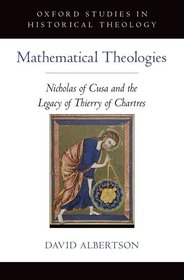
Mathematical Theologies
Nicholas of Cusa and the Legacy of Thierry of Chartres
Sorozatcím: Oxford Studies in Historical Theology;
-
10% KEDVEZMÉNY?
- A kedvezmény csak az 'Értesítés a kedvenc témákról' hírlevelünk címzettjeinek rendeléseire érvényes.
- Kiadói listaár GBP 110.00
-
52 552 Ft (50 050 Ft + 5% áfa)
Az ár azért becsült, mert a rendelés pillanatában nem lehet pontosan tudni, hogy a beérkezéskor milyen lesz a forint árfolyama az adott termék eredeti devizájához képest. Ha a forint romlana, kissé többet, ha javulna, kissé kevesebbet kell majd fizetnie.
- Kedvezmény(ek) 10% (cc. 5 255 Ft off)
- Kedvezményes ár 47 297 Ft (45 045 Ft + 5% áfa)
Iratkozzon fel most és részesüljön kedvezőbb árainkból!
Feliratkozom
52 552 Ft

Beszerezhetőség
Megrendelésre a kiadó utánnyomja a könyvet. Rendelhető, de a szokásosnál kicsit lassabban érkezik meg.
Why don't you give exact delivery time?
A beszerzés időigényét az eddigi tapasztalatokra alapozva adjuk meg. Azért becsült, mert a terméket külföldről hozzuk be, így a kiadó kiszolgálásának pillanatnyi gyorsaságától is függ. A megadottnál gyorsabb és lassabb szállítás is elképzelhető, de mindent megteszünk, hogy Ön a lehető leghamarabb jusson hozzá a termékhez.
A termék adatai:
- Kiadó OUP USA
- Megjelenés dátuma 2014. július 10.
- ISBN 9780199989737
- Kötéstípus Keménykötés
- Terjedelem512 oldal
- Méret 163x236x43 mm
- Súly 850 g
- Nyelv angol 0
Kategóriák
Rövid leírás:
This book uncovers the lost history of Christianity's encounters with Pythagorean ideas before the Renaissance. David Albertson skillfully examines ancient and medieval theologians, particularly Thierry of Chartres and Nicholas of Cusa, who successfully reconceived the Trinity and the Incarnation within the framework of Greek number theory. David Albertson challenges modern assumptions about the complex relationship between religion and science.
TöbbHosszú leírás:
The writings of theologians Thierry of Chartres (d. 1157) and Nicholas of Cusa (d. 1464) represent a lost history of momentous encounters between Christianity and Pythagorean ideas before the Renaissance. Their robust Christian Neopythagoreanism reconceived the Trinity and the Incarnation within the framework of Greek number theory, challenging our contemporary assumptions about the relation of religion and modern science.
David Albertson surveys the slow formation of theologies of the divine One from the Old Academy through ancient Neoplatonism into the Middle Ages. Against this backdrop, Thierry of Chartres's writings stand out as the first authentic retrieval of Neopythagoreanism within western Christianity. By reading Boethius and Augustine against the grain, Thierry reactivated a suppressed potential in ancient Christian traditions that harmonized the divine Word with notions of divine Number.
Despite achieving fame during his lifetime, Thierry's ideas remained well outside the medieval mainstream. Three centuries later Nicholas of Cusa rediscovered anonymous fragments of Thierry and his medieval readers, and drew on them liberally in his early works. Yet tensions among this collection of sources forced Cusanus to reconcile their competing understandings of Word and Number. Over several decades Nicholas eventually learned how to articulate traditional Christian doctrines within a fully mathematized cosmologyanticipating the situation of modern Christian thought after the seventeenth century. Mathematical Theologies skillfully guides readers through the newest scholarship on Pythagoreanism, the school of Chartres, and Cusanus, while revising some of the categories that have separated those fields in the past.
This is the most insightful and learned monograph on Nicholas of Cusa to appear in the last decade. Cusanus scholars will have to grapple with his new reading of the Chartrian lines of influence, including his brilliant insight into Nicholas's alleged forgery. Even more exciting is the new sketch for the pre-history of today's debates about science and theology. Are the intellectual presuppositions of our spiritual a-cosmism only to be found within the age of Galileo or can the ancient and medieval synthesis of arithmetic and Incarnation still speak to us? Albertson adds considerable depth and light to that pressing discussion.
Tartalomjegyzék:
Acknowledgements
Abbreviations
Introduction: Toward a Genealogy of Christian Neopythagoreanism
PART ONE
The Genesis of Neopythagoreanism: A Synopsis
1. Platonic Transformations of Early Pythagorean Philosophy
2. The Neopythagorean Revival: Henology and Mediation
3. The Late Antique Preservation of Neopythagoreanism
PART TWO
The Pearl Diver: Thierry of Chartres's Theology of the Quadrivium
5. The Discovery of Folding
6. Thierry's Diminished Legacy
PART THREE
Bright Nearness: Nicholas of Cusa's Mathematical Theology
7. The Accidental Triumph of De docta ignorantia
8. Chartrian Theology on Probation in the 1440s
9. The Advent of theologia geometrica in the 1450s
10. Completing the Circle in the 1460s
Epilogue
Bibliography

