

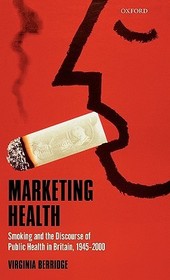
Marketing Health
Smoking and the Discourse of Public Health in Britain, 1945-2000
-
10% KEDVEZMÉNY?
- A kedvezmény csak az 'Értesítés a kedvenc témákról' hírlevelünk címzettjeinek rendeléseire érvényes.
- Kiadói listaár GBP 165.00
-
78 828 Ft (75 075 Ft + 5% áfa)
Az ár azért becsült, mert a rendelés pillanatában nem lehet pontosan tudni, hogy a beérkezéskor milyen lesz a forint árfolyama az adott termék eredeti devizájához képest. Ha a forint romlana, kissé többet, ha javulna, kissé kevesebbet kell majd fizetnie.
- Kedvezmény(ek) 10% (cc. 7 883 Ft off)
- Kedvezményes ár 70 946 Ft (67 568 Ft + 5% áfa)
Iratkozzon fel most és részesüljön kedvezőbb árainkból!
Feliratkozom
78 828 Ft

Beszerezhetőség
Megrendelésre a kiadó utánnyomja a könyvet. Rendelhető, de a szokásosnál kicsit lassabban érkezik meg.
Why don't you give exact delivery time?
A beszerzés időigényét az eddigi tapasztalatokra alapozva adjuk meg. Azért becsült, mert a terméket külföldről hozzuk be, így a kiadó kiszolgálásának pillanatnyi gyorsaságától is függ. A megadottnál gyorsabb és lassabb szállítás is elképzelhető, de mindent megteszünk, hogy Ön a lehető leghamarabb jusson hozzá a termékhez.
A termék adatai:
- Kiadó OUP Oxford
- Megjelenés dátuma 2007. július 19.
- ISBN 9780199260300
- Kötéstípus Keménykötés
- Terjedelem360 oldal
- Méret 223x146x23 mm
- Súly 599 g
- Nyelv angol
- Illusztrációk 12 halftones 0
Kategóriák
Rövid leírás:
Should politicians tell the public how to behave? Is it best for public health people to work with, or against, industrial interests? These are debates which still echo today. This book examines the way in which public health policy has changed and developed since the Second World War. It explains how public health began to focus on 'lifestyle' diseases, and looks at the debates which took place along the way, using smoking as a model.
TöbbHosszú leírás:
The post war history of public health and the role of smoking within that history epitomises the tensions which surround taking health to the public. Public health history has largely concentrated on the nineteenth century sanitary period or on the years before the Second World War, often focussing on the environmental advances, or on the professional and occupational history of public health as an activity. This book has a different focus: it deals with the change in the outlook of public health post war. From a focus on services, vaccination, and dealing with health issues at the local level, public health had developed new discourse. Centring on chronic disease, it became concerned with the concept of 'risk' and targeted individual behaviour. The mass media and centralised campaigning directed at the whole population replaced local campaigns, and politicians changed their mind about speaking directly to the public on health matters. Their early worries about the 'nanny state' gave place to a desire to inculcate new norms of behaviour, and it was debated how change was to be achieved.
Identifying debates between those believing in 'systematic gradualism' and those who advocated a more coercive approach, Virginia Berridge uses smoking as a model. Such debates brought into play tensions over the relationships between public health and industrial interests. Health campaigning by new style pressure groups like ASH, which were part state funded, was an important motive force behind the change.
In the 1980s and 1990s, public health changed again. Passive smoking and HIV/AIDS brought environmental concerns back into public health, which had disappeared after the 1950s. The 'rise of addiction' for smoking demonstrated the power of pharmaceutical interests to define a new 'pharmaceutical public health' in which treatment and 'magic bullets' were also tactics for prevention. In the early 21st century, public health was play to complex tensions and conflicting impetuses. This book shows that those tensions were nothing new and outlines their development over the last half century.
A consummate and finessed study of the many issues and wrangles around the politics of smoking in Britain in the second half of the twentieth century... a thoughtful and well-researched book.
Tartalomjegyzék:
Introduction: Marketing health. Smoking and the discourse 1-34 of public health, 1945-2000.
Public health in the 1950s; the watershed of smoking and lung cancer
Medicine and the media: marketing public health in the 1960s
Systematic gradualism: harm reduction public health and the industry 1950s-1971
Technical public health: the 1971 cross government enquiry and the rise of economics
Expert committees and regulation in the 1970s
The rise of health activism in the 1970s: the health pressure group
The new public health package
Environment and infectious disease in the 1980s: from passive smoking to AIDS
Medicating the underclass? Pharmaceutical public health and the discovery of addiction
Conclusion

