

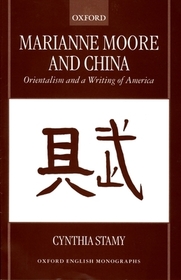
Marianne Moore and China
Orientalism and a Writing of America
Sorozatcím: Oxford English Monographs;
-
10% KEDVEZMÉNY?
- A kedvezmény csak az 'Értesítés a kedvenc témákról' hírlevelünk címzettjeinek rendeléseire érvényes.
- Kiadói listaár GBP 172.50
-
77 883 Ft (74 175 Ft + 5% áfa)
Az ár azért becsült, mert a rendelés pillanatában nem lehet pontosan tudni, hogy a beérkezéskor milyen lesz a forint árfolyama az adott termék eredeti devizájához képest. Ha a forint romlana, kissé többet, ha javulna, kissé kevesebbet kell majd fizetnie.
- Kedvezmény(ek) 10% (cc. 7 788 Ft off)
- Kedvezményes ár 70 095 Ft (66 758 Ft + 5% áfa)
Iratkozzon fel most és részesüljön kedvezőbb árainkból!
Feliratkozom
77 883 Ft

Beszerezhetőség
Megrendelésre a kiadó utánnyomja a könyvet. Rendelhető, de a szokásosnál kicsit lassabban érkezik meg.
Why don't you give exact delivery time?
A beszerzés időigényét az eddigi tapasztalatokra alapozva adjuk meg. Azért becsült, mert a terméket külföldről hozzuk be, így a kiadó kiszolgálásának pillanatnyi gyorsaságától is függ. A megadottnál gyorsabb és lassabb szállítás is elképzelhető, de mindent megteszünk, hogy Ön a lehető leghamarabb jusson hozzá a termékhez.
A termék adatai:
- Kiadó OUP Oxford
- Megjelenés dátuma 1999. december 16.
- ISBN 9780198184607
- Kötéstípus Keménykötés
- Terjedelem236 oldal
- Méret 223x145x18 mm
- Súly 404 g
- Nyelv angol 0
Kategóriák
Rövid leírás:
Marianne Moore's consistent ingenuity in employing Chinese models makes her work a particularly fruitful source for investigating orientalism and its contribution to modern poetry. Cynthia Stamy explores how Moore used the Far East to express her own dissatisfaction with contemporary trends in the writing of poetry, and how she embraced the more ancient culture of China as a means of resisting the American habit of looking to Europe as a singular source of cultural tradition 'at home'.
TöbbHosszú leírás:
Marianne Moore's poetry offers an extraordinarily rich site from which to analyse a tradition of American orientalism which focused upon China. Marianne Moore and China examines why she chose to participate in that tradition and analyses why her borrowing of Chinese models of all kinds - from poetry to painting and philosophy - was so critical to the formation of her verse. Moore's poetry is part of a long tradition of satirical critique in orientalist writing which finds its roots in English literature. In the early twentieth century, this tradition of critique in orientalist prose was adopted by American poets, who borrowed Far Eastern poetic models to permanently transform the ways in which poetry in English was being written by launching a literary assault upon what they saw as outmoded methods of versification. Moore used the Far East to express her own dissatisfaction with contemporary trends in the writing of poetry, and embraced the more ancient culture of China as a means of resisting the American habit of looking to Europe as a singular source of cultural tradition 'at home'.
Moore employed features of the ancient Chinese fu technique in her poems and used images of Chinese supernatural creatures in an effort to establish an alternative to logic and narrative linearity and to facilitate the moral didacticism for which her poetry is known. Moore's use of Chinese painting theory and philosophy in the creation of her poems enabled her to explore alternatives to Western perspectival principles and to Western ways of narrating visual experience. Marianne Moore and China also examines the ways in which Chinese linguistic features provide Moore with models for her compound nouns and syntactical ellipses, and gathers evidence to show that her abiding concerns for precision, brevity and restraint have both Confucian and Puritan antecedents. Additionally, this book analyses the degree to which her collection of quotations, from which she fashions so many of her poems, and her citation of them in numerous appended notes, are complicit in the same process of acquisition and display which characterizes the activity of the museum, the preoccupations of the curio-collector, and the pursuit of minute detail in orientalist discourse generally. Moore's consistent ingenuity in employing Chinese forms and methods makes her work a particularly fruitful source for investigating orientalism and its contribution to modern poetry.
Excellent study of Moore's interest in and contribution to American orientalism ... This fascinating study reveals an unexplored dimension of this poet's work, suggesting that it was not only Pound who mined Chinese sources

