

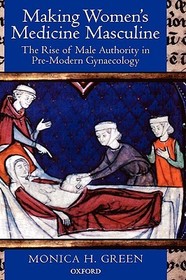
Making Women's Medicine Masculine
The Rise of Male Authority in Pre-Modern Gynaecology
-
10% KEDVEZMÉNY?
- A kedvezmény csak az 'Értesítés a kedvenc témákról' hírlevelünk címzettjeinek rendeléseire érvényes.
- Kiadói listaár GBP 202.50
-
91 428 Ft (87 075 Ft + 5% áfa)
Az ár azért becsült, mert a rendelés pillanatában nem lehet pontosan tudni, hogy a beérkezéskor milyen lesz a forint árfolyama az adott termék eredeti devizájához képest. Ha a forint romlana, kissé többet, ha javulna, kissé kevesebbet kell majd fizetnie.
- Kedvezmény(ek) 10% (cc. 9 143 Ft off)
- Kedvezményes ár 82 286 Ft (78 368 Ft + 5% áfa)
Iratkozzon fel most és részesüljön kedvezőbb árainkból!
Feliratkozom
91 428 Ft

Beszerezhetőség
Megrendelésre a kiadó utánnyomja a könyvet. Rendelhető, de a szokásosnál kicsit lassabban érkezik meg.
Why don't you give exact delivery time?
A beszerzés időigényét az eddigi tapasztalatokra alapozva adjuk meg. Azért becsült, mert a terméket külföldről hozzuk be, így a kiadó kiszolgálásának pillanatnyi gyorsaságától is függ. A megadottnál gyorsabb és lassabb szállítás is elképzelhető, de mindent megteszünk, hogy Ön a lehető leghamarabb jusson hozzá a termékhez.
A termék adatai:
- Kiadó OUP Oxford
- Megjelenés dátuma 2008. március 20.
- ISBN 9780199211494
- Kötéstípus Keménykötés
- Terjedelem432 oldal
- Méret 241x182x27 mm
- Súly 797 g
- Nyelv angol
- Illusztrációk 25 halftones; 3 tables 0
Kategóriák
Rövid leírás:
Using sources ranging from the famous 12th-century female practitioner, Trota of Salerno, through to the great tomes of Renaissance male physicians, this is a pioneering study challenging the common belief that, prior to the 18th century, men were never involved in any aspect of women's healthcare in Europe.
TöbbHosszú leírás:
Making Women's Medicine Masculine challenges the common belief that prior to the eighteenth century men were never involved in any aspect of women's healthcare in Europe. Using sources ranging from the writings of the famous twelfth-century female practitioner, Trota of Salerno, all the way to the great tomes of Renaissance male physicians, and covering both medicine and surgery, this study demonstrates that men slowly established more and more authority in diagnosing and prescribing treatments for women's gynaecological conditions (especially infertility) and even certain obstetrical conditions.
Even if their 'hands-on' knowledge of women's bodies was limited by contemporary mores, men were able to establish their increasing authority in this and all branches of medicine due to their greater access to literacy and the knowledge contained in books, whether in Latin or the vernacular. As Monica Green shows, while works written in French, Dutch, English, and Italian were sometimes addressed to women, nevertheless even these were often re-appropriated by men, both by practitioners who treated women and by laymen interested to learn about the 'secrets' of generation.
While early in the period women were considered to have authoritative knowledge on women's conditions (hence the widespread influence of the alleged authoress 'Trotula'), by the end of the period to be a woman was no longer an automatic qualification for either understanding or treating the conditions that most commonly afflicted the female sex - with implications of women's exclusion from production of knowledge on their own bodies extending to the present day.
[An] excellent new book... Green has painstakingly studied the content and circulation of medieval texts on women's medicine...[and] disproves popular ideas of the Middle Ages as a Golden Age for women's control over their own bodies.
Tartalomjegyzék:
Preface
Introduction: literacy, medicine, and gender
The gentle hand of a woman? Trota and women's medicine at Salerno
Men's practice of women's medicine in the thirteenth and fourteenth centuries
Bruno's paradox: women and literate medicine
In a language women understand: the gender of the vernacular
Slander and the secrets of women
The masculine birth of gynaecology
The medieval legacy: medicine of, for, and by women
Appendix I: medieval and Renaissance owners of Trotula manuscripts
Printed gynaecological and obstetrical texts, 1474-1600
References
Index of manuscripts cited
General Index

