

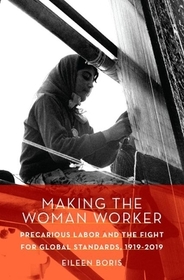
Making the Woman Worker
Precarious Labor and the Fight for Global Standards, 1919-2019
-
20% KEDVEZMÉNY?
- A kedvezmény csak az 'Értesítés a kedvenc témákról' hírlevelünk címzettjeinek rendeléseire érvényes.
- Kiadói listaár GBP 36.49
-
16 475 Ft (15 690 Ft + 5% áfa)
Az ár azért becsült, mert a rendelés pillanatában nem lehet pontosan tudni, hogy a beérkezéskor milyen lesz a forint árfolyama az adott termék eredeti devizájához képest. Ha a forint romlana, kissé többet, ha javulna, kissé kevesebbet kell majd fizetnie.
- Kedvezmény(ek) 20% (cc. 3 295 Ft off)
- Kedvezményes ár 13 180 Ft (12 552 Ft + 5% áfa)
- A kedvezmény érvényes eddig: 2026. június 30.
Iratkozzon fel most és részesüljön kedvezőbb árainkból!
Feliratkozom
16 475 Ft

Beszerezhetőség
Becsült beszerzési idő: A Prosperónál jelenleg nincsen raktáron, de a kiadónál igen. Beszerzés kb. 3-5 hét..
A Prosperónál jelenleg nincsen raktáron.
Why don't you give exact delivery time?
A beszerzés időigényét az eddigi tapasztalatokra alapozva adjuk meg. Azért becsült, mert a terméket külföldről hozzuk be, így a kiadó kiszolgálásának pillanatnyi gyorsaságától is függ. A megadottnál gyorsabb és lassabb szállítás is elképzelhető, de mindent megteszünk, hogy Ön a lehető leghamarabb jusson hozzá a termékhez.
A termék adatai:
- Kiadó OUP USA
- Megjelenés dátuma 2019. október 10.
- ISBN 9780190874629
- Kötéstípus Keménykötés
- Terjedelem352 oldal
- Méret 163x234x22 mm
- Súly 590 g
- Nyelv angol
- Illusztrációk 18 0
Kategóriák
Rövid leírás:
This book explains how the 20th century labor standard regime, forged by the International Labor Organization, cast the woman worker as a special type of worker, but a century later, previously excluded home-based workers placed caring labor at the center of debates over the future of work amid new precarity.
TöbbHosszú leírás:
Founded in 1919 along with the League of Nations, the International Labour Organization (ILO) establishes labor standards and produces knowledge about the world of work, serving as a forum for nations, unions, and employer associations. Before WWII, it focused on enhancing conditions for male industrial workers in Western, often imperial, economies, while restricting the circumstances of women's labors. Over time, the ILO embraced non-discrimination and equal treatment. It now promotes fair globalization, standardized employment and decent work for women in the developing world. In Making the Woman Worker, Eileen Boris illuminates the ILO's transformation in the context of the long fight for social justice.
Boris analyzes three ways in which the ILO has classified the division of labor: between women and men from 1919 to 1958; between women in the global south and the west from 1955 to 1996; and between the earning and care needs of all workers from 1990s to today. Before 1945, the ILO focused on distinguishing feminized labor from male workers, whom the organization prioritized. But when the world needed more women workers, the ILO (a UN agency after WWII) highlighted the global differences in women's work, began to combat sexism in the workplace, and declared care work essential to women's labor participation. Today, the ILO enters its second century with a mission to protect the interests of all workers in the face of increasingly globalized supply chains, the digitization of homework, and cross-border labor trafficking.
As Boris shows, the ILO's treatment of women is a window into the modern history of labor. The historic relegation of feminized labor to the part-time, short-term, and low-waged prefigures the future organization of work. The labor force is increasingly self-employed and working as long as possible--a steep price for flexibility--with minimal governmental oversight. How we treat workers in the next century will inevitably build upon evolving ideas of the woman worker, shaped significantly through the ILO.
Eileen Boris's Making the Woman Worker offers a fundamentally important contribution to the thriving research on twentieth-century global feminisms, to histories of the changing conditions of (women's) work, and to understandings of supranational organisations and the UN system.
Tartalomjegyzék:
Prologue
Acknowledgments
Abbreviations
Note on Nomenclature
List of Illustrations
Introduction: Making Women, Defining Work
I. Difference: The Problem of the Woman Worker, 1919-1958
1. Protection
2. Equality
II. Difference's Other: Women in "Developing" Countries, 1944-1996
3. Development
4. Reproduction
5. Outwork
III. Difference All: Centering Care, 1990s-2010s
6. Home
7. Women's Place (in the Future of Work)
Appendix 1 List of Key Conventions and Recommendations
Appendix 2 Publications of the Programme on Rural Women, 1978-1988

