

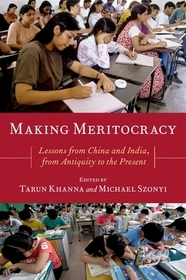
Making Meritocracy
Lessons from China and India, from Antiquity to the Present
Sorozatcím: Modern South Asia;
-
10% KEDVEZMÉNY?
- A kedvezmény csak az 'Értesítés a kedvenc témákról' hírlevelünk címzettjeinek rendeléseire érvényes.
- Kiadói listaár GBP 29.49
-
13 314 Ft (12 680 Ft + 5% áfa)
Az ár azért becsült, mert a rendelés pillanatában nem lehet pontosan tudni, hogy a beérkezéskor milyen lesz a forint árfolyama az adott termék eredeti devizájához képest. Ha a forint romlana, kissé többet, ha javulna, kissé kevesebbet kell majd fizetnie.
- Kedvezmény(ek) 10% (cc. 1 331 Ft off)
- Kedvezményes ár 11 983 Ft (11 412 Ft + 5% áfa)
Iratkozzon fel most és részesüljön kedvezőbb árainkból!
Feliratkozom
13 314 Ft

Beszerezhetőség
Becsült beszerzési idő: A Prosperónál jelenleg nincsen raktáron, de a kiadónál igen. Beszerzés kb. 3-5 hét..
A Prosperónál jelenleg nincsen raktáron.
Why don't you give exact delivery time?
A beszerzés időigényét az eddigi tapasztalatokra alapozva adjuk meg. Azért becsült, mert a terméket külföldről hozzuk be, így a kiadó kiszolgálásának pillanatnyi gyorsaságától is függ. A megadottnál gyorsabb és lassabb szállítás is elképzelhető, de mindent megteszünk, hogy Ön a lehető leghamarabb jusson hozzá a termékhez.
A termék adatai:
- Kiadó OUP USA
- Megjelenés dátuma 2022. október 13.
- ISBN 9780197602478
- Kötéstípus Puhakötés
- Terjedelem400 oldal
- Méret 157x233x27 mm
- Súly 567 g
- Nyelv angol 245
Kategóriák
Rövid leírás:
How do societies identify and promote merit? Enabling all people to fulfill their potential, and ensuring the selection of competent and capable leaders are central challenges for any society, and failure to meet them can have enormous costs. In Making Meritocracy, Tarun Khanna and Michael Szonyi have gathered over a dozen experts from a range of intellectual perspectives to discuss how China and India have addressed the issue of building meritocracy historically, philosophically, and in practice. Though the past, present, and future of meritocracy building in China and India have distinctive local inflections, their attempts to enhance their power, influence, and social well-being by prioritizing merit-based advancement offers rich lessons both for one another and for the rest of the world.
TöbbHosszú leírás:
How do societies identify and promote merit? Enabling all people to fulfill their potential, and ensuring the selection of competent and capable leaders are central challenges for any society. These are not new concerns. Scholars, educators, and political and economic elites in China and India have been pondering them for centuries and continue to do so today, with enormously high stakes.
In Making Meritocracy, Tarun Khanna and Michael Szonyi have gathered over a dozen experts from a range of intellectual perspectives--political science, history, philosophy, anthropology, economics, and applied mathematics--to discuss how the two most populous societies in the world have addressed the issue of building meritocracy historically, philosophically, and in practice. They focus on how contemporary policy makers, educators, and private-sector practitioners seek to promote it today. Importantly, they also discuss Singapore, which is home to large Chinese and Indian populations and the most successful meritocracy in recent times. Both China and India look to it for lessons. Though the past, present, and future of meritocracy building in China and India have distinctive local inflections, their attempts to enhance their power, influence, and social well-being by prioritizing merit-based advancement offers rich lessons both for one another and for the rest of the world--including rich countries like the United States, which are currently witnessing broad-based attacks on the very idea of meritocracy.
This remarkable series of essays examines the central issue of meritocracy from a broad yet complementary set of perspectives, from the historical to the contemporary and into the future. This novel and holistic approach allows for a much deeper and more nuanced understanding of this complex topic. I highly recommend this thought-provoking book as a must-read publication for both specialist and generalist readers.
Tartalomjegyzék:
Acknowledgements
Introduction
Tarun Khanna and Michael Szonyi
Philosophical
1. Political Theologies of Justice: Meritocratic Values from a Global Perspective
Michael Puett
2. Merit in the Mirror of Democracy: Caste and Affirmative Action in India
Ashutosh Varshney
3. Political Meritocracy in China: The Ideal versus the Reality
Daniel A. Bell
Historical
4. Locating Meritocracy in Early Modern Asia: Qing China and Mughal India
Sudev Sheth and Lawrence LC Zhang
5. Meritocratic Empires? South Asia c.1600-1947
Sumit Guha
6. Meritocracy and the Making of the Chinese Academe Redux, 1912-1952
James Lee, Bamboo Yunzhu Ren, and Chen Liang (Nanjing University)
Contemporary
7. The Origins and Effects of Affirmative Action Policies in India
Ashwini Deshpande
8. Merit and Caste at Elite Institutions: The Case of the IIT
Ajantha Subramanian
9. The National College Entrance Examination and the Myth of Meritocracy in Post-Mao China
Zachary M. Howlett
Prospective
10. The Singaporean Meritocracy: Theory, Practice and Policy Implications
Vincent Chua, Randall Morck, and Bernard Yeung
11. The Merits and Limits of China's Modern Universities
William C. Kirby
12. Reimagining Merit in India: Cognition and Affirmative Action
D Shyam Babu, Devesh Kapur, and Chandra Bhan Prasad
13. Meritocracy Enabled by Technology, Grounded in Science
Varun Aggarwal
Afterword
Tarun Khanna and Michael Szonyi

