

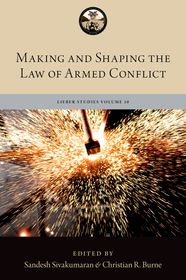
Making and Shaping the Law of Armed Conflict
Sorozatcím: The Lieber Studies Series;
-
20% KEDVEZMÉNY?
- A kedvezmény csak az 'Értesítés a kedvenc témákról' hírlevelünk címzettjeinek rendeléseire érvényes.
- Kiadói listaár GBP 91.00
-
41 086 Ft (39 130 Ft + 5% áfa)
Az ár azért becsült, mert a rendelés pillanatában nem lehet pontosan tudni, hogy a beérkezéskor milyen lesz a forint árfolyama az adott termék eredeti devizájához képest. Ha a forint romlana, kissé többet, ha javulna, kissé kevesebbet kell majd fizetnie.
- Kedvezmény(ek) 20% (cc. 8 217 Ft off)
- Kedvezményes ár 32 869 Ft (31 304 Ft + 5% áfa)
- A kedvezmény érvényes eddig: 2026. június 30.
Iratkozzon fel most és részesüljön kedvezőbb árainkból!
Feliratkozom
41 086 Ft

Beszerezhetőség
Becsült beszerzési idő: A Prosperónál jelenleg nincsen raktáron, de a kiadónál igen. Beszerzés kb. 3-5 hét..
A Prosperónál jelenleg nincsen raktáron.
Why don't you give exact delivery time?
A beszerzés időigényét az eddigi tapasztalatokra alapozva adjuk meg. Azért becsült, mert a terméket külföldről hozzuk be, így a kiadó kiszolgálásának pillanatnyi gyorsaságától is függ. A megadottnál gyorsabb és lassabb szállítás is elképzelhető, de mindent megteszünk, hogy Ön a lehető leghamarabb jusson hozzá a termékhez.
A termék adatai:
- Kiadó OUP USA
- Megjelenés dátuma 2025. január 31.
- ISBN 9780197775134
- Kötéstípus Keménykötés
- Terjedelem394 oldal
- Méret 239x164x29 mm
- Súly 699 g
- Nyelv angol 667
Kategóriák
Rövid leírás:
This volume in the Lieber Studies series explores how the law of armed conflict is made and shaped. It examines the fundamental materials of the law of armed conflict, key actors and influences, the spaces where the law is made, as well as questions of unmaking.
TöbbHosszú leírás:
How laws are created, shaped, and applied is a significant but often overlooked component of studies on armed conflict. Almost every contentious legal question involves aspects of law-making and shaping, be it the determination of a rule's scope of application, whether and how to regulate a “new” situation, or determining which sources and materials to take into account. As such, all who operate in this space - whether academic, practitioner, policy-maker, or legal advisor - must appreciate and understand the forces, factors, and actors which converge to make and shape the ever-developing law of armed conflict.
This volume brings together several key contributors to explore this making and shaping in depth. A variety of aspects of law-making and shaping are analyzed, from the methodology behind identifying principles and rules of law, to what weight should be given to the views of particular actors, to the various forums where the law is made and shaped. It examines foundational materials of the law of armed conflict including the 1949 Geneva Conventions and considers the influence of a wide scope of actors, ranging from States, the International Committee of the Red Cross, and international courts and tribunals through to expert groups, commissions of inquiry, and non-state armed groups. This volume also asks us to broaden our gaze beyond spaces where the law is traditionally created to uncover different types of making and unmaking
Tartalomjegyzék:
PART ONE: Introduction
1. Making and Shaping: An Overview
Sandesh Sivakumaran and Christian R. Burne
PART TWO: Foundational Materials
2. Where Vienna and Geneva Meet: Treaty Interpretation and the Geneva Conventions
Jean-Marie Henckaerts
3. Customary International Law: A Transformative Force in the Landscape of IHL
Katharine Fortin
4. Principles of International Humanitarian Law: A New Framework
Jeroen van den Boogaard
5. Soft Law: What is it Good For?
Michael W. Meier
PART THREE: Actors and Influences
6. Expert Manuals: An Insider's Account
Michael N. Schmitt
7. The Development of International Humanitarian Law by the International Committee of the Red Cross
Sandesh Sivakumaran
8. Applying the Law of Armed Conflict in Domestic Courts: The Fusion of Domestic and International Law and the Question of IHL Expertise
Yahli Shereshevsky
9. The Development of the Law of Armed Conflict by International Criminal Tribunals
Martha M. Bradley
10. The Role of Human Rights Mechanisms in Shaping International Humanitarian Law
Alessandra Spadaro
11. Applying and Interpreting the Law of Armed Conflict: Contributions by the United Nations Commissions on the Syrian Arab Republic and the Republic of South Sudan
Yousuf Syed Khan
12. Non-State Armed Groups, Law-Making, and the Shaping of International Law in Armed Conflict
Ezequiel Heffes
PART FOUR: Spaces
13. The Role of Regionalism in the Making and Shaping of the Law of Armed Conflict
Gus Waschefort
14. Between War and the Text: The Pedagogical Life of International Humanitarian Law
Rebecca Sutton
PART FIVE: Unmaking
15. A Prologue to Law of War Unmaking
Sean Watts

