

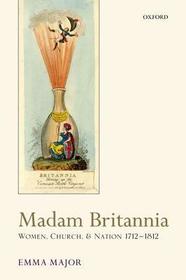
Madam Britannia
Women, Church, and Nation 1712-1812
-
10% KEDVEZMÉNY?
- A kedvezmény csak az 'Értesítés a kedvenc témákról' hírlevelünk címzettjeinek rendeléseire érvényes.
- Kiadói listaár GBP 142.50
-
64 338 Ft (61 275 Ft + 5% áfa)
Az ár azért becsült, mert a rendelés pillanatában nem lehet pontosan tudni, hogy a beérkezéskor milyen lesz a forint árfolyama az adott termék eredeti devizájához képest. Ha a forint romlana, kissé többet, ha javulna, kissé kevesebbet kell majd fizetnie.
- Kedvezmény(ek) 10% (cc. 6 434 Ft off)
- Kedvezményes ár 57 905 Ft (55 148 Ft + 5% áfa)
Iratkozzon fel most és részesüljön kedvezőbb árainkból!
Feliratkozom
64 338 Ft

Beszerezhetőség
Megrendelésre a kiadó utánnyomja a könyvet. Rendelhető, de a szokásosnál kicsit lassabban érkezik meg.
Why don't you give exact delivery time?
A beszerzés időigényét az eddigi tapasztalatokra alapozva adjuk meg. Azért becsült, mert a terméket külföldről hozzuk be, így a kiadó kiszolgálásának pillanatnyi gyorsaságától is függ. A megadottnál gyorsabb és lassabb szállítás is elképzelhető, de mindent megteszünk, hogy Ön a lehető leghamarabb jusson hozzá a termékhez.
A termék adatai:
- Kiadó OUP Oxford
- Megjelenés dátuma 2011. december 1.
- ISBN 9780199699377
- Kötéstípus Keménykötés
- Terjedelem384 oldal
- Méret 240x164x33 mm
- Súly 722 g
- Nyelv angol
- Illusztrációk 36 black-and-white halftones 0
Kategóriák
Rövid leírás:
Using Britannia as a central figure, this book explores the neglected relationship between women, church, and nation. Drawing on a wealth of manuscript, printed, and graphic material, Emma Major argues that Britannia became established as an emblem of nation from 1688 and gained in importance over the following century.
TöbbHosszú leírás:
Madam Britannia: Women, Church, and Nation, 1712-1812 explores the complex and fascinating relationship between women, Protestantism, and nationhood. Opening with a history of Britannia, this book argues that Britannia becomes increasingly popular as a national emblem from 1688 onwards. Over the eighteenth century, depictions of Britannia become exemplary as well as emblematic, her behaviour to be imitated as well as admired. Britannia takes life during the eighteenth century, stepping out of iconic representation on coins, out of the pages of James Thomson's poetry, down from the stage of David Mallett's plays, the frames of Francis Hayman and William Hogarth's paintings, and John Flaxman's monuments to enter people's lives as an identity to be experienced.
One of the key strands explored in this book is Britannia's relationship to female personifications of the Church of England, which themselves often drew on key Protestant Queens such as Elizabeth I and Anne. But during the eighteenth century, Britannia also gained cultural status by being a female figure of nationhood at a time when Enlightenment historians developed conjectural histories which placed women at the centre of civilisation. Women's religion, conversation, and social practice thus had a new resonance in this new, self-consciously civilised age. In this book, Emma Major looks at how narratives of faith, national identity, and civilisation allowed women such as Elizabeth Burnet, Elizabeth Montagu, Catherine Talbot, Anna Laetitia Barbauld, Hester Lynch Thrale Piozzi, and Hannah More to see themselves as active agents in the shaping of the nation.
[This is] a wonderfully rich and impressive study. It provides an original new assessment of women's public and religious sensibilities, and it also demonstrates convincingly that female religiosity was central to contemporaries' conceptualization of public life.
Tartalomjegyzék:
Introduction. Madam Britannia
The History of Madam Britannia
Performing Madam Britannia and The Blessing Of Example
Protestant Nunneries, Polygamy, and Christian Heroes
The Church of England, Methodism, and 'the province of public virtue
The Politics of Paradise: Insurrection, Sunday Schools, and Elizabeth Vesey's Dragon
'A free Government & Religion rational & pure': Two versions of nation
The Contrast I: Serpents, Rocks, and the Gates of Hell
The Contrast II: Bruising the Serpent's Head, the Little Sister, and Christian Professions
Epilogue
Bibliography

