

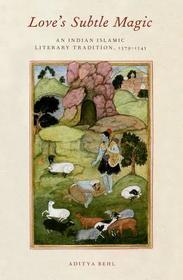
Love's Subtle Magic
An Indian Islamic Literary Tradition, 1379-1545
-
10% KEDVEZMÉNY?
- A kedvezmény csak az 'Értesítés a kedvenc témákról' hírlevelünk címzettjeinek rendeléseire érvényes.
- Kiadói listaár GBP 58.00
-
27 709 Ft (26 390 Ft + 5% áfa)
Az ár azért becsült, mert a rendelés pillanatában nem lehet pontosan tudni, hogy a beérkezéskor milyen lesz a forint árfolyama az adott termék eredeti devizájához képest. Ha a forint romlana, kissé többet, ha javulna, kissé kevesebbet kell majd fizetnie.
- Kedvezmény(ek) 10% (cc. 2 771 Ft off)
- Kedvezményes ár 24 939 Ft (23 751 Ft + 5% áfa)
Iratkozzon fel most és részesüljön kedvezőbb árainkból!
Feliratkozom
27 709 Ft

Beszerezhetőség
Megrendelésre a kiadó utánnyomja a könyvet. Rendelhető, de a szokásosnál kicsit lassabban érkezik meg.
Why don't you give exact delivery time?
A beszerzés időigényét az eddigi tapasztalatokra alapozva adjuk meg. Azért becsült, mert a terméket külföldről hozzuk be, így a kiadó kiszolgálásának pillanatnyi gyorsaságától is függ. A megadottnál gyorsabb és lassabb szállítás is elképzelhető, de mindent megteszünk, hogy Ön a lehető leghamarabb jusson hozzá a termékhez.
A termék adatai:
- Kiadó OUP USA
- Megjelenés dátuma 2016. szeptember 8.
- ISBN 9780190628802
- Kötéstípus Puhakötés
- Terjedelem418 oldal
- Méret 155x231x17 mm
- Súly 408 g
- Nyelv angol 0
Kategóriák
Rövid leírás:
The encounter between Muslim and Hindu remains one of the defining issues of South Asian society today. This encounter began as early as the 8th century, and the first Muslim kingdom in India would be established at the end of the 12th century. This powerful kingdom, the Sultanate of Delhi, eventually reduced to vassalage almost every independent kingdom on the subcontinent. In Love's Subtle Magic, a remarkable and deeply original book, Aditya Behl uses a little-understood genre of Sufi literature to paint an entirely new picture of the evolution of Indian culture during the period of Muslim domination.
TöbbHosszú leírás:
The encounter between Muslim and Hindu remains one of the defining issues of South Asian society today. It began as early as the 8th century, and the first Muslim kingdom in India, the Sultanate of Delhi, was established at the end of the 12th century. This power eventually reduced to vassalage almost every independent kingdom on the subcontinent. In Love's Subtle Magic, a remarkable and highly original book, Aditya Behl uses a little-understood genre of Sufi literature to paint an entirely new picture of the evolution of Indian culture during the earliest period of Muslim domination.
These curious romantic tales transmit a profound religious message through the medium of adventurous stories of love. Although composed in the Muslim courts, they are written in a vernacular Indian language and involve Hindu yogis, Hindu princes and princesses, and Hindu gods. Until now, they have defied analysis. Behl shows that the Sufi authors of these charming tales sought to convey an Islamic vision via an Indian idiom. They thus constitute the earliest attempt at the indigenization of Islamic literature in an Indian setting. More important, however, Behl's analysis brilliantly illuminates the cosmopolitan and composite culture of the Sultanate India in which they were composed. This in turn compels us completely to rethink the standard of the opposition between Indian Hindu and foreign Muslim and recognize that the Indo-Islamic culture of this era was already significantly Indian in many important ways.
Doniger has edited an excellent volume constructed from lectures and drafts written by the late Behl...This volume is an indispensable guide to a long-ignored literary genre that provides glimpses into a society in which Hindus and Muslims, kings and commoners, composed a social order now divided into two hostile communities...Highly recommended.
Tartalomjegyzék:
Chapter 1: Studying the Sultanate Period
Chapter 2: Inaugurating Hindavi
Chapter 3: Creating a New Genre: The Candayan
Chapter 4: Oceans and Stories: The Mirigivati
Chapter 5: The Landscape of Paradise and the Embodied City: The Padmavat, Part 1
Chapter 6: The Conquest of Chittaur: The Padmavat, Part 2
Chapter 7: Bodies That Signify: The Madhumalati, Part 1
Chapter 8: The Seasons of Madhumalati's Separation: The Madhumalati, Part 2
Chapter 9: Hierarchies of Response
Epilogue: The Story of Stories
Notes
Index

