

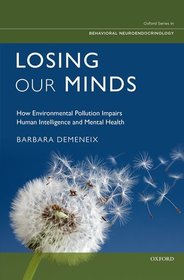
Losing Our Minds
How Environmental Pollution Impairs Human Intelligence and Mental Health
Sorozatcím: Oxford Series in Behavioral Neuroendocrinology;
-
10% KEDVEZMÉNY?
- A kedvezmény csak az 'Értesítés a kedvenc témákról' hírlevelünk címzettjeinek rendeléseire érvényes.
- Kiadói listaár GBP 83.00
-
37 474 Ft (35 690 Ft + 5% áfa)
Az ár azért becsült, mert a rendelés pillanatában nem lehet pontosan tudni, hogy a beérkezéskor milyen lesz a forint árfolyama az adott termék eredeti devizájához képest. Ha a forint romlana, kissé többet, ha javulna, kissé kevesebbet kell majd fizetnie.
- Kedvezmény(ek) 10% (cc. 3 747 Ft off)
- Kedvezményes ár 33 727 Ft (32 121 Ft + 5% áfa)
Iratkozzon fel most és részesüljön kedvezőbb árainkból!
Feliratkozom
37 474 Ft

Beszerezhetőség
Megrendelésre a kiadó utánnyomja a könyvet. Rendelhető, de a szokásosnál kicsit lassabban érkezik meg.
Why don't you give exact delivery time?
A beszerzés időigényét az eddigi tapasztalatokra alapozva adjuk meg. Azért becsült, mert a terméket külföldről hozzuk be, így a kiadó kiszolgálásának pillanatnyi gyorsaságától is függ. A megadottnál gyorsabb és lassabb szállítás is elképzelhető, de mindent megteszünk, hogy Ön a lehető leghamarabb jusson hozzá a termékhez.
A termék adatai:
- Kiadó OUP USA
- Megjelenés dátuma 2014. szeptember 11.
- ISBN 9780199917518
- Kötéstípus Keménykötés
- Terjedelem312 oldal
- Méret 157x236x25 mm
- Súly 590 g
- Nyelv angol
- Illusztrációk 49 illustrations 0
Kategóriák
Rövid leírás:
The exponential increases in neurodevelopmental disorders implicate both genetic causes and environmental factors. Flame-retardants, pesticides, plasticizers, and other every-day products contain chemicals shown to affect thyroid hormone signaling, which if disrupted can result in significant impairment to IQ. Across entire populations, such effects spell large-scale social and economic consequences.
TöbbHosszú leírás:
The global prevalence of neurodevelopmental disorders is accelerating. Numbers of children affected by an autism spectrum disorder (ASD) in the United States have reached 1 in 88 -- 1 in 56 among boys -- and even more children have developed attention deficit/hyperactivity disorders (ADHD). The burden of these disorders to individuals and society overall is enormous; ASD alone costs the United States a staggering $130 billion, with ADHD costs reaching similar heights.
Genetic causes of these neurodevelopmental disorders cannot account for such radically increased rates of incidence. The causes must also implicate environmental chemicals, many of which have been shown to disrupt normal thyroid function. In this book, Barbara Demeneix makes the case that thyroid hormone signaling bridges the environment and gene programs needed for brain development--and that environmental chemicals that disrupt normal thyroid function pose significant risks to the inherited intelligence and mental health of future generations.
The first chapter provides an historical overview of documented cases in which environmental pollution has caused IQ loss across populations. The following chapters explain the physiology of thyroid hormone action, the importance of iodine and selenium for thyroid hormone signaling and brain development, and why thyroid hormone is such a sensitive target for environmental pollution. The final chapters discuss the role of gene-environment interactions in neurodevelopmental disorders and address what can and must be done by individuals, associations, and decision-makers to staunch these epidemics.
Tartalomjegyzék:
Contents
1. Chemical Pollution and IQ Loss in Children: Learning from the Past
2. Thyroid Hormone, Iodine, Selenium, and Mercury
3. Thyroid Hormone and Brain Development: Bridging Environment to Gene Expression
4. Thyroid Hormone Signalling as a Target of Multiple Pollutants
5. Examples of Chemical Pollution Targeting Thyroid Hormone Action
6. Mixtures and Low Doses: The Complexity of Risk Assessment
7. Autism Spectrum Disorder, Attention Deficit/Hyperactivity Disorder, Congenital Hypothyroidism: The Case for Gene x Environment Interactions
8. What Can Be Done by Individuals, Associations and Governments: Time to End the Pied Piper Scenario

