

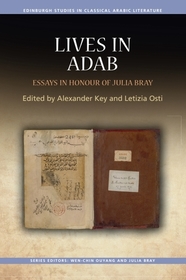
Lives in Adab
Essays in Honour of Julia Bray
Sorozatcím: Edinburgh Studies in Classical Arabic Literature;
-
20% KEDVEZMÉNY?
- A kedvezmény csak az 'Értesítés a kedvenc témákról' hírlevelünk címzettjeinek rendeléseire érvényes.
- Kiadói listaár GBP 100.00
-
45 150 Ft (43 000 Ft + 5% áfa)
Az ár azért becsült, mert a rendelés pillanatában nem lehet pontosan tudni, hogy a beérkezéskor milyen lesz a forint árfolyama az adott termék eredeti devizájához képest. Ha a forint romlana, kissé többet, ha javulna, kissé kevesebbet kell majd fizetnie.
- Kedvezmény(ek) 20% (cc. 9 030 Ft off)
- Kedvezményes ár 36 120 Ft (34 400 Ft + 5% áfa)
- A kedvezmény érvényes eddig: 2026. június 30.
Iratkozzon fel most és részesüljön kedvezőbb árainkból!
Feliratkozom
45 150 Ft

Beszerezhetőség
Még nem jelent meg, de rendelhető. A megjelenéstől számított néhány héten belül megérkezik.
Why don't you give exact delivery time?
A beszerzés időigényét az eddigi tapasztalatokra alapozva adjuk meg. Azért becsült, mert a terméket külföldről hozzuk be, így a kiadó kiszolgálásának pillanatnyi gyorsaságától is függ. A megadottnál gyorsabb és lassabb szállítás is elképzelhető, de mindent megteszünk, hogy Ön a lehető leghamarabb jusson hozzá a termékhez.
A termék adatai:
- Kiadó Edinburgh University Press
- Megjelenés dátuma 2026. május 31.
- ISBN 9781399543132
- Kötéstípus Keménykötés
- Terjedelem496 oldal
- Méret 234x156 mm
- Nyelv angol 700
Kategóriák
Rövid leírás:
Essays and translations by modern-day scholars organised along the principles of the Arabic narrative tradition.
TöbbHosszú leírás:
Adab is not an English word, but it could become one. This collection, in honour of Julia Bray, experiments with juxtaposed articles, quotations, translations and lines of poetry to let readers create connections in the same way authors did a thousand years ago in Arabic. The collaboration is inspired by the ongoing work of Julia Bray, which continues to demonstrate the rewards of taking what we read seriously.
The field of Arabic studies is increasingly rejecting a hard line between the modern and the premodern. This book is an intervention in that development – arguing that the premodern can structure contemporary thinking. It offers translations, commentaries and discussions of important and insufficiently known primary texts together with the original Arabic text of poems. These cross-genre and cross-disciplinary connections can catalyse future research and show how a key feature of the Arabic literary tradition is relevant to how we think about scholarship today. The chapters provide readers with both an academic resource and an intellectual conversation with the past.
Tartalomjegyzék:
Transliterations, Translations and Thanks
List of Illustrations
1. Practical adab and the practice of adab
Alexander Key and Letizia Osti
2. Bodily peculiarities and lists in Ibn Qutayba’s Kitab al-maʿarif
Antonella Ghersetti
3. Insects: The Tiniest Creatures in Kalila wa-Dimna
Beatrice Gruendler with Dima Mustafa Sakran and Mahmoud Kozae
4. The absence of Baghdad in the ʿIqd al-farid--Abbasid myth in the making
Isabel Toral
5. Nobility and Prestige (شرف) as Criteria for Inclusion in Anthologies
Bilal W. Orfali and Maurice A. Pomerantz
6. The Novel in Adab: a Modern genre placed in conversation with al-Tanukhi
Alexander Key
7. Al-birka al-husna and the birkas of Samarra
Alastair Northedge
8. Al-Mutanabbi in Tiberias and Shiraz
James E. Montgomery
9. Virtue in Misfortune: al-Buhturi on al-Fath ibn Khaqan’s Fall from a Bridge
Gabrielle Russo
10. Barmakid Benevolence: An Account from Deliverance Follows Adversity
Shawkat M. Toorawa
11. Al-Tanukhi, Storytelling and Adab
Wen-chin Ouyang
12. A text from AR3222
Robert Hoyland
13. Letter to a treacherous lover: love and responsibility in Abbasid romance
Pernilla Myrne
14. Parody and Play, Gender and Genre
Jonny Lawrence
15. Trailing John Greaves’s Timeline
Taha Yasin Arslan, Fyza Parviz Jazra
16. In Search of Intertexts: Literary Imitation, Authorial Lineage and Networked Time in Premodern Arabic Criticism
James White
17. Death in the monastery: visualising emotions, space, and performance in al-Tanukhi
Letizia Osti
18. The flattening of the Arabic lexicon
Michael Cooperson
19. Ibn Taymiyya on Reason, Anger and Desire
Robert Gleave
20. The Emotional Lives of Prophets in al-Kisaʾi’s Qisas al-anbiyaʾ
Helen Blatherwick
21. Remarks on Recognition in Hadith and Akhbar
Philip Kennedy
22. Inspired by Ibn al-Farid? An anonymous mukhammas (مُخَمَّس) featuring St. John of Damascus, St. Peter and the Virgin Mary
Hilary Kilpatrick
23. From Poem to Song: The Artistry of Singer-Composers in Abu l-Faraj al-Isbahani’s Kitab al-Aghani
Dwight F. Reynolds
24. Revisiting The Letter to the Proponents of Freewill (al-Risalah ila l-Qadariyyah) attributed to the Umayyad caliph ʿUmar b. ʿAbd al-ʿAziz (r. 99-101/717-720)
Sean W. Anthony
25. How to be a bad ruler: Miskawayh’s demolition of ʿIzz al-Dawla Bakhtiyar (r. 356/967-367-977)
Hugh Kennedy
26. Al-Tanukhi and the Arabian Adventure Tale
Peter Webb
27. Ibn Rushd on Fraud, Morality and The Law
Joseph E. Lowry
28. You Can Take it with You: Self, Wealth, and Legacy in Arabic Letters
Devin J. Stewart
Julia Bray’s Published Works to Date
Index
Bibliography

