

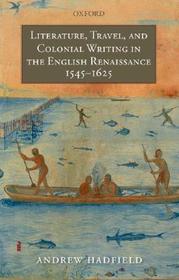
Literature, Travel, and Colonial Writing in the English Renaissance, 1545-1625
-
10% KEDVEZMÉNY?
- A kedvezmény csak az 'Értesítés a kedvenc témákról' hírlevelünk címzettjeinek rendeléseire érvényes.
- Kiadói listaár GBP 55.00
-
24 832 Ft (23 650 Ft + 5% áfa)
Az ár azért becsült, mert a rendelés pillanatában nem lehet pontosan tudni, hogy a beérkezéskor milyen lesz a forint árfolyama az adott termék eredeti devizájához képest. Ha a forint romlana, kissé többet, ha javulna, kissé kevesebbet kell majd fizetnie.
- Kedvezmény(ek) 10% (cc. 2 483 Ft off)
- Kedvezményes ár 22 349 Ft (21 285 Ft + 5% áfa)
Iratkozzon fel most és részesüljön kedvezőbb árainkból!
Feliratkozom
24 832 Ft

Beszerezhetőség
Megrendelésre a kiadó utánnyomja a könyvet. Rendelhető, de a szokásosnál kicsit lassabban érkezik meg.
Why don't you give exact delivery time?
A beszerzés időigényét az eddigi tapasztalatokra alapozva adjuk meg. Azért becsült, mert a terméket külföldről hozzuk be, így a kiadó kiszolgálásának pillanatnyi gyorsaságától is függ. A megadottnál gyorsabb és lassabb szállítás is elképzelhető, de mindent megteszünk, hogy Ön a lehető leghamarabb jusson hozzá a termékhez.
A termék adatai:
- Kiadó OUP Oxford
- Megjelenés dátuma 2007. október 4.
- ISBN 9780199233656
- Kötéstípus Puhakötés
- Terjedelem330 oldal
- Méret 215x136x18 mm
- Súly 403 g
- Nyelv angol
- Illusztrációk 13 halftones 0
Kategóriák
Rövid leírás:
Andrew Hadfield's innovative and wide-ranging study examines the ways in which Renaissance travel-writers used their works to reflect on the state of contemporary English politics. Exploring representations of Europe, the Americas, Africa, and the Far East, as well as some of the problems involved in the usual assumption that we can make sense of the past with the categories available to us, his work offers fresh readings of Shakespeare, Marlowe, More, and many others.
TöbbHosszú leírás:
What was the purpose of representing foreign lands for writers in the English Renaissance? This innovative and wide-ranging study argues that writers often used their works as vehicles to reflect on the state of contemporary English politics, particularly their own lack of representation in public institutions. Sometimes such analyses took the form of displaced allegories, whereby writers contrasted the advantages enjoyed, or disadvantages suffered, by foreign subjects with the political conditions of Tudor and Stuart England. Elsewhere, more often in explicitly colonial writings, authors meditated on the problems of government when faced with the possibly violent creation of a new society. If Venice was commonly held up as a beacon of republican liberty which England would do well to imitate, the fear of tyrannical Catholic Spain was ever present - inspiring and haunting much of the colonial literature from 1580 onwards. This stimulating book examines fictional and non-fictional writings, illustrating both the close connections between the two made by early modern readers and the problems involved in the usual assumption that we can make sense of the past with the categories available to us. Hadfield explores in his work representations of Europe, the Americas, Africa, and the Far East, selecting pertinent examples rather than attempting to embrace a total coverage. He also offers fresh readings of Shakespeare, Marlowe, More, Lyly, Hakluyt, Harriot, Nashe, and others.
Review from previous edition Hadfield's . . . scholarly and informed book . . . is an enterprising examination of the intricacies of political comment in Tudor and Stuart times, and he is adept in teasing out the significance of cautious multi-layered narrative.
Tartalomjegyzék:
Preface
Introduction: Changing Places in Renaissance Literature
Chapter One: `How harmful be the errors of princes': English Travellers in Europe, 1545-1620
Chapter Two: `What is the Matter with you Christian Men?': English Colonial Literature, 1555-1625
Chapter Three: `The perfect glass of state': English Fiction from William Baldwin to John Brady, 1553-1625
Chapter Four: `All my travels history': Reading the Locations of Renaissance Plays
Afterword
Bibliography
Index

