

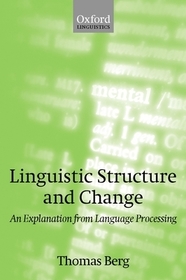
Linguistic Structure and Change
An Explanation from Language Processing
-
10% KEDVEZMÉNY?
- A kedvezmény csak az 'Értesítés a kedvenc témákról' hírlevelünk címzettjeinek rendeléseire érvényes.
- Kiadói listaár GBP 19.99
-
9 025 Ft (8 595 Ft + 5% áfa)
Az ár azért becsült, mert a rendelés pillanatában nem lehet pontosan tudni, hogy a beérkezéskor milyen lesz a forint árfolyama az adott termék eredeti devizájához képest. Ha a forint romlana, kissé többet, ha javulna, kissé kevesebbet kell majd fizetnie.
- Kedvezmény(ek) 10% (cc. 903 Ft off)
- Kedvezményes ár 8 122 Ft (7 736 Ft + 5% áfa)
Iratkozzon fel most és részesüljön kedvezőbb árainkból!
Feliratkozom
9 025 Ft

Beszerezhetőség
Megrendelésre a kiadó utánnyomja a könyvet. Rendelhető, de a szokásosnál kicsit lassabban érkezik meg.
Why don't you give exact delivery time?
A beszerzés időigényét az eddigi tapasztalatokra alapozva adjuk meg. Azért becsült, mert a terméket külföldről hozzuk be, így a kiadó kiszolgálásának pillanatnyi gyorsaságától is függ. A megadottnál gyorsabb és lassabb szállítás is elképzelhető, de mindent megteszünk, hogy Ön a lehető leghamarabb jusson hozzá a termékhez.
A termék adatai:
- Kiadó OUP Oxford
- Megjelenés dátuma 2001. február 15.
- ISBN 9780198299851
- Kötéstípus Puhakötés
- Terjedelem350 oldal
- Méret 233x156x20 mm
- Súly 507 g
- Nyelv angol
- Illusztrációk 4 black and white line figures 0
Kategóriák
Rövid leírás:
Thomas Berg analyses language as a psychological phenomenon in order to reach a clearer understanding of why the structure of language is the way it is and how it changes. He claims that real explanations of the structure of language can only emerge by establishing connections between language and its context. The explanatory power of one of these contexts, the psychological one, is examined in detail.
TöbbHosszú leírás:
Thomas Berg challenges context-free theories of linguistics; he is concerned with how the term 'explanation' is typically used in the discipline. He argues that real explanations cannot emerge from a view which asserts the autonomy of language, but only from an approach which seeks to establish a connection between language and the contexts in which it is embedded.
The author examines the psychological context in detail. He uses an interactive activation model of language processing to derive predictions about synchronic linguistic patterns, the course of linguistic change, and the structure of poetic rhymes. The majority of these predictions are borne out, and the author concludes that the structure of language is shaped by the properties of the mechanism which puts it to use, and that psycholinguistics thus qualifies as one likely approach from which to derive an explanation of linguistic structure.
The book can be praised for the breadth of linguistic and psycholinguistic patterns that are discussed, and for the way the results are integrated into a complete model of linguistic patterning . . . a much needed contribution to a relatively understudied area of linguistic research that is gradually entering the theoretical realm. This work has broad implications for many of the foundational issues of linguistic theory.
Tartalomjegyzék:
On the 'Art' of Explanation
Explanation from a Macrolinguistic Perspective
Method
Language Structure
Language Change
Poetic Language
Discussion
A Psycholinguistic Model of Language Structure and Change
Implications for Psycholinguistic Theory
The Overall Perspective: Reductionist or Non-Reductionist?

