

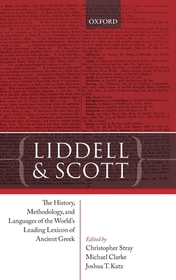
Liddell and Scott
The History, Methodology, and Languages of the World's Leading Lexicon of Ancient Greek
-
10% KEDVEZMÉNY?
- A kedvezmény csak az 'Értesítés a kedvenc témákról' hírlevelünk címzettjeinek rendeléseire érvényes.
- Kiadói listaár GBP 127.50
-
60 913 Ft (58 012 Ft + 5% áfa)
Az ár azért becsült, mert a rendelés pillanatában nem lehet pontosan tudni, hogy a beérkezéskor milyen lesz a forint árfolyama az adott termék eredeti devizájához képest. Ha a forint romlana, kissé többet, ha javulna, kissé kevesebbet kell majd fizetnie.
- Kedvezmény(ek) 10% (cc. 6 091 Ft off)
- Kedvezményes ár 54 821 Ft (52 211 Ft + 5% áfa)
Iratkozzon fel most és részesüljön kedvezőbb árainkból!
Feliratkozom
60 913 Ft

Beszerezhetőség
Megrendelésre a kiadó utánnyomja a könyvet. Rendelhető, de a szokásosnál kicsit lassabban érkezik meg.
Why don't you give exact delivery time?
A beszerzés időigényét az eddigi tapasztalatokra alapozva adjuk meg. Azért becsült, mert a terméket külföldről hozzuk be, így a kiadó kiszolgálásának pillanatnyi gyorsaságától is függ. A megadottnál gyorsabb és lassabb szállítás is elképzelhető, de mindent megteszünk, hogy Ön a lehető leghamarabb jusson hozzá a termékhez.
A termék adatai:
- Kiadó OUP Oxford
- Megjelenés dátuma 2019. október 21.
- ISBN 9780198810803
- Kötéstípus Keménykötés
- Terjedelem472 oldal
- Méret 241x162x32 mm
- Súly 886 g
- Nyelv angol
- Illusztrációk 19 black-and-white illustrations 5
Kategóriák
Rövid leírás:
Everyone who studies or researches ancient Greek uses the Greek-English Lexicon of Liddell and Scott: this volume brings together essays on all aspects of the history, constitution, and problematics of this extraordinary work, in order to better understand its significance for both Greek studies and the theory and practice of lexicography.
TöbbHosszú leírás:
The Greek-English Lexicon of Liddell and Scott is one of the most famous dictionaries in the world, and for the past century-and-a-half has been a constant and indispensable presence in teaching, learning, and research on ancient Greek throughout the English-speaking world and beyond. Despite continuous modification and updating, it is still recognizably a Victorian creation; at the same time, however, it carries undiminished authority both for its account of the Greek language and for its system of organizing and presenting linguistic data.
The present volume brings together essays by twenty-two scholars on all aspects of the history, constitution, and problematics of this extraordinary work, enabling the reader both to understand its complex history and to appreciate it as a monument to the challenges and pitfalls of classical scholarship. The contributors have combined a variety of approaches and methodologies - historical, philological, theoretical - in order to situate the book within the various disciplines to which it is relevant, from semantics, lexicography, and historical linguistics, to literary theory, Victorian studies, and the history of the book. Paying tribute to the Lexicon's enormous effect on the evolving theory and practice of lexicography, it also includes a section looking forward to new developments in dictionary-making in the digital age, bringing comprehensively up to date the question of what the future holds for this fascinating and perplexing monument to the challenges of understanding an ancient language.
in the end ... what we have [in the existing 'Lexicon'] is a work of remarkably high quality. Put another way, LSJ remains not just important but essential for serious scholarly work on ancient Greek because, whatever else one may say about them and their 'Lexicon', Liddell, Scott, and Jones were very, very good at what they did.
Tartalomjegyzék:
Frontmatter
List of Figures and Tables
List of Abbreviations
List of Contributors
A Note on the History of the Lexicon
I. HISTORY AND CONSTITUTION OF THE LEXICON
Liddell and Scott in Historical Context: Victorian Beginnings, Twentieth-Century Developments
Dictionaries as Translations: English in the Lexicon
Latin in the Lexicon
Obscenity: A Problem for the Lexicographer
Etymology and Etymologies in the Lexicon
II. PERIODS AND GENRES OF EVIDENCE
Incorporating New Evidence: Mycenaean Greek in the Revised Supplement (1996)
A Canonical Author: The Case of Hesiod
Philosophy and Linguistic Authority: The Problem of Plato's Greek
Medical Vocabulary, with Especial Reference to the Hippocratic Corpus
The Greek of the New Testament
The Ancient, the Medieval, and the Modern in a Greek-English Lexicon, or How To Get Your Daily 'Bread' in Greek Any Day Through the Ages
Greek Dialects in the Lexicon
Between Cunning and Chaos: mêtis
III. METHODOLOGY AND PROBLEMS
Looking for Unity in a Dictionary Entry: A Perspective from Prototype Theory
Discourse Particles in LSJ: A Fresh Look at γε
LSJ and the Diachronic Taxonomy of the Greek Vocabulary
Literary Lexicography: Aims and Principles
IV. COMPARISONS IN TIME AND SPACE
Lessons Learned During my Time at the Lexikon des frühgriechischen Epos (LfgrE)
Diminishing Returns and New Challenges
báptō: An Illustration of the State of our Ancient Greek Dictionaries
Liddell and Scott and the Oxford English Dictionary
Endmatter
Bibliography
Index

