

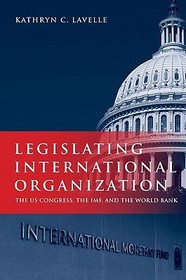
Legislating International Organization
The US Congress, the IMF, and the World Bank
-
10% KEDVEZMÉNY?
- A kedvezmény csak az 'Értesítés a kedvenc témákról' hírlevelünk címzettjeinek rendeléseire érvényes.
- Kiadói listaár GBP 97.00
-
43 795 Ft (41 710 Ft + 5% áfa)
Az ár azért becsült, mert a rendelés pillanatában nem lehet pontosan tudni, hogy a beérkezéskor milyen lesz a forint árfolyama az adott termék eredeti devizájához képest. Ha a forint romlana, kissé többet, ha javulna, kissé kevesebbet kell majd fizetnie.
- Kedvezmény(ek) 10% (cc. 4 380 Ft off)
- Kedvezményes ár 39 416 Ft (37 539 Ft + 5% áfa)
Iratkozzon fel most és részesüljön kedvezőbb árainkból!
Feliratkozom
43 795 Ft

Beszerezhetőség
Megrendelésre a kiadó utánnyomja a könyvet. Rendelhető, de a szokásosnál kicsit lassabban érkezik meg.
Why don't you give exact delivery time?
A beszerzés időigényét az eddigi tapasztalatokra alapozva adjuk meg. Azért becsült, mert a terméket külföldről hozzuk be, így a kiadó kiszolgálásának pillanatnyi gyorsaságától is függ. A megadottnál gyorsabb és lassabb szállítás is elképzelhető, de mindent megteszünk, hogy Ön a lehető leghamarabb jusson hozzá a termékhez.
A termék adatai:
- Kiadó OUP USA
- Megjelenés dátuma 2011. november 3.
- ISBN 9780199765348
- Kötéstípus Keménykötés
- Terjedelem272 oldal
- Méret 160x239x25 mm
- Súly 564 g
- Nyelv angol
- Illusztrációk 6 diagrams and charts 0
Kategóriák
Rövid leírás:
In Legislating International Organization, Kathryn Lavelle argues against the commonly-held idea that key international organizations are entities unto themselves, immune from the influence and pressures of individual states' domestic policies.
TöbbHosszú leírás:
In Legislating International Organization, Kathryn Lavelle argues against the commonly-held idea that key international organizations are entities unto themselves, immune from the influence and pressures of individual states' domestic policies. Covering the history of the IMF and World Bank from their origins, she shows that domestic political constituencies in advanced industrial states have always been important drivers of international financial institution policy. Lavelle focuses in particular on the U.S. Congress, tracing its long history of involvement with these institutions and showing how it wields significant influence. Drawing from archival research and interviews with members and staff, Lavelle shows that Congress is not particularly hostile to the multilateralism inherent in the IMF and World Bank, and has championed them at several key historical junctures. Congress is not uniformly supportive of these institutions, however. As Lavelle illustrates, it is more defensive of its constitutionally designated powers and more open to competing interest group concerns than legislatures in other advanced industrial states. Legislating International Organization will reshape how we think about how the U.S. Congress interacts with international institutions and more broadly about the relationship of domestic politics to global governance throughout the world. This is especially relevant given the impact of 2008 financial crisis, which has made the issue of multilateralism in American politics more important than ever.
An important book...Lavelle succeeds handily at documenting the politics of funding the world's most important public financial institutions from inside the legislature of the world's most powerful country. It is a 'must read' for anyone interested in understanding Congress's role in shaping the activities and agendas of the IMF and the World Bank.
Tartalomjegyzék:
Preface
Introduction
1. Congressional Advocacy Towards International Organizations
2. Enacting a Multilateral Framework for Finance: Treasury and Congressional Compromise
3. Building Constituencies for the Bretton Woods Framework: Banks, Big Business, and the Cold War Coalition
4. Domestic Constituencies Speak: The End of Fixed Parity and the Rise of Development Lending
5. Iron Triangles Go Global: The 1982 Debt Crisis and the End of the Cold War
6. Widening the Circle, Narrowing the Outcome: The 1997 Asian Financial Crisis
7. Reviving a Role for the Bretton Woods Institutions: the Financial Crisis of 2008
8. Conclusions
Notes
Bibliography
Index

